State of Preschool
West Virginia
Access Rankings
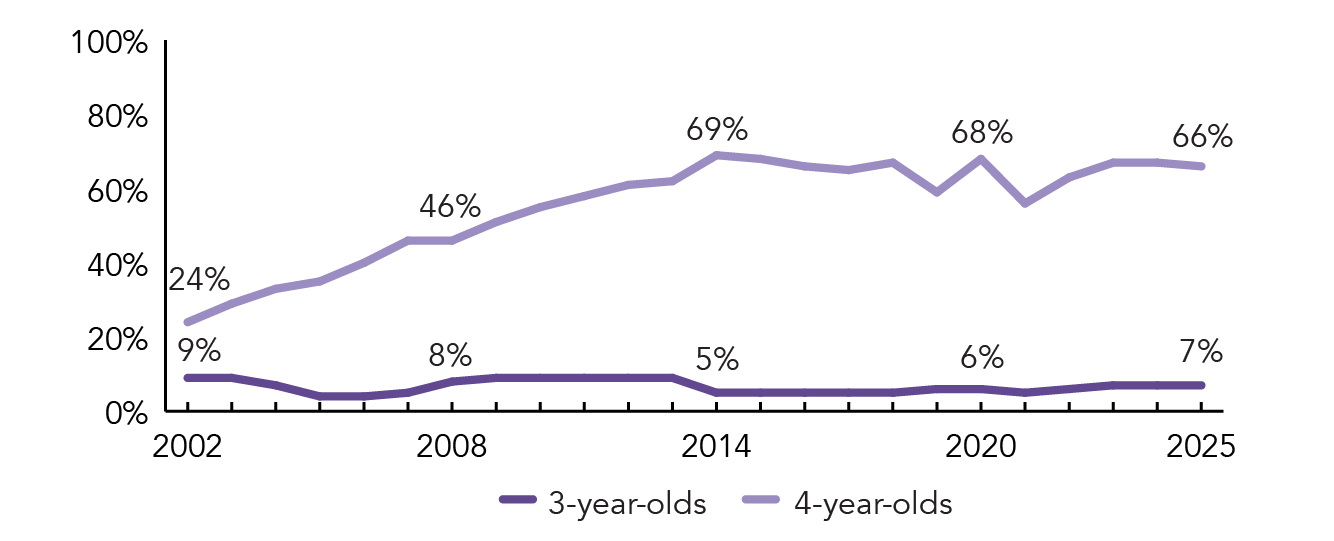
4-year-Olds
4
3-year-Olds
20
Resource Rankings
State spending
13
All reported spending
14
Total Benchmarks Met
Of 10 benchmarks possible
9
Overview
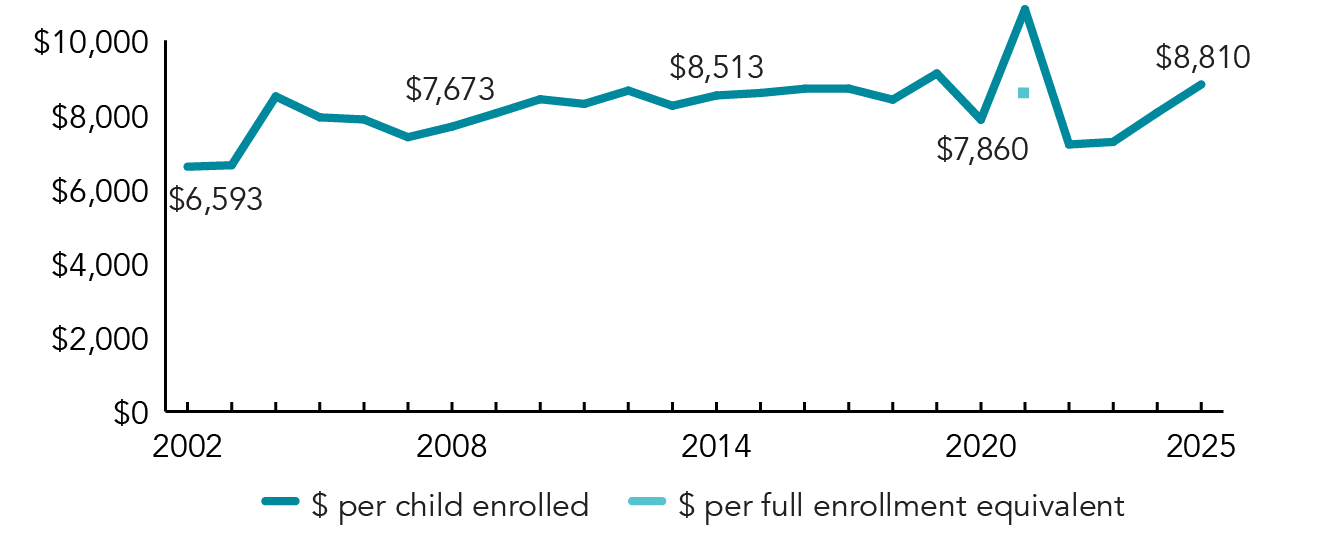
During the 2024-2025 school year, West Virginia preschool enrolled 13,674 children, a decrease of 190 from the prior year. State spending totaled $115,116,798 and an additional $5,326,168 in TANF funds and $23,625 in federal recovery funds supported the program, up $8,862,817 (8%), adjusted for inflation, since last year. State spending per child (including TANF and federal recovery funds) equaled $8,810 in 2024-2025, up $760 from 2023-2024, adjusted for inflation. West Virginia met 9 of 10 quality standards benchmarks.
What's New
The West Virginia Pre-K Standards were updated during the 2024-25 school year to be adopted for the 2025-26 school year in preparation for the 2025-26 Pre-K Instructional Materials adoption cycle required by WV Code AS 18-2A and WVBE Policy 2445.40. These code changes to instructional materials adoption impacts the selection and adoption process. Beginning with the five-year cycle (2025-26), county teams must use the state provided criteria to adopt a comprehensive curriculum. This review and adoption process must be completed by a county team that includes core team members, as defined in WV Pre-K policy. A cursory review was conducted at the request of publishers that can be used by county teams to assist in completion of the Pre-K Instructional Materials Criteria; however, there is no longer a state-approved list.
Background
West Virginia introduced public preschool in 1983 for 3- and 4-year-olds through the Public School Early Childhood Education program. In 2002, legislation passed that required pre-K to be available to all 4-year-olds by 2012. Today, West Virginia’s Universal Pre-K System provides pre-K programs in all 55 counties in the state, serving 4-year-olds, as well as some 3-year-olds with special needs, and some kindergarten-eligible children if it is determined that kindergarten placement is not in the child’s best interest.
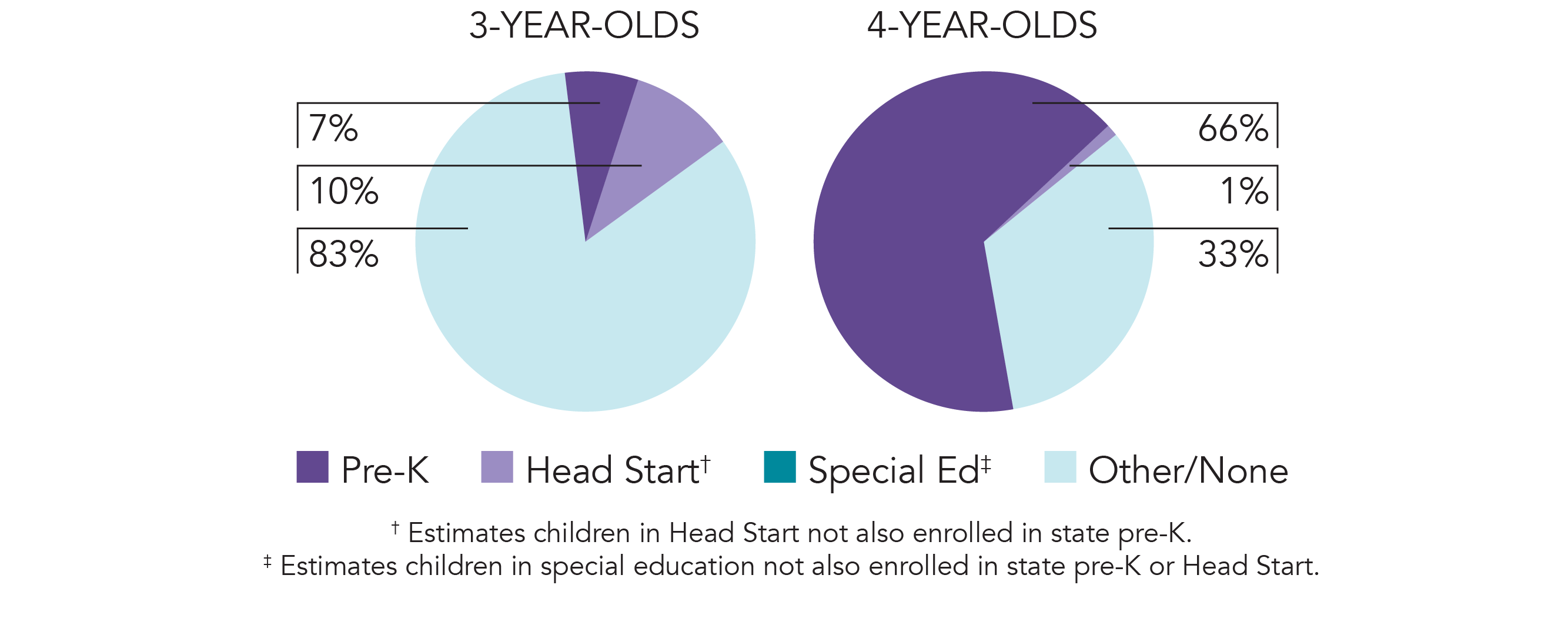
Public schools receive West Virginia Universal Pre-K funding directly, with half of all programs required to partner with child care centers, private pre-K, or Head Start agencies to meet demand. During the 2024-2025 school year, the collaboration rate was 83%. Programs are permitted to use additional funding from IDEA and federal Head Start.
As of July 2013, all new lead teachers in nonpublic settings are required to have at least a BA in ECE or a related field and, as of July 2014, all assistant teachers are required to apply for the Early Childhood Classroom Assistant Teacher Authorization, which requires a CDA or equivalent, as determined by the West Virginia Board of Education. Durin the 2016-2017 school year, West Virginia increased instructional days per year and hours per week to at least 1,500 minutes (25 hours) of instruction per week and 48,000 minutes (800 hours) of instruction per year. Programs must operate no fewer than four days per week.
The West Virginia Universal Pre-K program had undergone a multi-year study to assess the effects of program participation. Programs develop monitoring systems to offer ongoing continuous quality improvement, using reliable monitoring tools selected by a local collaborative team. Children are assessed three times per year using the Early Learning Scale, and this information is used to track child and program outcomes over time, guide teacher professional development and coaching, adjust instructional practices, and support school readiness.
West Virginia Universal Pre-K
Access
| |
| Total state pre-K enrollment | 13,674 |
| School districts that offer state program | 100% (counties/parishes) |
| Income requirement | No income requirement |
| Minimum hours of operation | 25 hours/week; 4 days/week |
| Operating schedule | School or academic year |
| Special education enrollment, ages 3 and 4 | 3,535 |
| Federally funded Head Start enrollment, ages 3 and 4 | 5,959 |
| State-funded Head Start enrollment, ages 3 and 4 | 0 |
Resources
| Total state pre-K spending | $120,466,591 |
| Local match required? | No |
| State Head Start spending | $0 |
| State spending per child enrolled | $8,810 |
| All reported spending per child enrolled* | $11,918 |
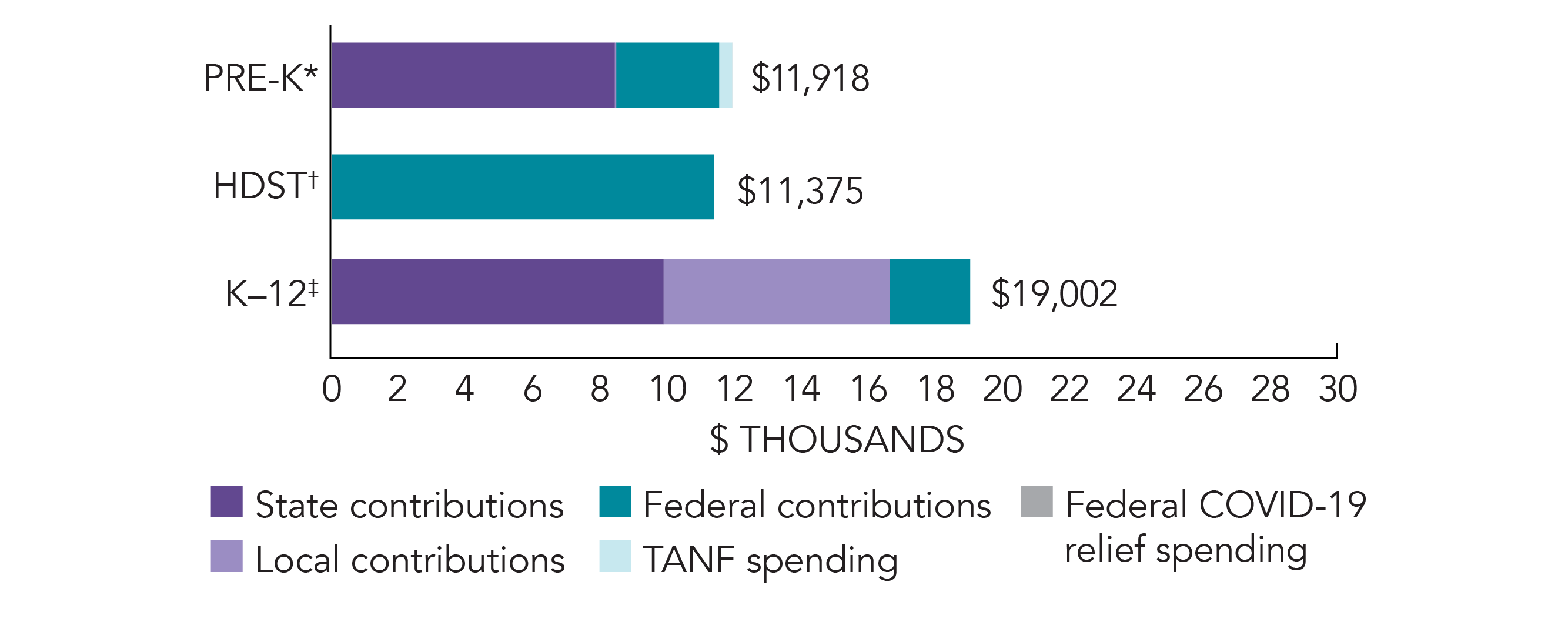
*Pre-K programs may receive additional funds from federal or local sources that are not included in this figure. †Head Start per-child spending includes funding only for 3- and 4-year-olds. ‡K–12 expenditures include capital spending as well as current operating expenditures.
West Virginia Quality Standards Checklist
| Policy | Requirement | Benchmark | Meets Benchmark? |
|---|---|---|---|
For more information about the benchmarks, see the Executive Summary and the Roadmap to State pages. | 9benchmarks met | ||
| Early Learning & Development Standards Benchmark | Comprehensive, aligned, supported, culturally sensitive | Comprehensive, aligned, supported, culturally sensitive | |
| Curriculum Supports Benchmark | Approval process & supports | Approval process & supports | |
| Teacher Degree Benchmark | BA | BA | |
| Teacher Specialized Training Benchmark | ECE, CD, ECE SpEd | Specializing in pre-K | |
| Assistant Teacher Degree Benchmark | CDA or equivalent | CDA or equivalent | |
| Staff Professional Development Benchmark | 15 hours/year; PD plans; Coaching (classrooms collaborating with Head Start) | For teachers & assistants: At least 15 hours/year; individual PD plans; coaching | |
| Maximum Class Size Benchmark | 20 (3- & 4-year-olds) | 20 or lower | |
| Staff to Child Ratio Benchmark | 1:10 (3- & 4-year-olds) | 1:10 or better | |
| Screening & Referral Benchmark | Vision, hearing, health & more | Vision, hearing & health screenings; & referral | |
| Continuous Quality Improvement System Benchmark | Structured classroom observations; Data used for program improvement | Structured classroom observations; data used for program improvement | |