State of Preschool
Washington
Access Rankings
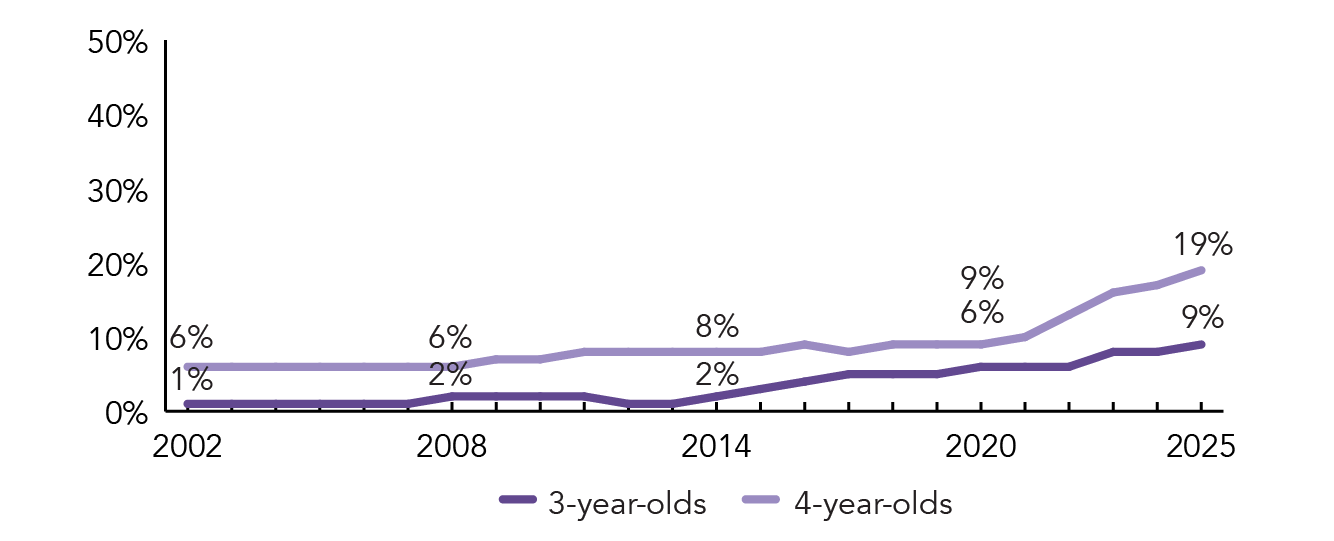
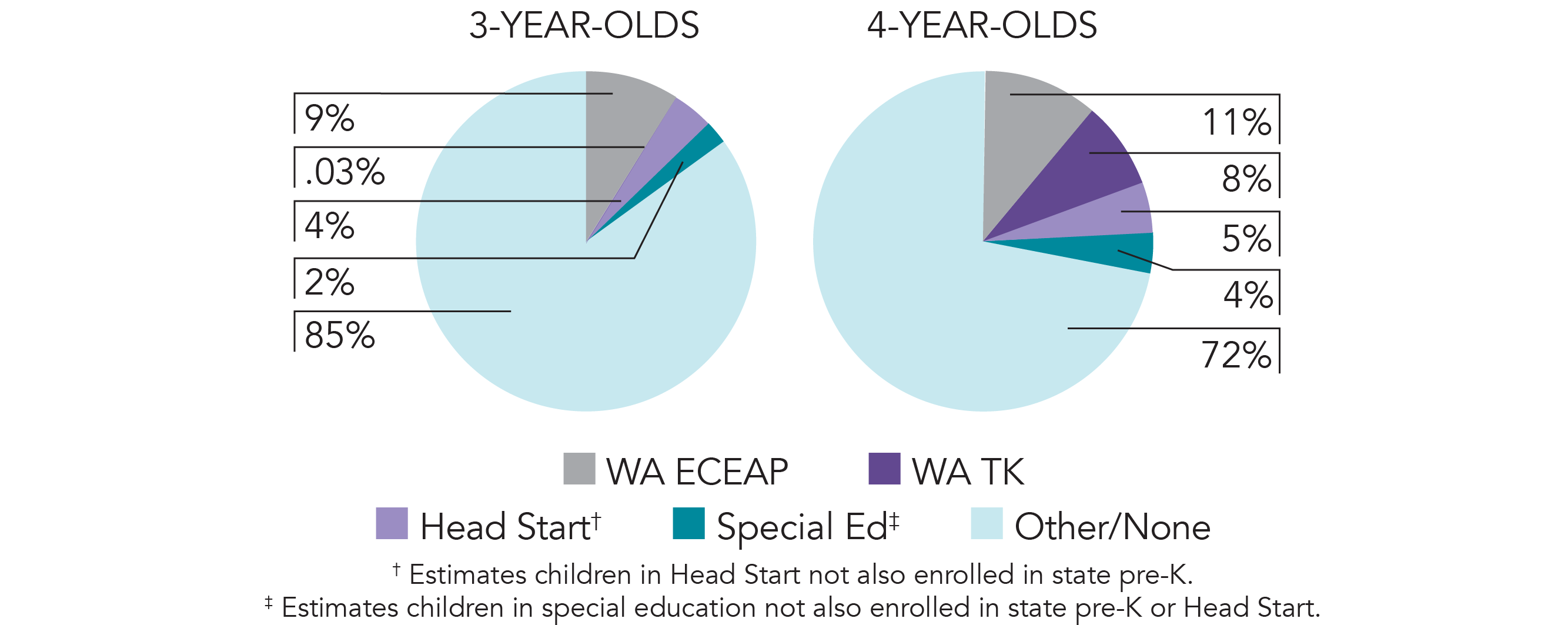
4-year-Olds
34
3-year-Olds
17
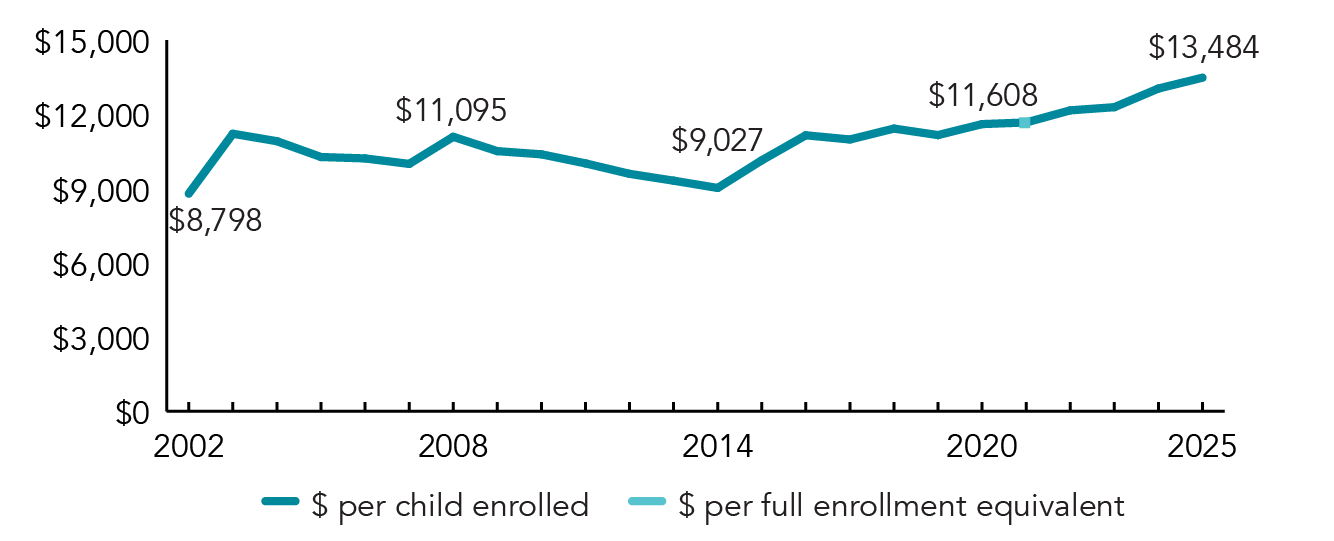
Resource Rankings
State spending
7
All reported spending
6
Total Benchmarks Met
Of 10 benchmarks possible
ECEAP: 9; TK: 6
Overview
During the 2024-2025 school year Washington’s Department of Children, Youth, and Families (DCYF) enrolled 16,432 children in the Early Childhood Education and Assistance Program (ECEAP), an increase of 139 children from the prior year. State spending for ECEAP totaled $223,931,571, up $12,173,518 (6%), adjusted for inflation, since last year. State spending per child on ECEAP averaged $13,628 in 2024-25, up $631 from 2023-2024, adjusted for inflation. Washington ECEAP met 9 of 10 quality standards benchmarks.
Washington’s Office of Superintendent of Public Instruction (OSPI) also served 8,039 children in a Transition to Kindergarten (TK) program during the 2024-2025 school year, an increase of 2,519 children from the prior year. State spending for TK was $106,032,423, an increase of $33,225,623 (46%), adjusted for inflation, since last year. State spending per child on TK was $13,190, the same as in 2023-2024, adjusted for inflation. TK met 6 out of 10 quality standards benchmarks.
What's New
ECEAP added 300 slots in 2024-2025 as well as 1,000 part- to school-day conversions. In 2024- 2025, contractors received slot rate increases: 5% for school-day slots and 9% for working-day slots. Due to statewide budget cuts, 2025-2026 ECEAP funding was reduced which resulted in over 2,000 fewer slots. However, in November 2025, Ballmer Group Philanthropy announced a new grant to dramatically expand ECEAP by funding up to 10,000 additional ECEAP slots for the next ten years.
Transitional Kindergarten was codified by the legislature as Transition to Kindergarten and OSPI published new rules and guidance for the 2024-2025 school year to set minimum standards and requirements for TK. DCYF and OSPI are supporting TK programs with technical assistance on collaborating with community-based partners including ECEAP, Head Start, child care, family child care, and licensed tribally-led early learning programs. DCYF and OSPI jointly identified strategies to improve alignment of high-quality preschool across the two agencies and increase equitable access to preschool. Originally, TK enrollment was projected to be capped at 7,266 students for both years of the 2025–2027 biennium. A 25% reduction in TK funding for the 2026–2027 school year is expected to reduce access to the program by approximately 2,000 students.
In 2024-2025, the Washington State Legislature funded 178 Early ECEAP slots. They also funded $7,687,754 in Complex Needs Funds. These funds were intended to support children with developmental delays (no IEP requirement), disabilities, or challenging behaviors due to complex trauma. The Early ECEAP slots are no longer funded, and CNF were reduced in 2025-2026 due to the state budget shortfall.
Background
The Department of Children, Youth, and Families (DCYF) oversees early learning programs, as well as child welfare and juvenile rehabilitation. DCYF prioritizes the creation of a high-quality integrated birth-to-eight system, which includes expanding access to affordable, high-quality care that is both responsive and inclusive. ECEAP, created in 1985, is a large part of the state’s strategy to accomplish this goal. In 2010, the state Legislature established the ECEAP as a statutory entitlement for all eligible children, not funded by Head Start, with an extension to 2030-2031.
ECEAP focuses on the whole child, providing nutrition, health, education, and family support services to at-risk young children. To be eligible, children must be 3- or 4-years-old and meet specific income or special circumstance criteria, such as eligible for special education services or experiencing homelessness. ECEAP enrollment can include children whose families do not meet the income requirement but face other risk factors that are linked to development or school success.
The Office of Superintendent of Public Instruction (OSPI) is the primary agency charged with overseeing public K–12 education in Washington state. Working with the state’s 295 public school districts and eight state-tribal education compact schools, OSPI allocates funding and provides tools, resources, and technical assistance so every student in Washington is provided a high-quality public education. The goal of Washington’s K–12 education system is to prepare every student for postsecondary pathways, careers, and civic engagement.
OSPI’s Transition to Kindergarten (TK) is a legislatively established and authorized program for children who are at least 4-years-old by August 31 and have been identified through a screening process to be in need of additional preparation to be successful kindergarten students in the following school year. Districts may offer TK programs, but they are not required to do so. The requirements for TK are outlined in the Washington State Administrative Code (WAC) Chapter 392-425. TK has gained momentum in recent years as a strategy for closing opportunity gaps.
-
Access

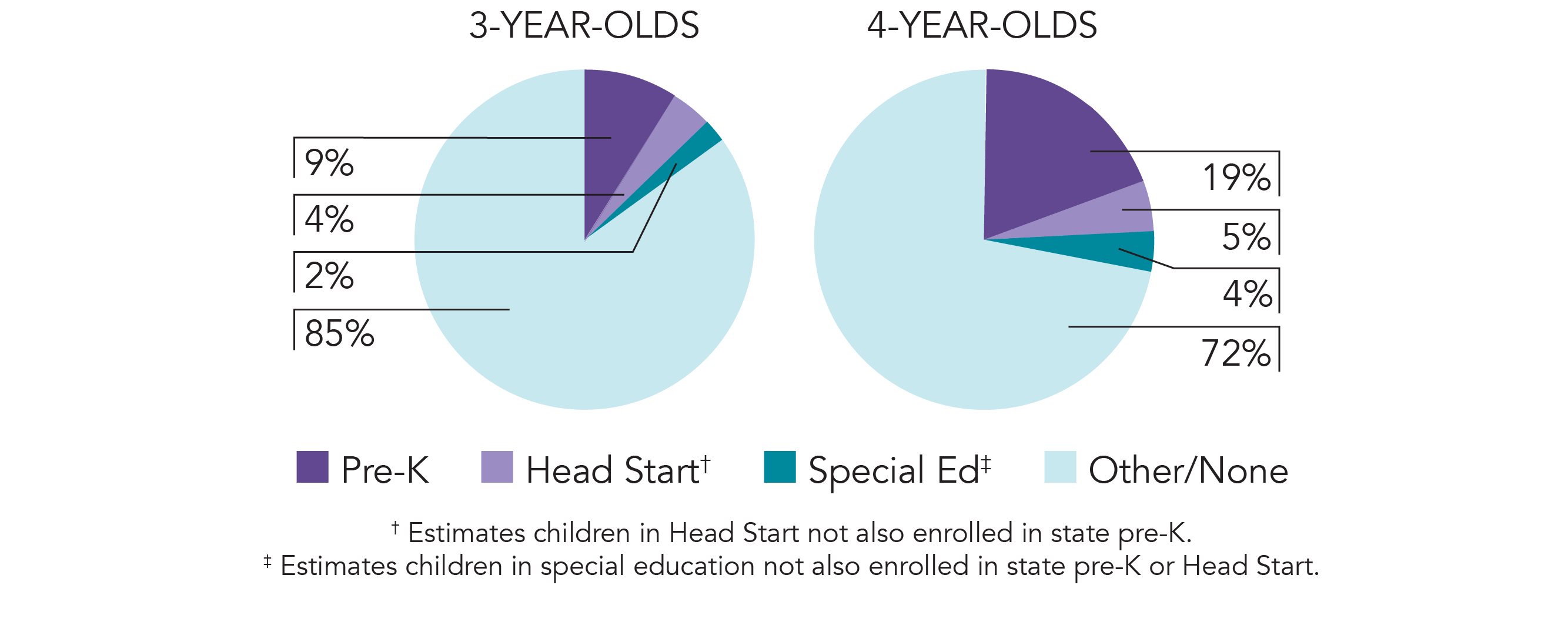
Total state pre-K enrollment 24,471 Special education enrollment, ages 3 and 4 11,193 Federally funded Head Start enrollment, ages 3 and 4 7,454 State-funded Head Start enrollment, ages 3 and 4 0 Resources
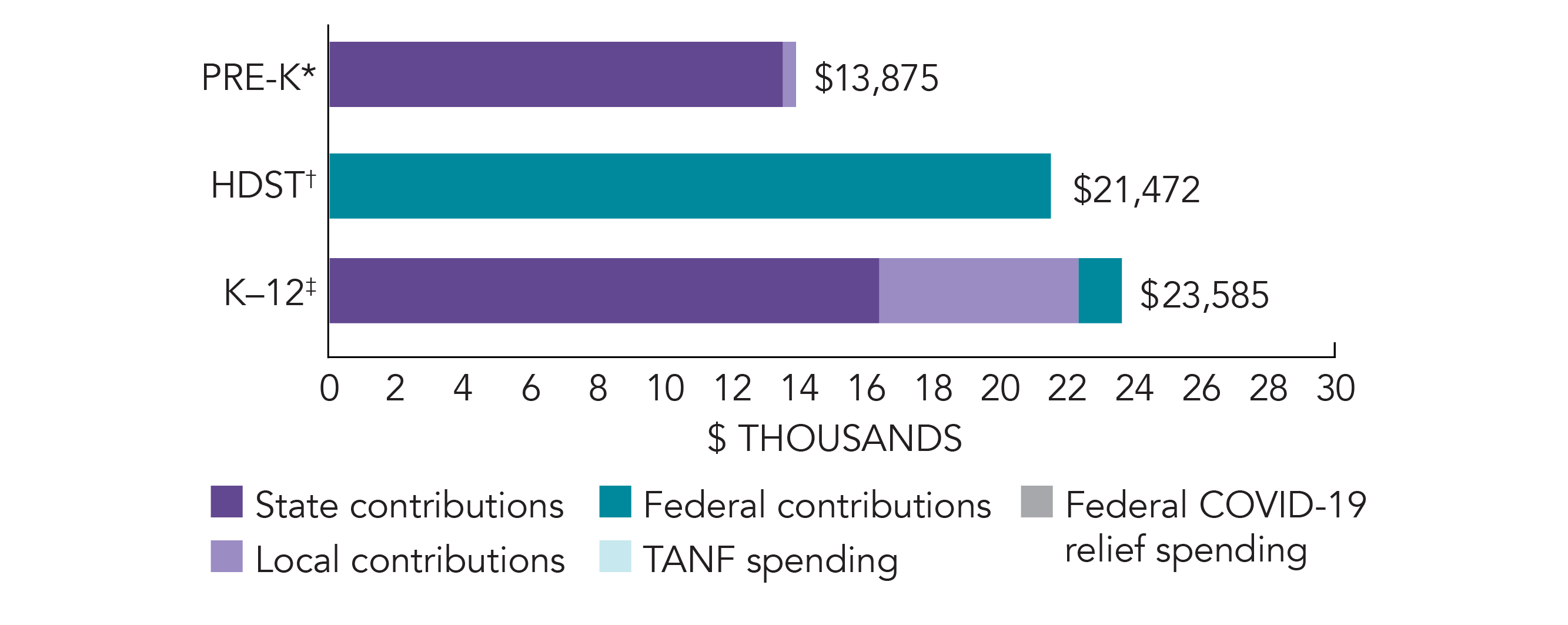
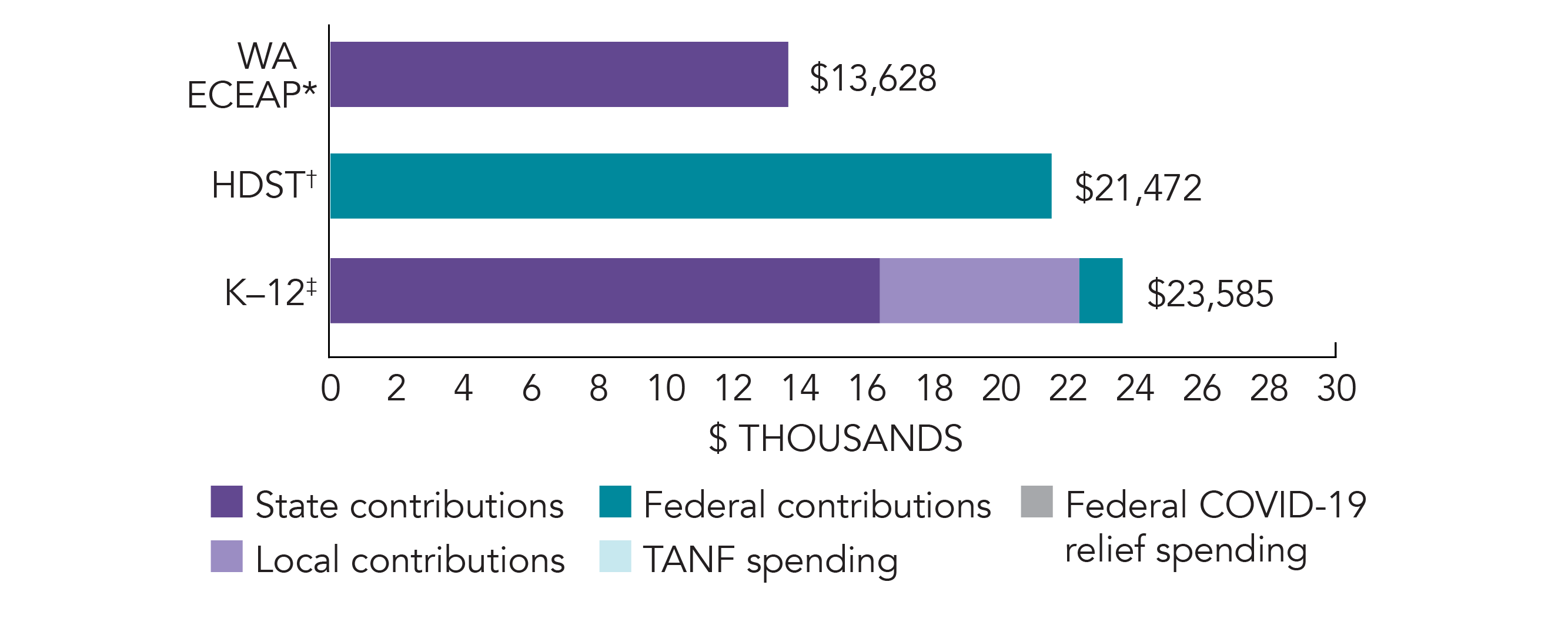
Total state pre-K spending $329,963,994 State Head Start spending $0 State spending per child enrolled $13,484 All reported spending per child enrolled* $13,875 
*Pre-K programs may receive additional funds from federal or local sources that are not included in this figure. †Head Start per-child spending includes funding only for 3- and 4-year-olds. ‡K–12 expenditures include capital spending as well as current operating expenditures.
-
Access

Total state pre-K enrollment 16,432 School districts that offer state program 92% (counties) Income requirement 36% SMI (non-tribal children); 100% SMI (tribal children) Minimum hours of operation 3 hours/day Operating schedule School year (part- & school day); Full calendar year (working-day) Resources
Total state pre-K spending $223,931,571 Local match required? No State spending per child enrolled $13,628 All reported spending per child enrolled* $13,628 
*Pre-K programs may receive additional funds from federal or local sources that are not included in this figure. †Head Start per-child spending includes funding only for 3- and 4-year-olds. ‡K–12 expenditures include capital spending as well as current operating expenditures.
Washington Early Childhood Education and Assistance Program (ECEAP) Quality Standards Checklist
| Policy | WA ECEAP Requirement | Benchmark | Meets Benchmark? |
|---|---|---|---|
For more information about the benchmarks, see the Executive Summary and the Roadmap to State pages. | 9benchmarks met | ||
| Early Learning & Development Standards Benchmark | Comprehensive, aligned, supported, culturally sensitive | Comprehensive, aligned, supported, culturally sensitive | |
| Curriculum Supports Benchmark | Approval process & supports | Approval process & supports | |
| Teacher Degree Benchmark | AA | BA | |
| Teacher Specialized Training Benchmark | ECE, CD, ECE SpEd | Specializing in pre-K | |
| Assistant Teacher Degree Benchmark | CDA | CDA or equivalent | |
| Staff Professional Development Benchmark | 20 hours/year (teachers), 15 hours/year (assistants); PD plans; Coaching | For teachers & assistants: At least 15 hours/year; individual PD plans; coaching | |
| Maximum Class Size Benchmark | 20 (3- & 4-year-olds) | 20 or lower | |
| Staff to Child Ratio Benchmark | 1:10 (3- & 4-year-olds) | 1:10 or better | |
| Screening & Referral Benchmark | Vision, hearing, health & more | Vision, hearing & health screenings; & referral | |
| Continuous Quality Improvement System Benchmark | Structured classroom observations; Data used for program improvement | Structured classroom observations; data used for program improvement | |
-
Access
Total state pre-K enrollment 8,039 School districts that offer state program 54% + 1 tribal school Income requirement No income requirement Minimum hours of operation 27.75 hours/week Operating schedule School or academic year Resources
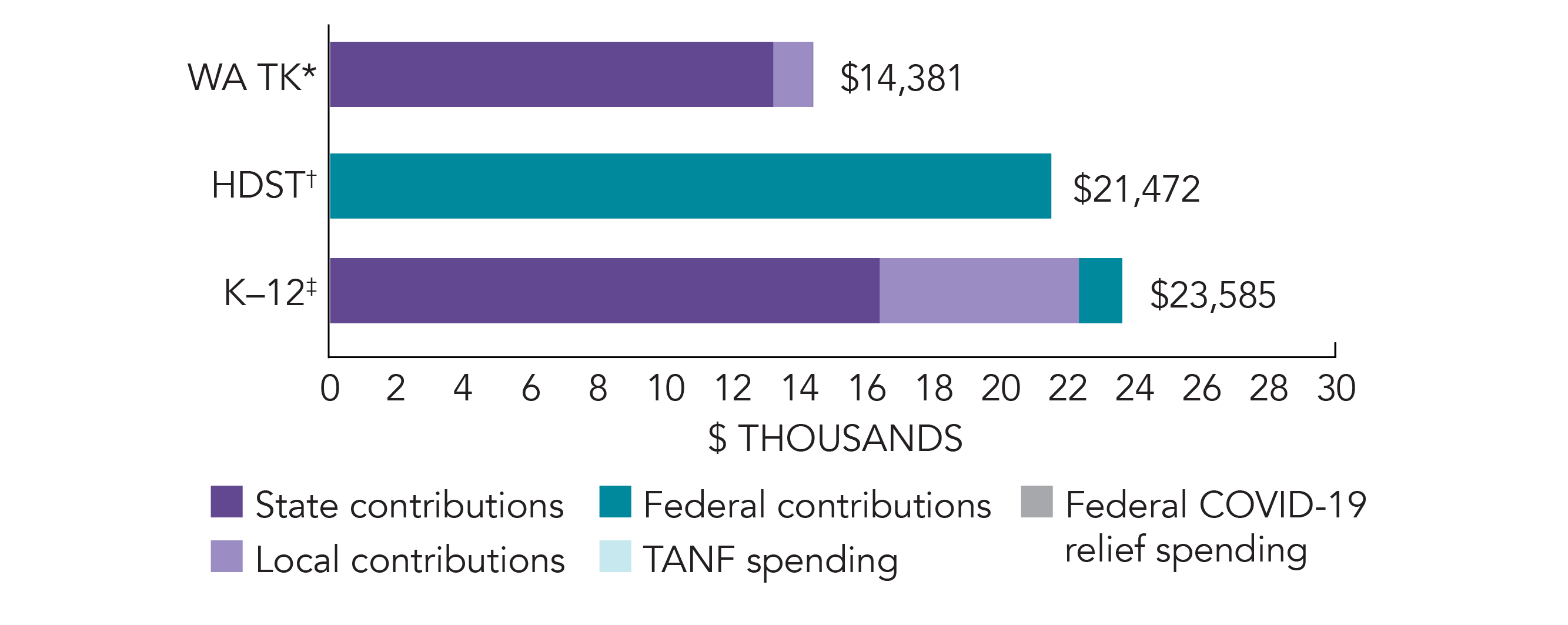
Total state pre-K spending $106,032,423 Local match required? No State spending per child enrolled $13,190 All reported spending per child enrolled* $14,381 
*Pre-K programs may receive additional funds from federal or local sources that are not included in this figure. †Head Start per-child spending includes funding only for 3- and 4-year-olds. ‡K–12 expenditures include capital spending as well as current operating expenditures.
Washington Transition to Kindergarten (TK) Quality Standards Checklist
| Policy | WA TK Requirement | Benchmark | Meets Benchmark? |
|---|---|---|---|
For more information about the benchmarks, see the Executive Summary and the Roadmap to State pages. | 6benchmarks met | ||
| Early Learning & Development Standards Benchmark | Comprehensive, aligned, supported, culturally sensitive | Comprehensive, aligned, supported, culturally sensitive | |
| Curriculum Supports Benchmark | Approval process & supports | Approval process & supports | |
| Teacher Degree Benchmark | BA | BA | |
| Teacher Specialized Training Benchmark | ECE, Elem. Ed., ECE SpEd, SpEd | Specializing in pre-K | |
| Assistant Teacher Degree Benchmark | HSD | CDA or equivalent | |
| Staff Professional Development Benchmark | 100 hours/5 years (teachers), 3 days/year (assistants); PD plans; Coaching | For teachers & assistants: At least 15 hours/year; individual PD plans; coaching | |
| Maximum Class Size Benchmark | No limit (3- & 4-year-olds) | 20 or lower | |
| Staff to Child Ratio Benchmark | No limit (3- & 4-year-olds) | 1:10 or better | |
| Screening & Referral Benchmark | Vision, hearing, health & more | Vision, hearing & health screenings; & referral | |
| Continuous Quality Improvement System Benchmark | Structured classroom observations; Data used for program improvement | Structured classroom observations; data used for program improvement | |