State of Preschool
Vermont
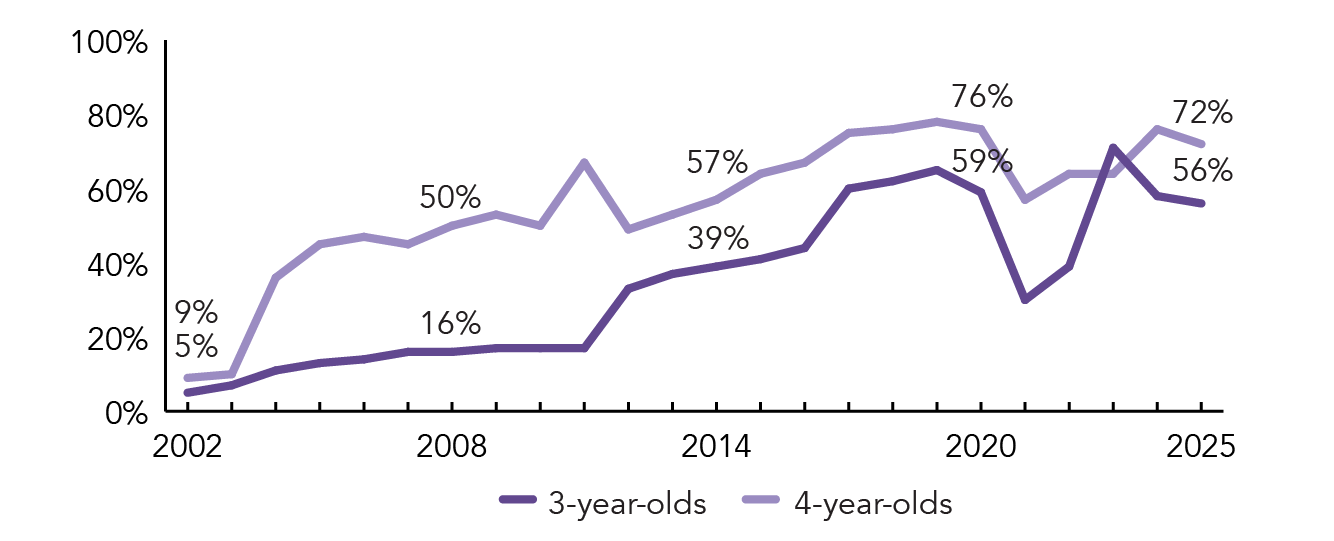
Access Rankings
4-year-Olds
2
3-year-Olds
2
Resource Rankings
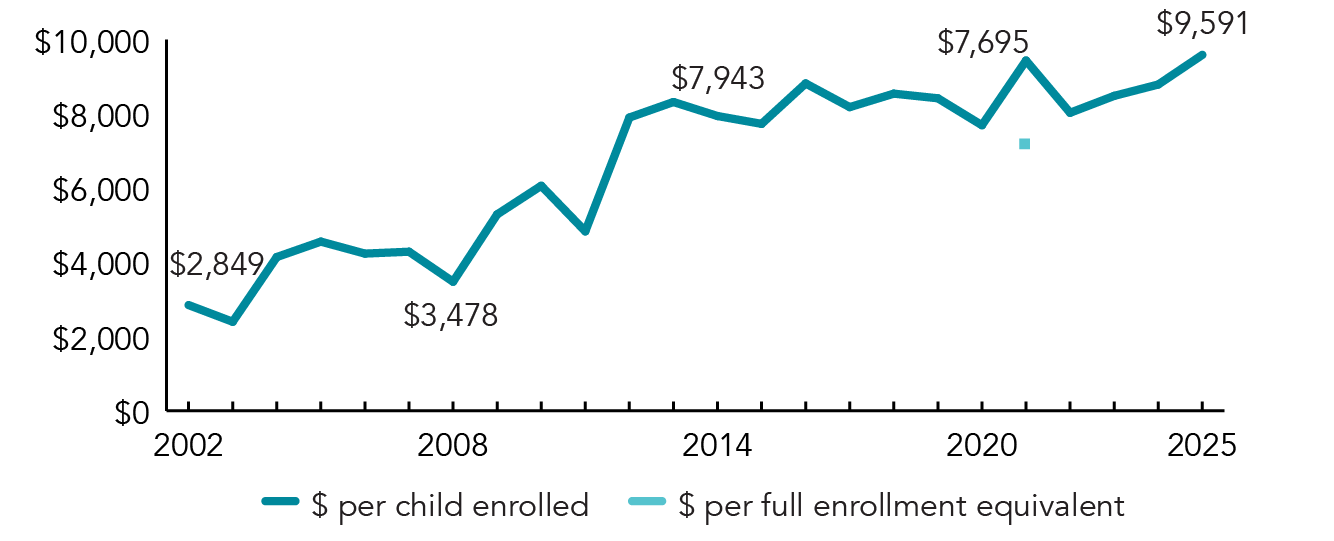
State spending
11
All reported spending
12
Total Benchmarks Met
Of 10 benchmarks possible
7
Overview
During the 2024-2025 school year, Vermont preschool enrolled 7,614 children, a decrease of 707 from the prior year. State spending totaled $73,025,082, down $133,489 (0.2%), adjusted for inflation, since last year. State spending per child equaled $9,591 in 2024- 2025, up $799 from 2023-2024, adjusted for inflation. Vermont met 7 of 10 quality standards benchmarks.
What's New
In 2024, the Vermont Legislature approved a five-year waiver (expires 2029) for eliminating all fees for the Vermont Agency of Education (AOE) Peer Review “alternate route to licensure” for educators. Vermont Act 76 (passed June 2023) provided child care funding in the form of scholarships and loan forgiveness for professional advancement, including educator licensure.
In December 2025, Vermont was awarded a federal Preschool Development Grant (PDG 2026) Birth to 5 Systems Building Grant totaling $12,706,625 to support system building and strengthen early childhood education programs in a mixed-delivery system, improve system efficiency and collaboration, and raise the overall quality of programs.
Background
In 1987, Vermont created the Vermont Early Education Initiative (EEI), an annual competitive grant program to finance early education opportunities for at-risk 3- to 5-year-olds. In 2007, legislation expanded publicly funded prekindergarten education for 4-year-old children in public schools and private programs and provided funding through the state’s Education Fund, similar to K–12, pro-rated based on a model of 10 hours per week.
Starting in 2014, Act 166, required all public school districts to offer Universal Prekindergarten (UPK) for every 3-, 4-, and 5-year-old child not enrolled in kindergarten, for a minimum of 10 hours per week for 35 weeks annually. UPK was fully implemented beginning in the 2016-2017 school year, with pre-K provided through school district operated programs and in contractual partnerships with state approved public and private programs.
Act 166 also requires an annual legislative evaluation of the state’s pre-K efforts that includes the number of children and programs participating in UPK, child progress monitoring data, and quality rating and improvement system (QRIS) level information. All Vermont state pre-K programs are required to attain at least four of five stars in Vermont’s QRIS, Step Ahead Recognition Systems (STARS), or hold NAEYC accreditation. STARS requires structured observations of classroom quality using the CLASS or TPOT. Public schools are required to have a Vermont licensed educator in each classroom and nonpublic schools are required to have licensed educator onsite during Universal Prekindergarten hours.
The AOE and Agency of Human Services (AHS) completed the process of designing a joint agency Pre-K Monitoring System that builds upon existing monitoring systems and procedures to assess the quality of the state’s approved private and public UPK programs.
Vermont Universal Prekindergarten Education (Act 166)
Access
| |
| Total state pre-K enrollment | 7,614 |
| School districts that offer state program | 100% |
| Income requirement | No income requirement |
| Minimum hours of operation | 10 hours/week |
| Operating schedule | School or academic year |
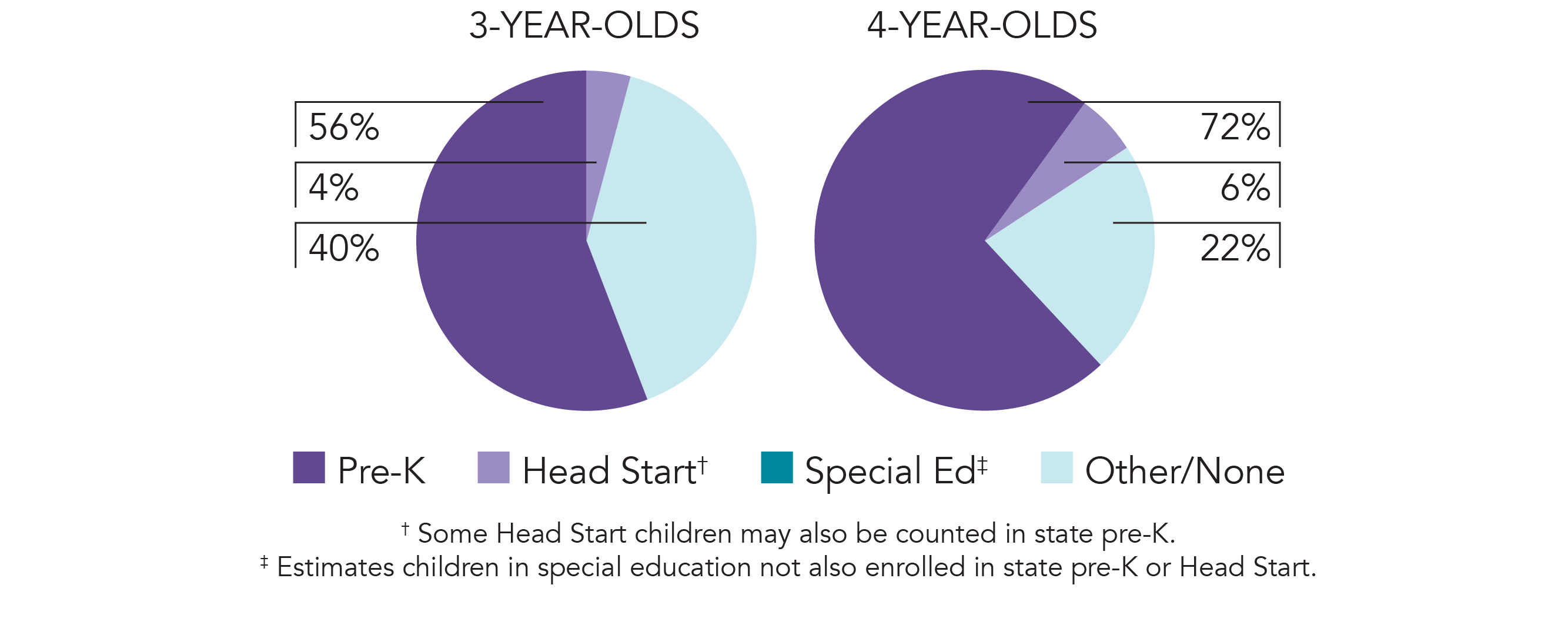
| Special education enrollment, ages 3 and 4 | 1,200 |
| Federally funded Head Start enrollment, ages 3 and 4 | 604 |
| State-funded Head Start enrollment, ages 3 and 4 | 0 |
Resources
| Total state pre-K spending | $73,025,082 |
| Local match required? | No |
| State Head Start spending | $0 |
| State spending per child enrolled | $9,591 |
| All reported spending per child enrolled* | $11,937 |
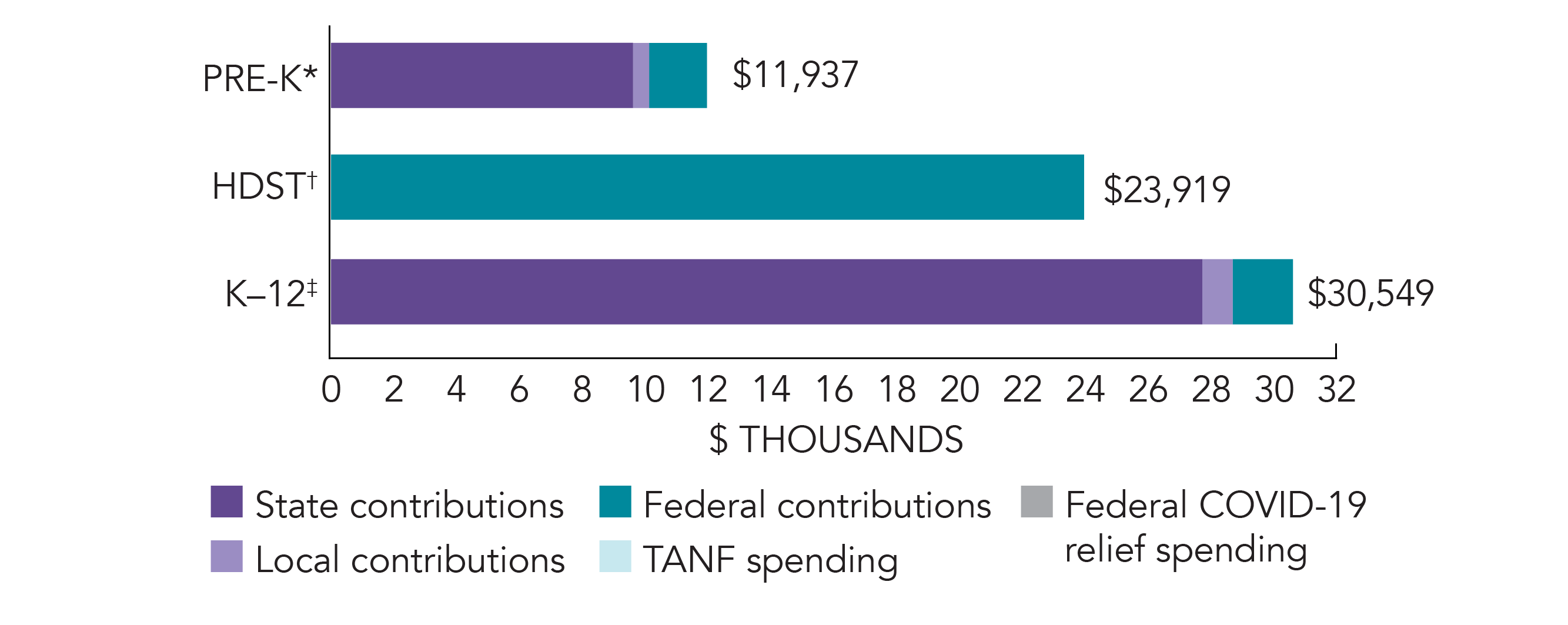
*Pre-K programs may receive additional funds from federal or local sources that are not included in this figure. †Head Start per-child spending includes funding only for 3- and 4-year-olds. ‡K–12 expenditures include capital spending as well as current operating expenditures.
Vermont Quality Standards Checklist
| Policy | Requirement | Benchmark | Meets Benchmark? |
|---|---|---|---|
For more information about the benchmarks, see the Executive Summary and the Roadmap to State pages. | 7benchmarks met | ||
| Early Learning & Development Standards Benchmark | Comprehensive, aligned, supported, culturally sensitive | Comprehensive, aligned, supported, culturally sensitive | |
| Curriculum Supports Benchmark | Approval process & supports | Approval process & supports | |
| Teacher Degree Benchmark | BA (public); BA for lead teacher, AA for classroom teacher (nonpublic) | BA | |
| Teacher Specialized Training Benchmark | ECE, CD, Elem. Ed. with ECE, ECE SpEd | Specializing in pre-K | |
| Assistant Teacher Degree Benchmark | HSD | CDA or equivalent | |
| Staff Professional Development Benchmark | 6 credit hours/5 years (teachers); 15 hours/year (assistants); PD plans; Coaching (public & some nonpublic) | For teachers & assistants: At least 15 hours/year; individual PD plans; coaching | |
| Maximum Class Size Benchmark | 20 (3- & 4-year-olds) | 20 or lower | |
| Staff to Child Ratio Benchmark | 1:10 (3- & 4-year-olds) | 1:10 or better | |
| Screening & Referral Benchmark | Vision, hearing, health & more | Vision, hearing & health screenings; & referral | |
| Continuous Quality Improvement System Benchmark | Structured classroom observations; Data used for program improvement | Structured classroom observations; data used for program improvement | |