State of Preschool
Texas
Access Rankings
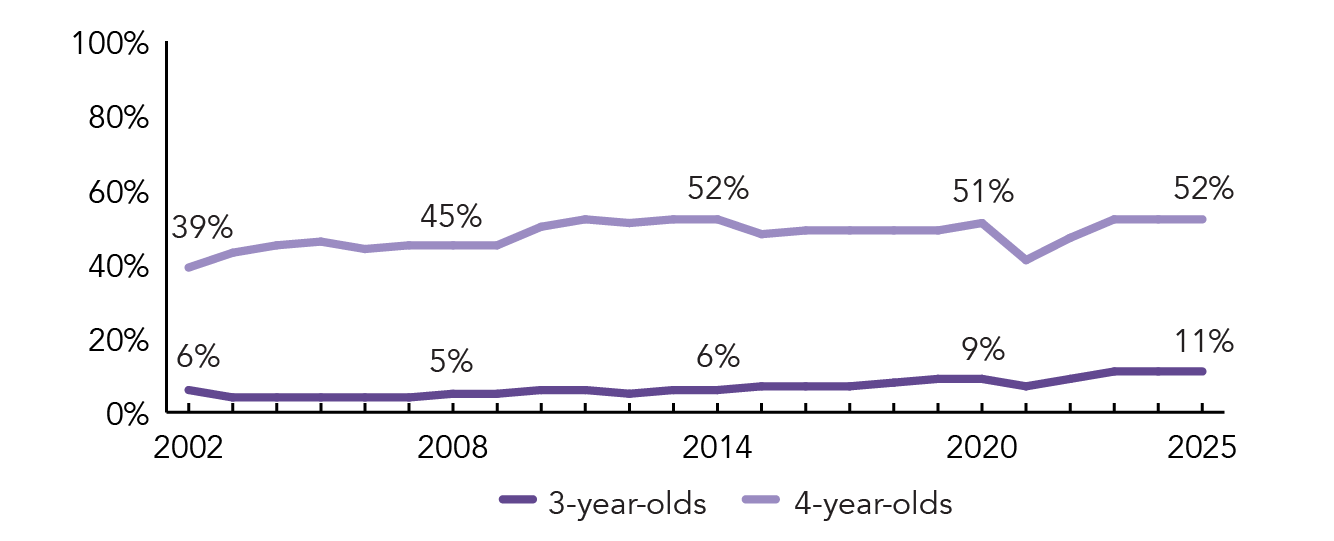
4-year-Olds
12
3-year-Olds
16
Resource Rankings
State spending
37
All reported spending
41
Total Benchmarks Met
Of 10 benchmarks possible
2
Overview
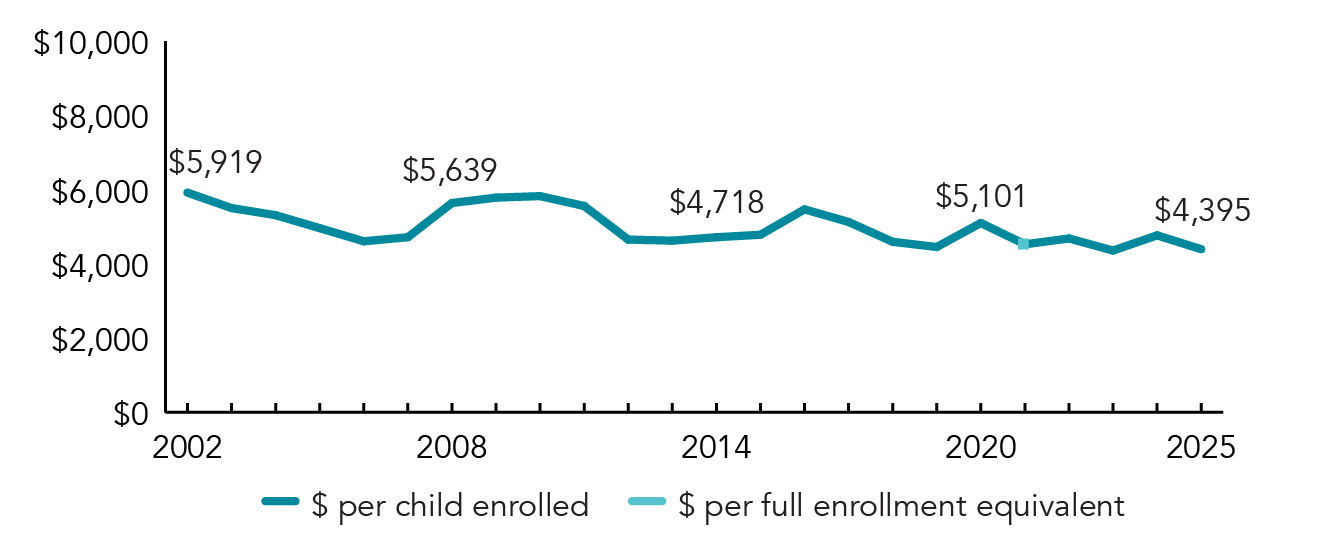
During the 2024-2025 school year, Texas preschool enrolled 248,483 children, an increase of 112 children from the prior year. State spending totaled $996,609,407, down $84,504,056 (8%), adjusted for inflation, since last year. State spending per child equaled $4,395 in 2024-2025, down $373 from 2023-2024, adjusted for inflation. Texas met 2 of 10 quality standards benchmarks.
What's New
During the 2025 regular session, the 89th Texas Legislature enacted House Bill 2 (HB 2), which expanded public prekindergarten eligibility to include children of classroom teachers. The legislation also established new requirements for prekindergarten partnerships and tuition-based prekindergarten programs, including provisions governing how participating school districts structure agreements with child care providers.
HB 2 requires that a minimum percentage of state prekindergarten funding be passed through to child care providers in partnership arrangements, strengthening expectations for resource sharing in mixed-delivery models. Together, these changes aim to expand access to prekindergarten while clarifying partnership requirements between school districts and community-based providers.
Background
In 1985, Texas began funding half-day prekindergarten for eligible 4-year-olds through the Texas Public School Prekindergarten program. Currently, school districts with 15 or more eligible 4-year-olds are required to offer prekindergarten. Districts with 15 or more eligible 3-year-olds can also offer prekindergarten but are not required to do so. The Texas Education Agency (TEA) Early Childhood Education Division oversees prekindergarten programs in school districts and open-enrollment charter schools, and school districts that are permitted to subcontract with nonpublic preschools to serve eligible children.
Children are eligible to participate in a Texas public school prekindergarten program if they are age-eligible and meet at least one of the following conditions: qualify for free or reduced-price lunch (185% FPL), are homeless, are in foster care, have a parent on active military duty or who was injured or killed on active duty, are unable to speak or comprehend English, and/or have a parent eligible for the Star of Texas Award.
In 2019, the Texas PDG B–5 team and Texas Early Learning Council led the use of grant funding to conduct a statewide 0-5 needs assessment, develop a statewide 0-5 strategic plan, increase parental choice and knowledge, share best practices, and improve overall quality of care. Also in 2019, House Bill 3 was passed by the 86th Texas Legislature and signed into law by Governor Abbott. House Bill 3 added an early education allotment that school districts and charter schools can use to fund full-day high-quality prekindergarten for eligible 4-year-olds, expanded early education reporting, updated requirements for early learning progress monitoring tools (single kindergarten assessment with one alternative available), and updated requirements related to early childhood partnerships.
The Children’s Learning Institute at the University of Texas-Health Science Center at Houston, in partnership with the TEA and Texas Workforce Commission, has developed a comprehensive professional development platform for early childhood educators that is free to all public school teachers, Head Start programs, families, and child care providers.
Texas Public School Prekindergarten
Access
| |
| Total state pre-K enrollment | 248,483 |
| School districts that offer state program | 90% |
| Income requirement | 185% FPL |
| Minimum hours of operation | 32,400 minutes/year (part-day, PK3); 75,600 minutes/year (full-day PK4) |
| Operating schedule | School or academic year |
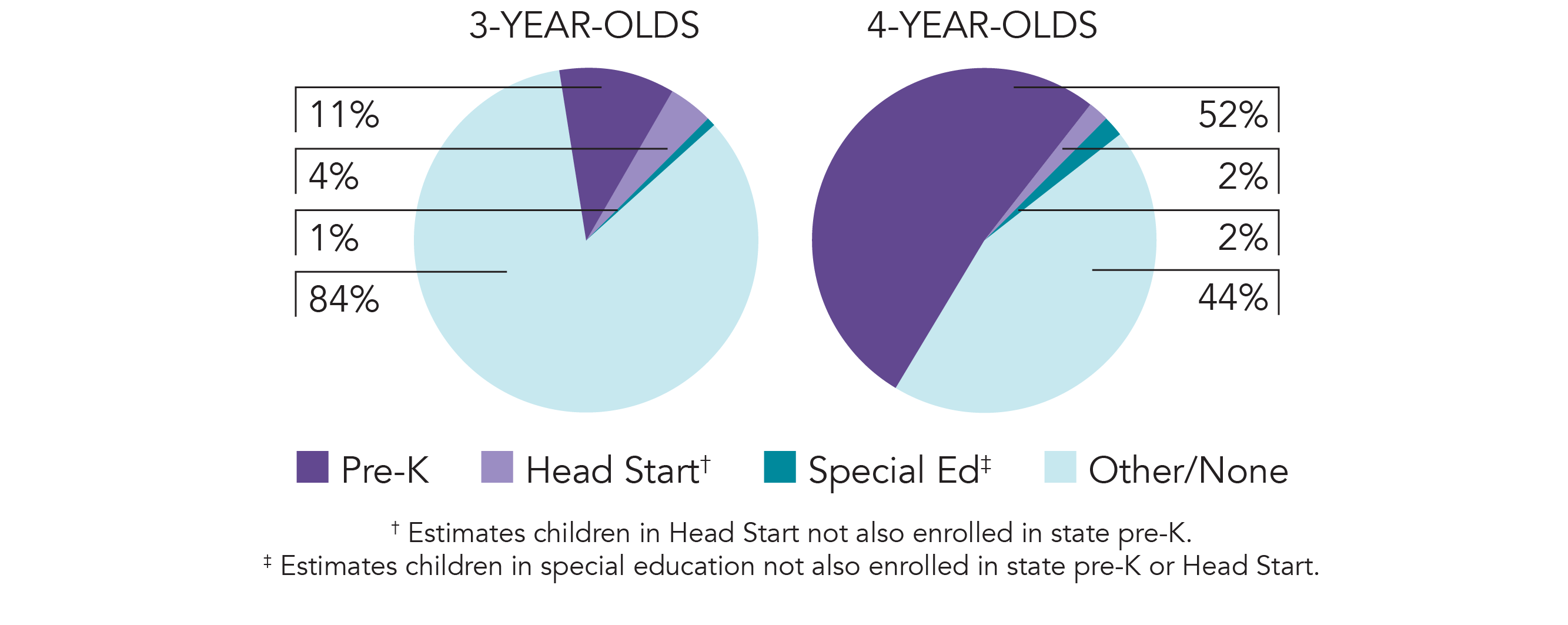
| Special education enrollment, ages 3 and 4 | 35,156 |
| Federally funded Head Start enrollment, ages 3 and 4 | 44,683 |
| State-funded Head Start enrollment, ages 3 and 4 | 0 |
Resources
| Total state pre-K spending | $996,609,407 |
| Local match required? | No |
| State Head Start spending | $0 |
| State spending per child enrolled | $4,395 |
| All reported spending per child enrolled* | $4,480 |
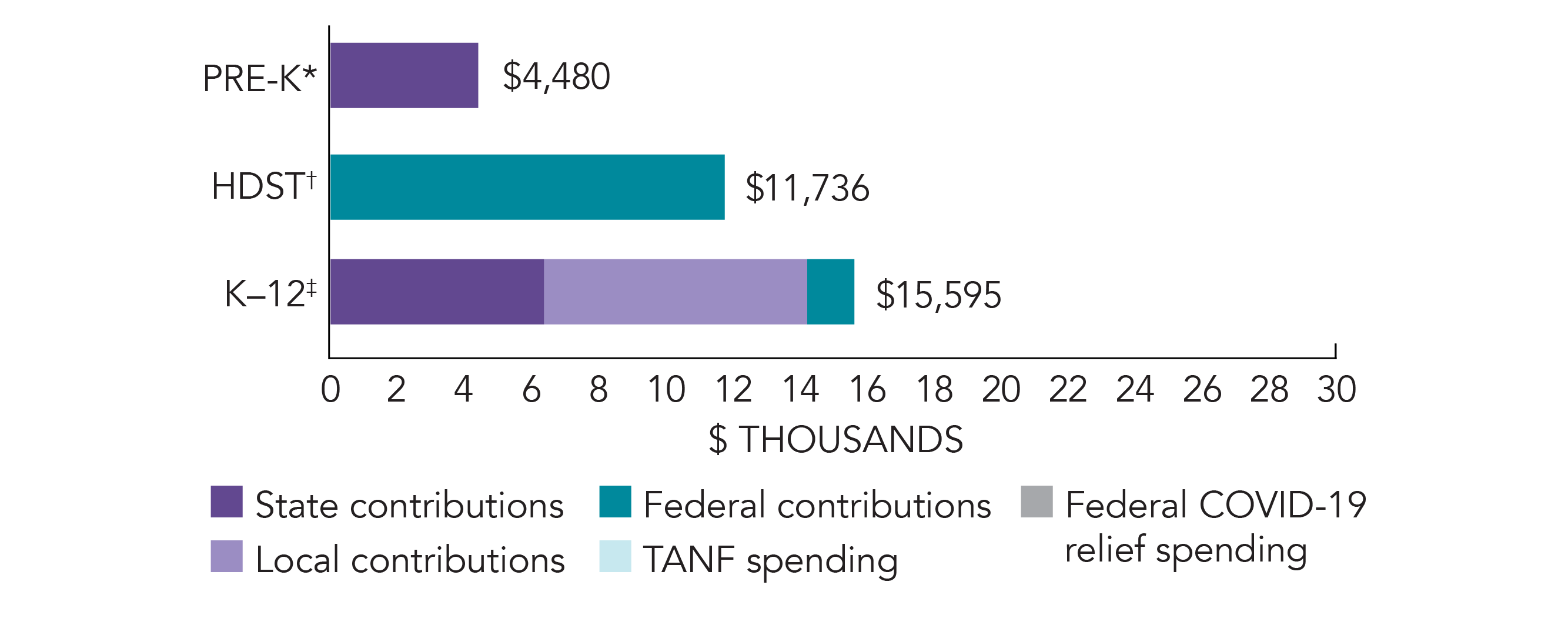
*Pre-K programs may receive additional funds from federal or local sources that are not included in this figure. †Head Start per-child spending includes funding only for 3- and 4-year-olds. ‡K–12 expenditures include capital spending as well as current operating expenditures.
Texas Quality Standards Checklist
| Policy | Requirement | Benchmark | Meets Benchmark? |
|---|---|---|---|
For more information about the benchmarks, see the Executive Summary and the Roadmap to State pages. | 2benchmarks met | ||
| Early Learning & Development Standards Benchmark | Comprehensive, aligned, supported, culturally sensitive | Comprehensive, aligned, supported, culturally sensitive | |
| Curriculum Supports Benchmark | Approval process | Approval process & supports | |
| Teacher Degree Benchmark | BA (public); Other (nonpublic) | BA | |
| Teacher Specialized Training Benchmark | P-6 (public); Other (nonpublic) | Specializing in pre-K | |
| Assistant Teacher Degree Benchmark | HSD | CDA or equivalent | |
| Staff Professional Development Benchmark | 30 hours/year (teachers only); Coaching (some teachers) | For teachers & assistants: At least 15 hours/year; individual PD plans; coaching | |
| Maximum Class Size Benchmark | 22 (3- & 4-year olds) | 20 or lower | |
| Staff to Child Ratio Benchmark | No limit (3-year-olds); Must strive for 1:11 (4-year-olds) | 1:10 or better | |
| Screening & Referral Benchmark | Vision, hearing, immunizations | Vision, hearing & health screenings; & referral | |
| Continuous Quality Improvement System Benchmark | None | Structured classroom observations; data used for program improvement | |