State of Preschool
Tennessee
Access Rankings
4-year-Olds
33
3-year-Olds
31
Resource Rankings
State spending
34
All reported spending
33
Total Benchmarks Met
Of 10 benchmarks possible
9
Overview
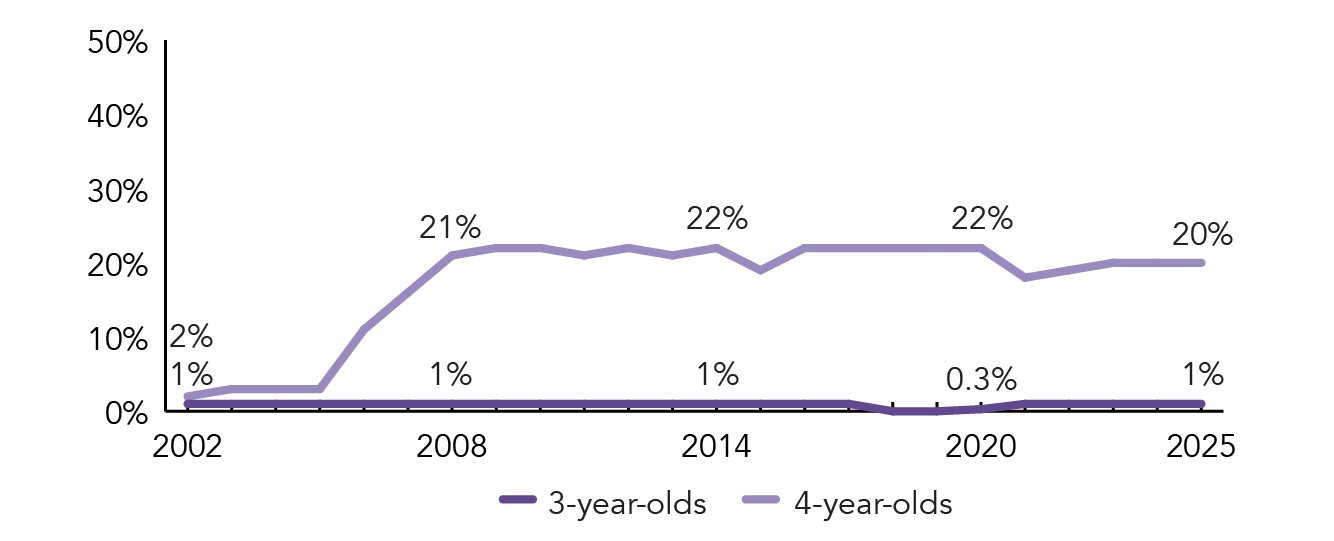
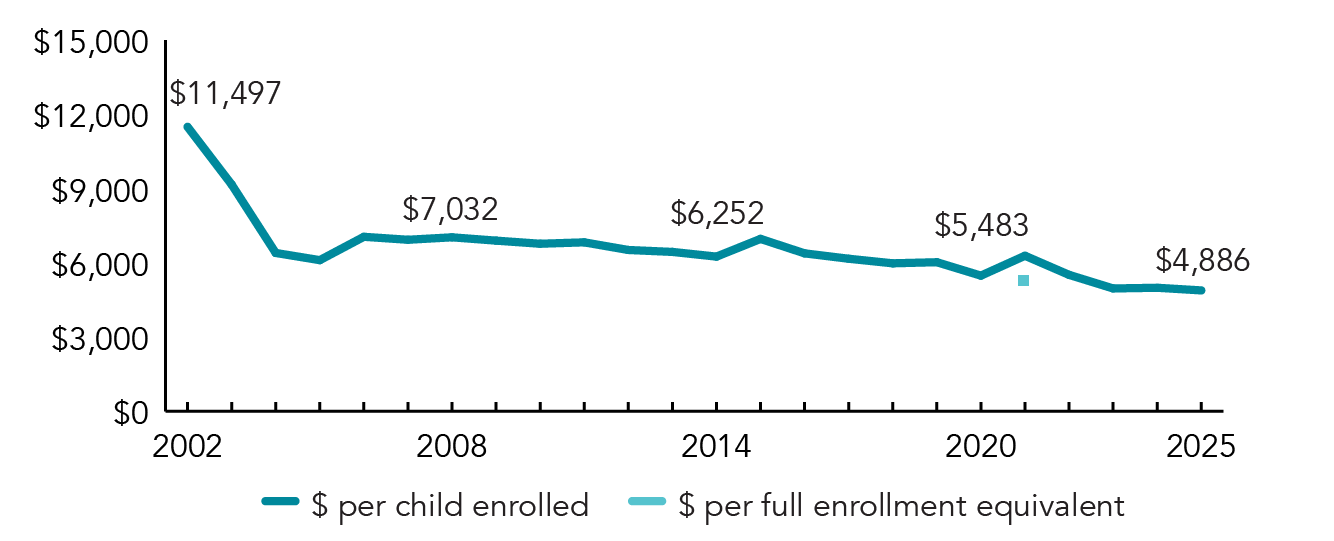
During the 2024-2025 school year, Tennessee preschool enrolled 17,501 children, a decrease of 132 from the prior year. State spending totaled $85,505,733, down $2,535,487 (3%), adjusted for inflation, since last year. State spending per child equaled $4,886 in 2024-2025, down $107 from 2023-2024, adjusted for inflation. Tennessee met 9 of 10 quality standards benchmarks.
What's New
Tennessee leveraged its Preschool Development Grant Birth through Five (PDG B–5) award to expand professional development and credentialing opportunities for early learning educators. In fall 2025, the state implemented a no-cost pathway for teaching assistants to earn a Child Development Associate (CDA) credential, supporting compliance with T.C.A. § 49-6-104 by ensuring all local education agencies can meet minimum qualification requirements for Voluntary Pre-K assistant teachers. PDG B–5 funds are also supporting monetary stipends for educators who earn the credential, CLASS training for school administrators, and planning for an Early Learning Summit in summer 2026 featuring professional development on topics such as high quality instruction and working with children with challenging behaviors.
The PDG B–5 grant is further supporting system improvements and program expansion. Tennessee is preparing subgrant and microgrant opportunities for schools to increase birth-to-five slots and/or extend hours or days of service, along with materials and professional development grants to improve program quality. In addition, Public Chapter 225, enacted during the 2025 legislative session, allows four-year-old children of local education agency staff who live outside the LEA’s geographic boundaries to enroll in Voluntary Pre-K after the enrollment deadline.
Background
Tennessee Voluntary Pre-K (VPK) was launched in 2005, building on the 1998 Early Childhood Education Pilot Project. VPK classrooms are now in 137 of the state’s 147 school districts. Children from families meeting the income eligibility requirements are prioritized for enrollment in VPK, as are children with disabilities and dependent children of a parent who died as a result of war.
The Tennessee State Department of Education and Early Learning Division have administrative authority over VPK. Only local education agencies may apply for VPK grants, but districts may contract with private childcare agencies, Head Start agencies, institutions of higher education, public housing authorities, and any community-based or private agency attaining the highest designation under the rated licensing system administered by TN Department of Human Services.
Tennessee Voluntary Pre-K (VPK)
Access
| |
| Total state pre-K enrollment | 17,501 |
| School districts that offer state program | 93% |
| Income requirement | 185% FPL |
| Minimum hours of operation | 6 hours/day (5.5 hours of instruction); 5 days/week |
| Operating schedule | School or academic year |
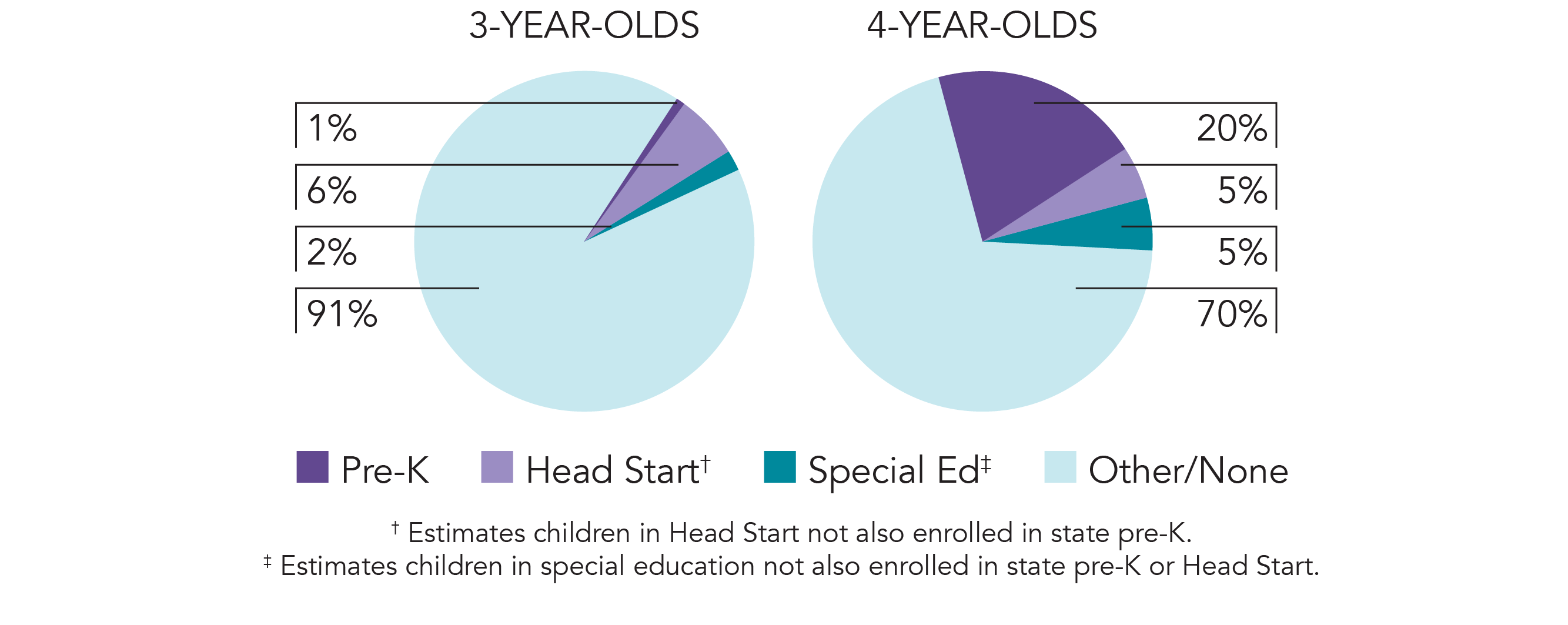
| Special education enrollment, ages 3 and 4 | 8,624 |
| Federally funded Head Start enrollment, ages 3 and 4 | 11,056 |
| State-funded Head Start enrollment, ages 3 and 4 | 0 |
Resources
| Total state pre-K spending | $85,505,733 |
| Local match required? | Yes |
| State Head Start spending | $0 |
| State spending per child enrolled | $4,886 |
| All reported spending per child enrolled* | $6,509 |
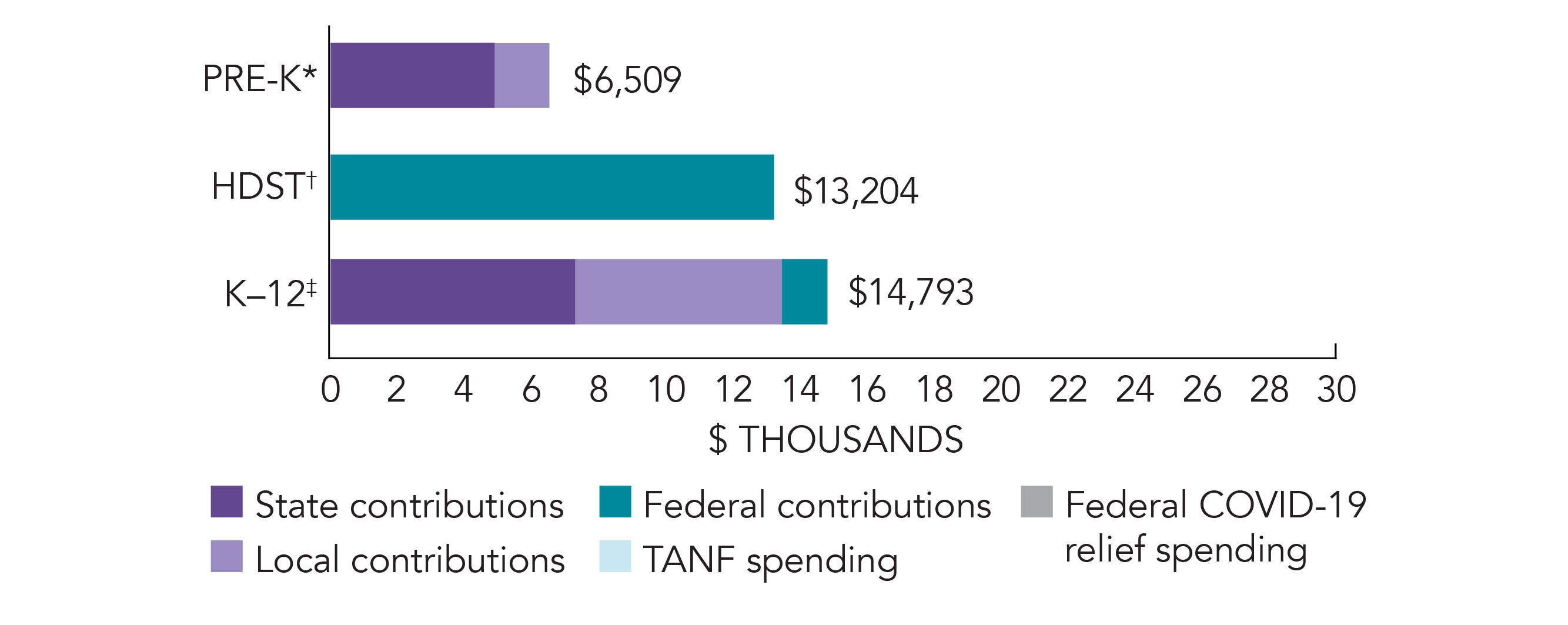
*Pre-K programs may receive additional funds from federal or local sources that are not included in this figure. †Head Start per-child spending includes funding only for 3- and 4-year-olds. ‡K–12 expenditures include capital spending as well as current operating expenditures.
Tennessee Quality Standards Checklist
| Policy | Requirement | Benchmark | Meets Benchmark? |
|---|---|---|---|
For more information about the benchmarks, see the Executive Summary and the Roadmap to State pages. | 9benchmarks met | ||
| Early Learning & Development Standards Benchmark | Comprehensive, aligned, supported, culturally sensitive | Comprehensive, aligned, supported, culturally sensitive | |
| Curriculum Supports Benchmark | Approval process & supports | Approval process & supports | |
| Teacher Degree Benchmark | BA | BA | |
| Teacher Specialized Training Benchmark | ECE, CD, ECE SpEd | Specializing in pre-K | |
| Assistant Teacher Degree Benchmark | HSD | CDA or equivalent | |
| Staff Professional Development Benchmark | 30 hours/year; PD plans; Coaching | For teachers & assistants: At least 15 hours/year; individual PD plans; coaching | |
| Maximum Class Size Benchmark | 20 (3- & 4-year-olds) | 20 or lower | |
| Staff to Child Ratio Benchmark | 1:10 (3- & 4-year-olds) | 1:10 or better | |
| Screening & Referral Benchmark | Vision, hearing, health & more | Vision, hearing & health screenings; & referral | |
| Continuous Quality Improvement System Benchmark | Structured classroom observations; Data used for program improvement | Structured classroom observations; data used for program improvement | |