State of Preschool
Oklahoma
Access Rankings
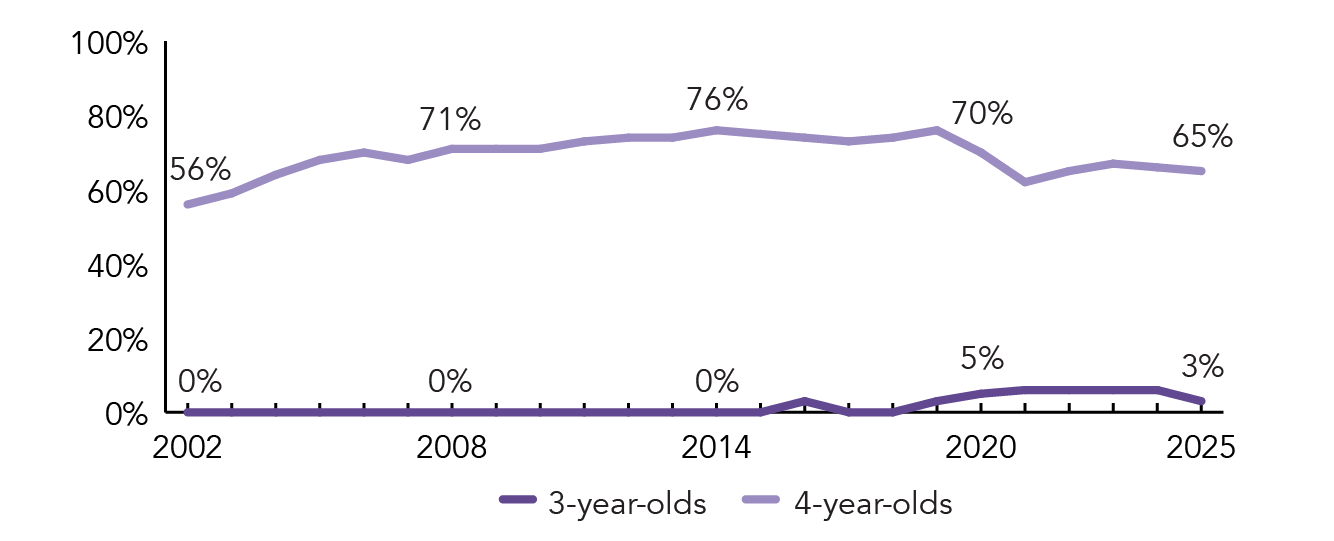
4-year-Olds
5
3-year-Olds
27
Resource Rankings
State spending
30
All reported spending
10
Total Benchmarks Met
Of 10 benchmarks possible
9
Overview
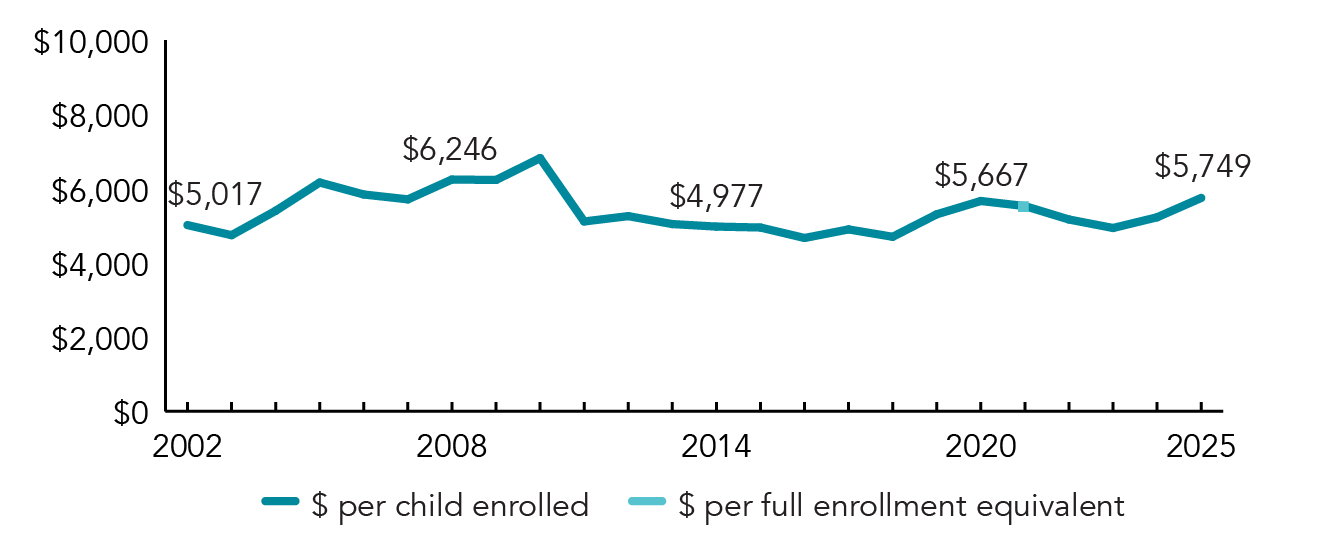
During the 2024-2025 school year, Oklahoma preschool enrolled 36,114 children, a decrease of 2,343 from the prior year. State spending totaled $207,632,498, up $6,584,399 (3%), adjusted for inflation, since last year. State spending per child equaled $5,749 in 2024-2025, up $521 from 2023-2024, adjusted for inflation. Oklahoma met 9 of 10 quality standards benchmarks.
What's New
Oklahoma strengthened early literacy implementation through close coordination between the Oklahoma Comprehensive Literacy State Development (CLSD) grant team and the Oklahoma State Department of Education (OSDE) early childhood team. Through this partnership, the state supported implementation of the Early Learning Inventory (ELI) across 20 subgrantee districts by aligning professional learning, instructional resources, and coaching supports. These efforts focused on strengthening early literacy instruction grounded in the Science of Reading and promoting coherence between state early childhood literacy standards and classroom practice, with the goal of building sustainable, evidence-based instructional capacity among early childhood educators.
Dolly Parton’s Imagination Library mails books to children every month, from birth through their fifth birthday, at no cost to families. In 2025, OSDE contracted with the Oklahoma Partnership for School Readiness (OPSR) to be the state’s managing partner for Dolly Parton’s Imagination Library. OPSR’s leadership over the program has continued to expand its reach across the state. Currently, partners are active in 74 of 77 Oklahoma counties—bringing critical support to more communities than ever before.
The state also continued to advance system-level supports for young children and educators. Oklahoma expanded implementation of a framework of evidence-based practices that supports healthy development and positive behavior across Pre-K, kindergarten, early childhood special education, and early intervention settings. In addition, the OSDE early childhood team began developing two statewide initiatives: guidance to support the creation of outdoor learning environments and nature-based learning opportunities, and free asynchronous training to establish a clear certification pathway for early childhood teacher assistants. Together, these efforts aim to strengthen instructional quality, workforce capacity, and inclusive learning environments statewide.
OPSR received $14,751,000 from a new round of PDG B–5 Systems Building Grants that will be used to strengthen Oklahoma’s early childhood system through three strategies. First, reduce fragmentation through enhanced Head Start collaboration, a Unified Birth- Five Transitions Framework with pilots, coordinated statewide financing, and a safety alignment initiative. Second, improve workforce stability via statewide business supports, integrated workforce strategies, retention incentives, and strengthened community capacity for literacy and family engagement. Third, modernize data and navigation by unifying B-5 indicators, updating ECIDS, publishing
accessible data tools, and supporting the OKDHS Portal and eligibility study. These strategies create a more effective, family-first system, improving outcomes for young children statewide.
Background
Oklahoma launched its Early Childhood Four-Year-Old Program in 1980, intending to serve all 4-year-olds in the state. In 1990, the program received statewide funding for 4-year-olds eligible for the federal Head Start program, but local areas could choose to serve additional 4-year-olds with local funds or tuition. In 1998, Oklahoma became the second state in the nation to provide free preschool for all 4-year-olds, with 100% of school districts providing the program. In addition, funding for 3-year-olds is provided by the Oklahoma Early Childhood Program (OECP) through a pass-through from the state to public school districts.
Oklahoma Early Childhood Four-Year-Old Program
Access
| |
| Total state pre-K enrollment | 36,114 |
| School districts that offer state program | 100% (non-charter districts) |
| Income requirement | No income requirement |
| Minimum hours of operation | 2.5 hours/day; 5 days/week |
| Operating schedule | School or academic year |
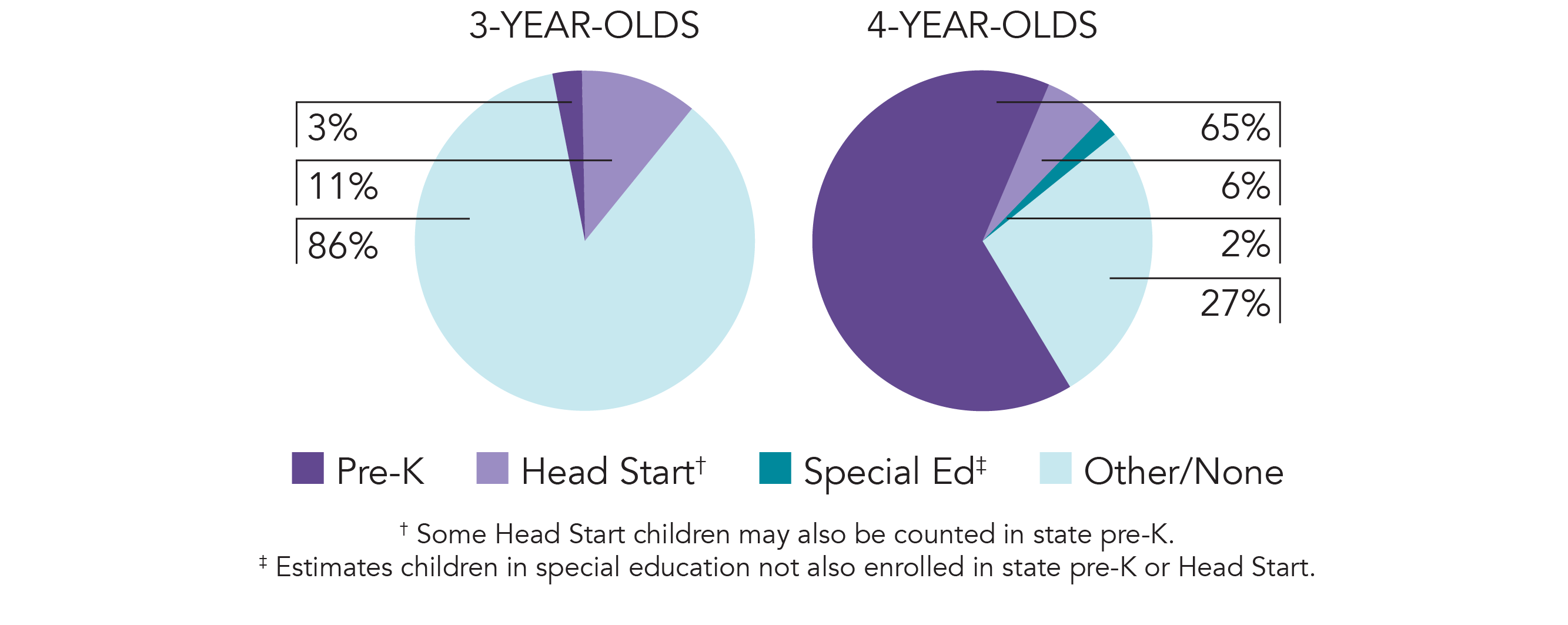
| Special education enrollment, ages 3 and 4 | 4,692 |
| Federally funded Head Start enrollment, ages 3 and 4 | 8,267 |
| State-funded Head Start enrollment, ages 3 and 4 | 0 |
Resources
| Total state pre-K spending | $207,632,498 |
| Local match required? | No |
| State Head Start spending | $16,000,000 |
| State spending per child enrolled | $5,749 |
| All reported spending per child enrolled* | $12,433 |
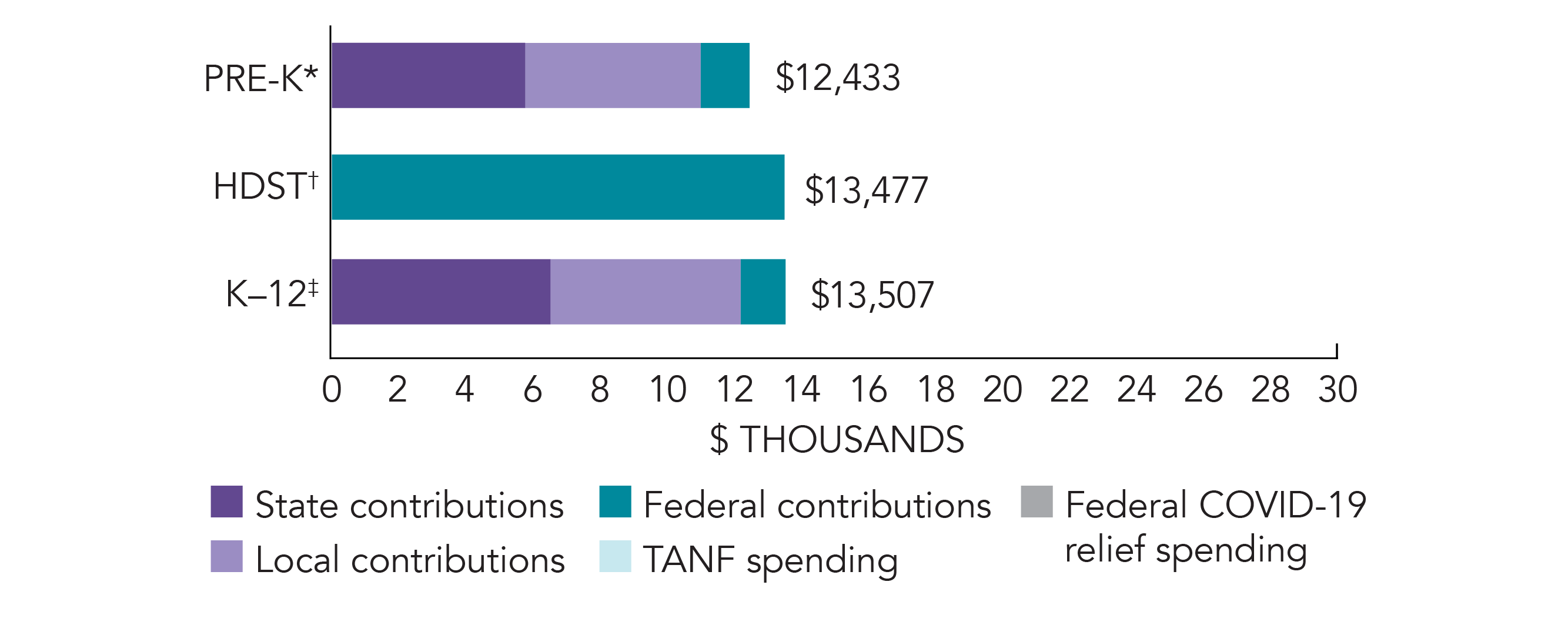
*Pre-K programs may receive additional funds from federal or local sources that are not included in this figure. †Head Start per-child spending includes funding only for 3- and 4-year-olds. ‡K–12 expenditures include capital spending as well as current operating expenditures.
Oklahoma Quality Standards Checklist
| Policy | Requirement | Benchmark | Meets Benchmark? |
|---|---|---|---|
For more information about the benchmarks, see the Executive Summary and the Roadmap to State pages. | 9benchmarks met | ||
| Early Learning & Development Standards Benchmark | Comprehensive, aligned, supported, culturally sensitive | Comprehensive, aligned, supported, culturally sensitive | |
| Curriculum Supports Benchmark | Approval process & supports | Approval process & supports | |
| Teacher Degree Benchmark | BA | BA | |
| Teacher Specialized Training Benchmark | ECE | Specializing in pre-K | |
| Assistant Teacher Degree Benchmark | HSD | CDA or equivalent | |
| Staff Professional Development Benchmark | 15 hours/year; PD plans; Coaching | For teachers & assistants: At least 15 hours/year; individual PD plans; coaching | |
| Maximum Class Size Benchmark | 18 (3-year-olds); 20 (4-year-olds) | 20 or lower | |
| Staff to Child Ratio Benchmark | 1:9 (3-year-olds); 1:10 (4-year-olds) | 1:10 or better | |
| Screening & Referral Benchmark | Vision, hearing, immunizations | Vision, hearing & health screenings; & referral | |
| Continuous Quality Improvement System Benchmark | Structured classroom observations; Data used for program improvement | Structured classroom observations; data used for program improvement | |