State of Preschool
New York
Access Rankings
4-year-Olds
9
3-year-Olds
9
Resource Rankings
State spending
21
All reported spending
4
Total Benchmarks Met
Of 10 benchmarks possible
7*
Overview
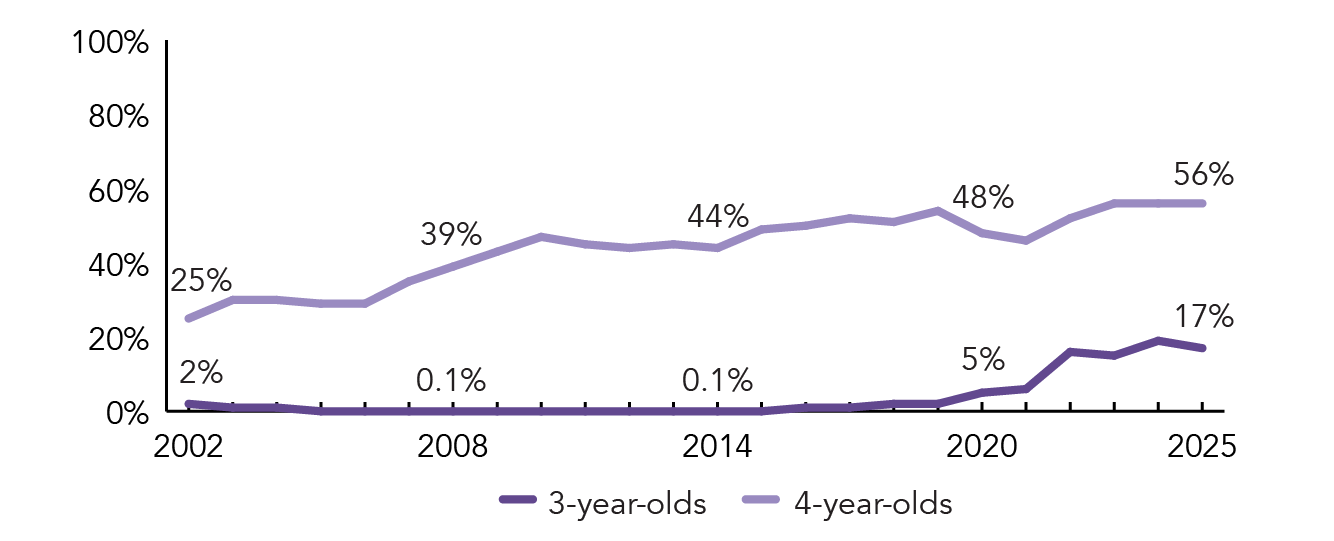
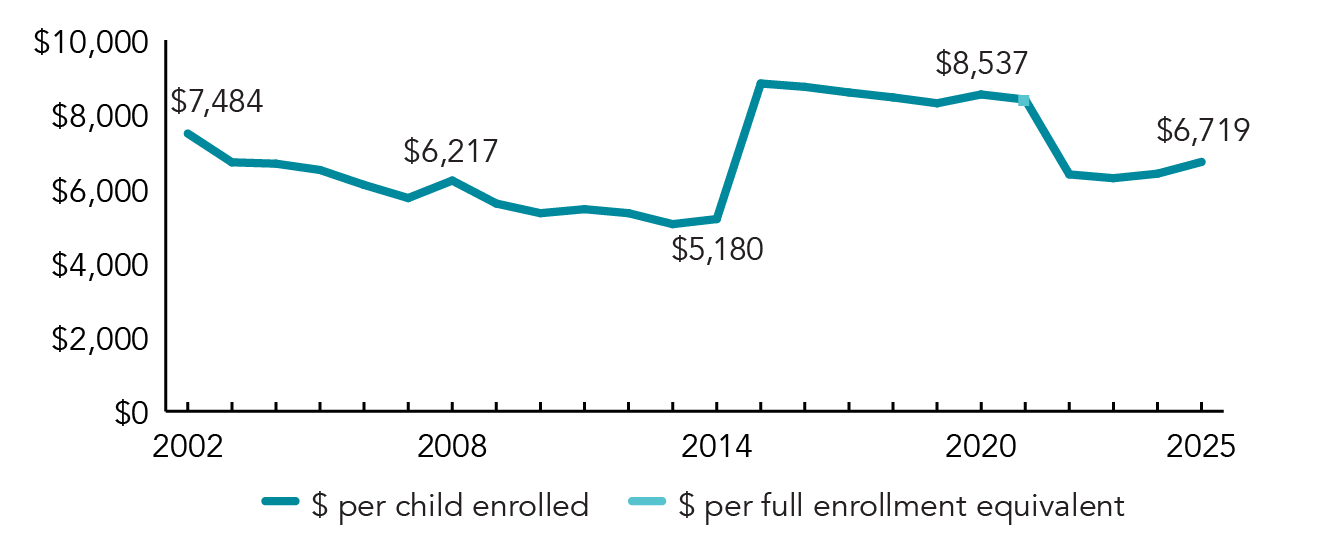
During the 2024-2025 school year, New York preschool enrolled 153,004 children, a decrease of 5,952 from the prior year. However, a higher percentage of children enrolled in full-day preschool. State spending totaled $1,028,061,297, an increase of $10,409,156 (1%), adjusted for inflation, since last year. State spending per child equaled $6,719 in 2024-2025, up $317 from 2023-2024, adjusted for inflation. New York met 7 of 10 quality standards benchmarks.
What's New
Federal recovery funds ended for New York in 2023-2024. These funds rolled into State Universal PreK allocations to further enhance prekindergarten services across NY. Designed with equity at its core, New York’s Universal Prekindergarten (UPK) program is free to all families based solely on age and residency, creating an expansive and inclusive educational landscape.
Purposeful Move Toward PreK Universality: The New York State Board of Regents priority is to provide truly universal prekindergarten for 3-and 4-year-old children by 2035. Starting in the 2024-2025 school year, an annual review of school district curriculum and instructional practices in reading for students in prekindergarten through grade three is required. All NYS public school districts must ensure that curriculum and instruction are aligned with the literacy instructional best practices provided.
Steps to Align UPK and Childcare Systems: To better understand the relationship between district and community-based partners who collaborate to deliver prekindergarten services, NY State Education Department’s (NYSED) Office of Early Learning (OEL) and NYS’s Office of Children and Family Services (OCFS) Division of Child Care Services convened a UPK Collaboration Council.
Background
In 1998, NY began its UPK with the goal of making prekindergarten education available to all 4-year-olds in the state. In 2007, the Targeted Prekindergarten Program merged with UPK. In 2013-2014, the state continued targeting its PreK funding, launching the New York State Priority Prekindergarten Program (NYSPPK), offering competitive grants for new full- and half-day slots for high-need children in low-income school districts and enabling districts to convert half-day slots to full-day. In 2014-2015, the SUFDPK competitive grant for full-day pre-K was launched. Most of this funding ($300 million) went to New York City; $40 million was used to expand full-day pre-K in the rest of the state. In 2015-2016, the Expanded Prekindergarten for 3- and 4-Year-Old Students grant began, creating new
slots for 3- and 4-year-olds. NYS shifted focus to full-day programs and 95% of children were in full-day programs in 2024-2025.
The NY Board of Regents adopted revised comprehensive, multi-domain early learning standards in 2021, which are aligned with state’s K–3 Learning Standards, state college and career ready standards, and the NY State Common Core Learning Standards. In 2012, the state also implemented a voluntary QRIS (QUALITYstarsNY). In 2017-2018, all districts receiving state pre-K funds were required to adopt approved quality indicators within two years, such as valid and reliable measures of environmental quality, quality of teacher-student interactions, and child outcomes. The NYS Pre-K Self-Assessment documents districts’ progress in implementing the approved quality indicators. Districts develop Quality Improvement Action Plans to assess strengths and weaknesses. SED staff review plans and provide feedback to inform technical assistance and monitoring. All prekindergarten programs are required to adopt and implement curricula that contain key skill areas for 21st Century Learners that align with the full articulation of the NYS P–12 Next Generation Learning Standards. All districts are required to submit action plans to outline their Prekindergarten programming for the current school year in annual applications.
New York State Administered Prekindergarten Program
Access
| |
| Total state pre-K enrollment | 153,004 |
| School districts that offer state program | 93% |
| Income requirement | No income requirement |
| Minimum hours of operation | 2.5 hours/day; 5 days/week |
| Operating schedule | School or academic year |
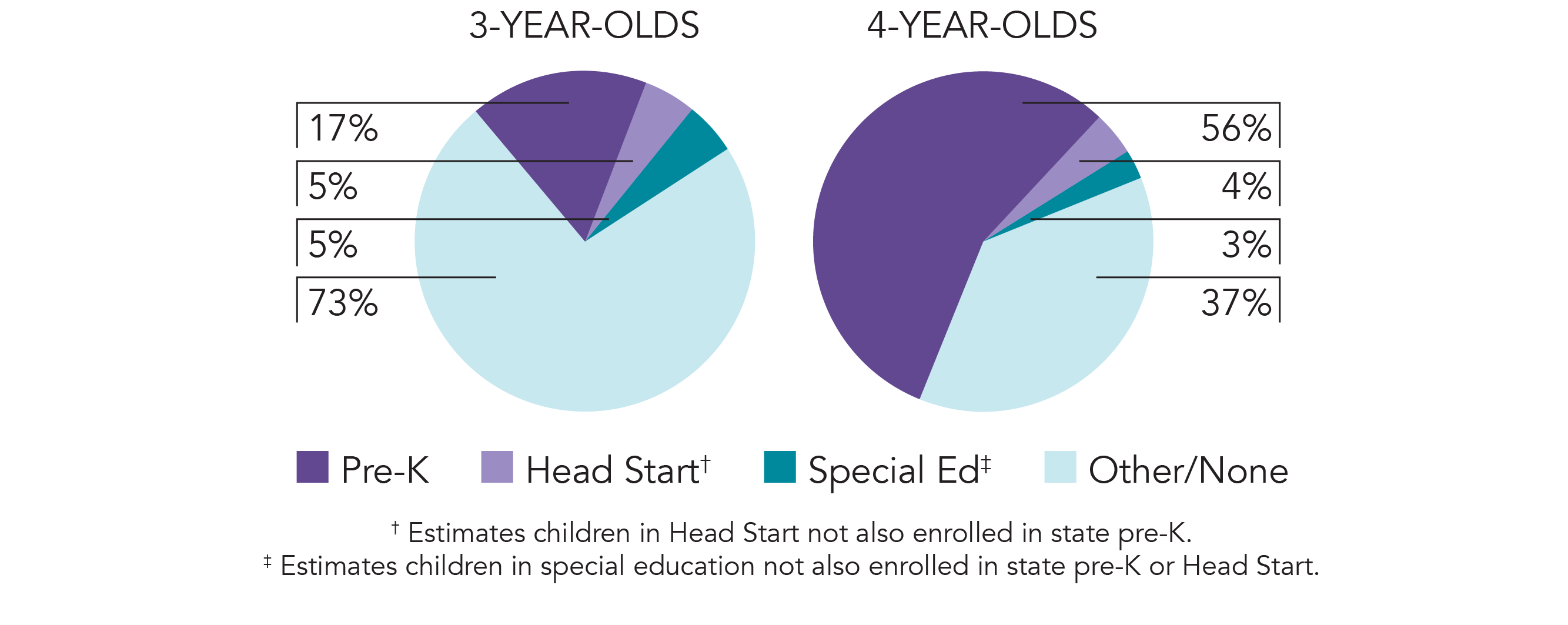
| Special education enrollment, ages 3 and 4 | 49,732 |
| Federally funded Head Start enrollment, ages 3 and 4 | 23,408 |
| State-funded Head Start enrollment, ages 3 and 4 | 0 |
Resources
| Total state pre-K spending | $1,028,061,297 |
| Local match required? | No |
| State Head Start spending | $0 |
| State spending per child enrolled | $6,719 |
| All reported spending per child enrolled* | $16,940 |
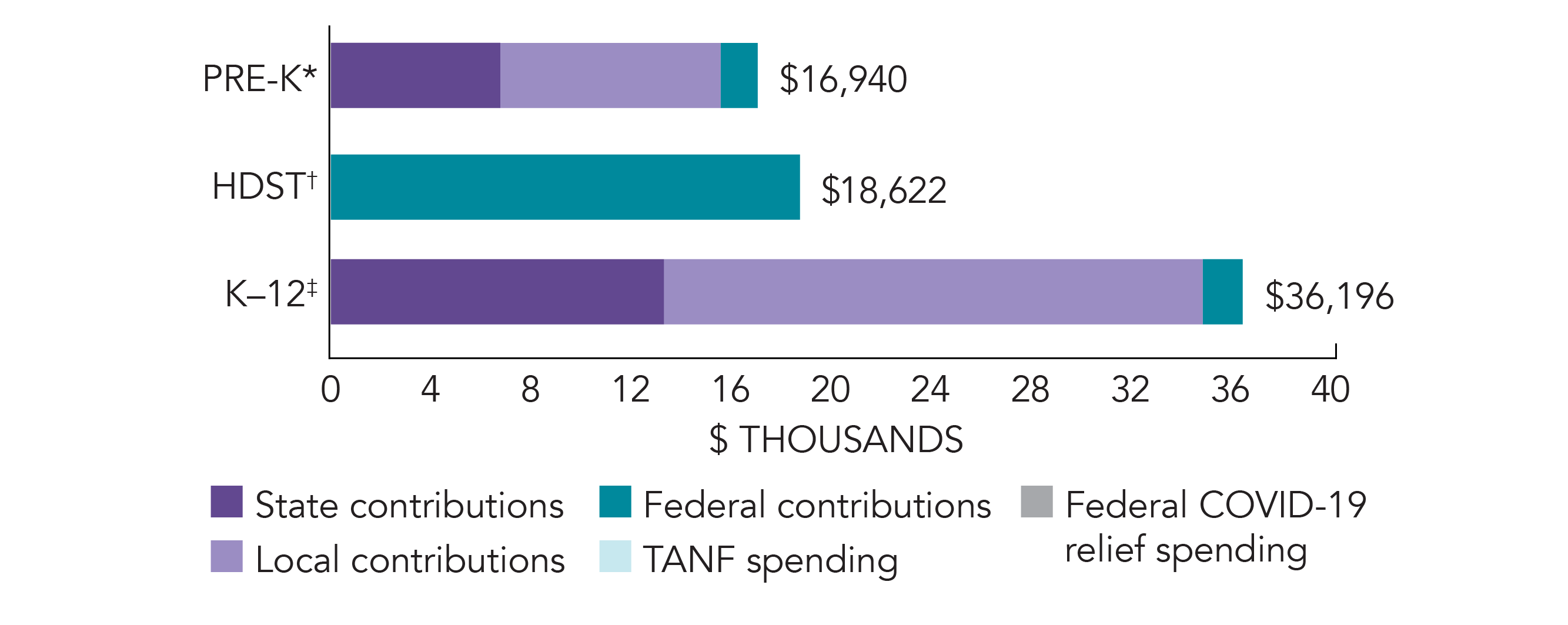
*Pre-K programs may receive additional funds from federal or local sources that are not included in this figure. †Head Start per-child spending includes funding only for 3- and 4-year-olds. ‡K–12 expenditures include capital spending as well as current operating expenditures.
New York Quality Standards Checklist
| Policy | Requirement | Benchmark | Meets Benchmark? |
|---|---|---|---|
For more information about the benchmarks, see the Executive Summary and the Roadmap to State pages. | 7*benchmarks met | ||
| Early Learning & Development Standards Benchmark | Comprehensive, aligned, supported, culturally sensitive | Comprehensive, aligned, supported, culturally sensitive | |
| Curriculum Supports Benchmark | Approval process & supports | Approval process & supports | |
| Teacher Degree Benchmark | BA* | BA | |
| Teacher Specialized Training Benchmark | ECE | Specializing in pre-K | |
| Assistant Teacher Degree Benchmark | Level I Teaching Assistant Certification (public); HSD (nonpublic) | CDA or equivalent | |
| Staff Professional Development Benchmark | 175 hours/5 years (teachers only); Coaching (first year public school teachers only) | For teachers & assistants: At least 15 hours/year; individual PD plans; coaching | |
| Maximum Class Size Benchmark | 20 (3- & 4-year-olds) | 20 or lower | |
| Staff to Child Ratio Benchmark | 1:9 (3- & 4-year olds) | 1:10 or better | |
| Screening & Referral Benchmark | Vision, hearing, health & more | Vision, hearing & health screenings; & referral | |
| Continuous Quality Improvement System Benchmark | Annual structured classroom observations; Data used at the local level only | Structured classroom observations; data used for program improvement | |
* Indicates that while policy meets the benchmark, it is not being implemented fully