State of Preschool
Michigan
Access Rankings
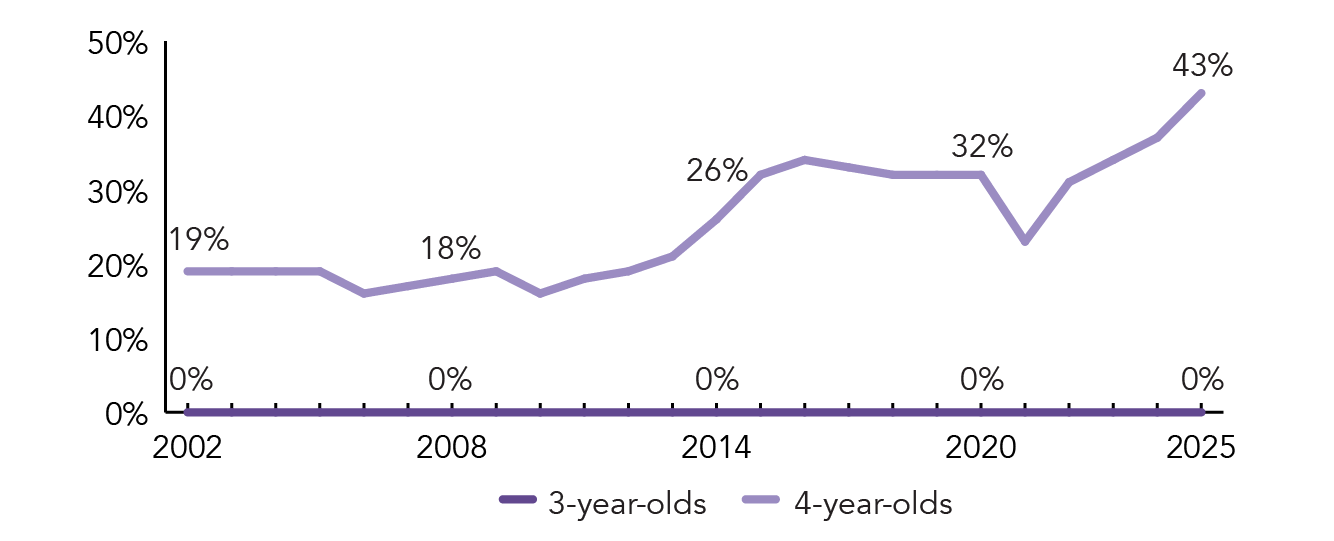
4-year-Olds
17
3-year-Olds
None Served
Resource Rankings
State spending
6
All reported spending
9
Total Benchmarks Met
Of 10 benchmarks possible
10*
Overview
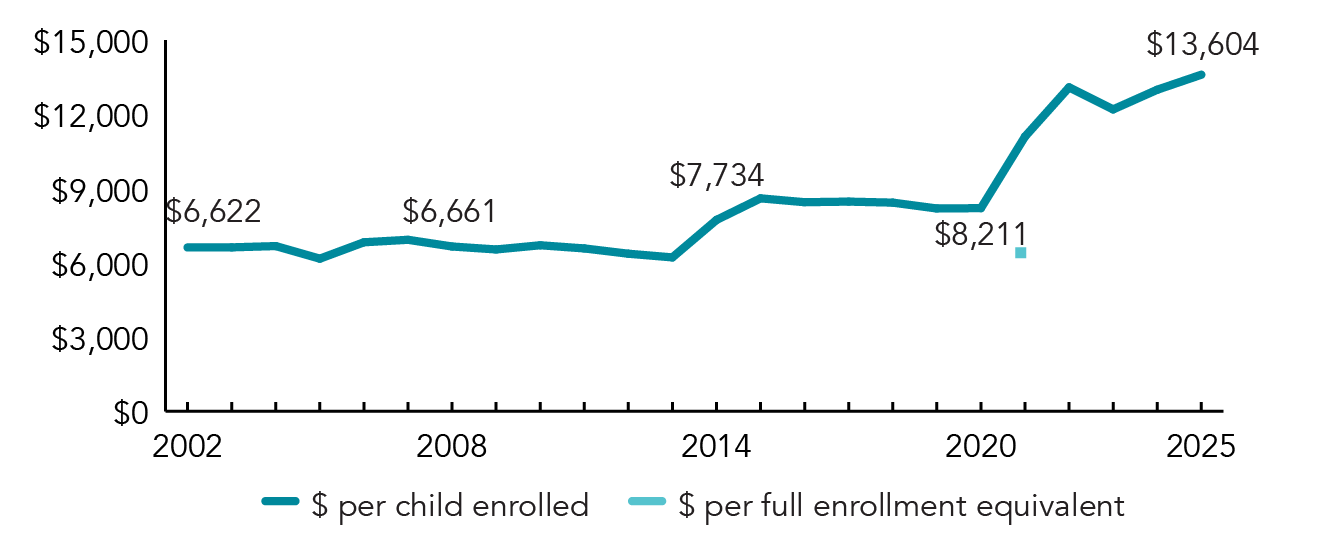
During the 2024-2025 school year, Michigan Great Start School Readiness (GSRP) enrolled 47,981 children, an increase of 6,861 from the prior year. State spending totaled $652,720,000, up $118,264,216 (22%), adjusted for inflation, since last year. State spending per child equaled $13,604 in 2024-2025, up $606 from 2023-2024, adjusted for inflation. Michigan met 10 of 10 quality standards benchmarks.
What's New
As of December 1, 2023, GSRP moved to the newly created Michigan Department of Lifelong Education, Advancement, and Potential (MiLEAP) created by the Governor under Executive Order 2023-6. Michigan also created a PreK for All Initiative, which includes GSRP, Head Start, Developmental Kindergarten, and Early Childhood Special Education, and aims to provide free prekindergarten to 75% of 4-year-olds by 2027. In 2024-2025, the income requirement for GSRP eligibility was removed.
In September 2024, Michigan was one of 10 states and D.C. awarded a 3-year federal renewal Preschool Development Grant B-5 (PDG B-5) totaling $8,999,241 annually. The PDG B-5 renewal grant is intended to carry out the strategic plans developed with the 2023 planning grants which focused on addressing the workforce, social-emotional well-being, and sustainable infrastructure in the state’s early childhood system.
Background
Established in 1985, the GSRP, formerly known as Michigan School Readiness Program, provides preschool education for at-risk 4-year- olds, and is associated with the state’s early childhood initiative. Starting in 2013-2014, 90% of families had to be at or below 250% FPL with some exceptions for up to 300% FPL. Beginning in 2024-2025, children at or below 400% FPL are prioritized for enrollment over those from families that exceed 400%.
GSRP serves the majority of children in school-day programs. Intermediate School Districts (ISDs) serve as program grantees, but they may distribute funds to local school districts and to providers in community-based settings to offer GSRP. GSRP providers must attain an enhancing quality or higher level in Michigan’s Great Start to Quality (GSQ) tiered rating and improvement system.
Overall ISD funding is determined by the level of poverty in each ISD and a funding formula, with final grantee awards based on a community needs assessment and a formula component. State funding includes a transportation fund, a curriculum/training fund, a Start Up Grant Fund, and funding to recruit families and increase public awareness of GSRP; as well as $600,000 for ongoing statewide evaluation activities.
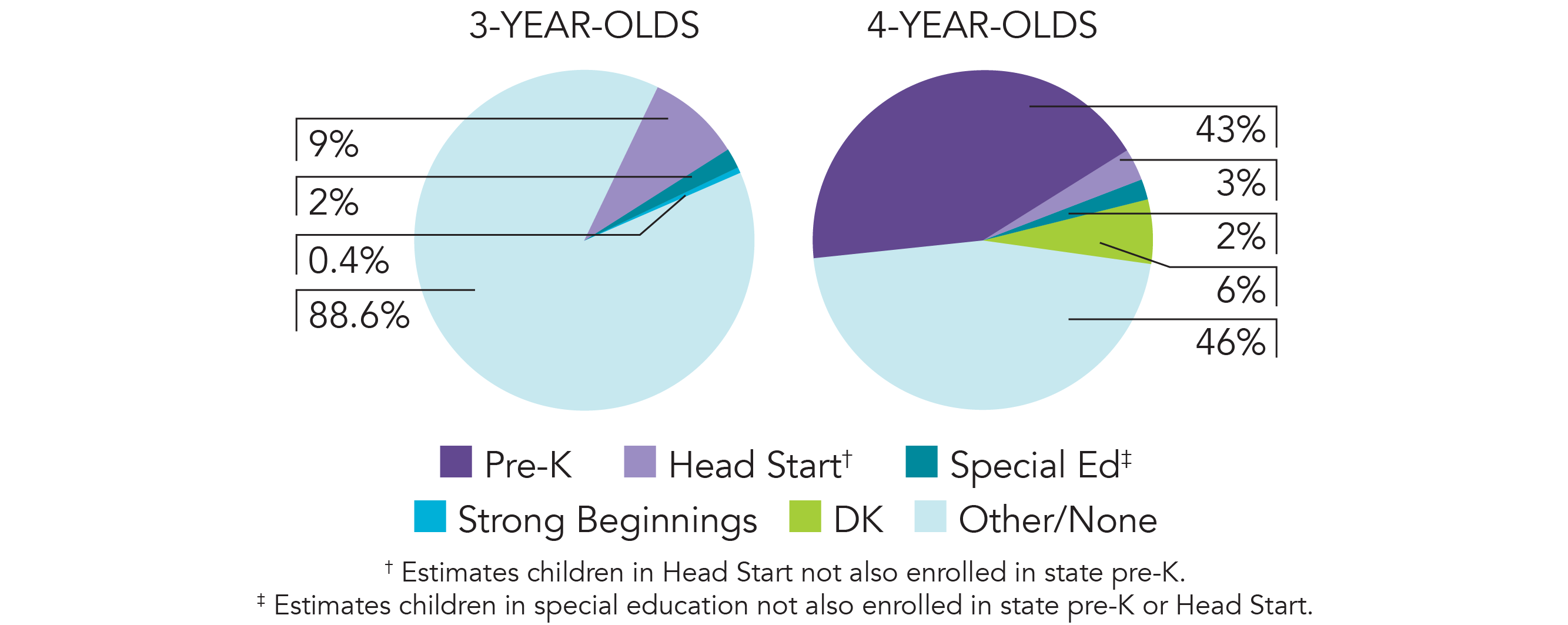
Michigan’s Developmental Kindergarten (DK, not included in this report) is the first year of a planned two-year kindergarten program sequence for children who turn five between September 2 and December 1 or whose parents and/or schools feel they are “not ready” for kindergarten, usually those with birthdays between July and September 1. It is funded in the same way as kindergarten, using the school funding formula and follows kindergarten requirements, which are based on local district control. DK enrolled 6,740 four-year- olds with $64,757,920 in total spending in 2024-2025. Michigan’s Strong Beginnings is a pilot state-funded center-based preschool program for three-year-olds. In 2024-2025, 398 three-year-olds participated in the program with $5,692,327 in state school aid funding.
Michigan Great Start Readiness Program
Access
| |
| Total state pre-K enrollment | 47,981 |
| School districts that offer state program | 98% (counties) |
| Income requirement | No income requirement |
| Minimum hours of operation | 3 hours/day; 4 days/week |
| Operating schedule | Determined locally |
| Special education enrollment, ages 3 and 4 | 10,391 |
| Federally funded Head Start enrollment, ages 3 and 4 | 16,751 |
| State-funded Head Start enrollment, ages 3 and 4 | 0 |
Resources
| Total state pre-K spending | $652,720,000 |
| Local match required? | No |
| State Head Start spending | $0 |
| State spending per child enrolled | $13,604 |
| All reported spending per child enrolled* | $13,604 |
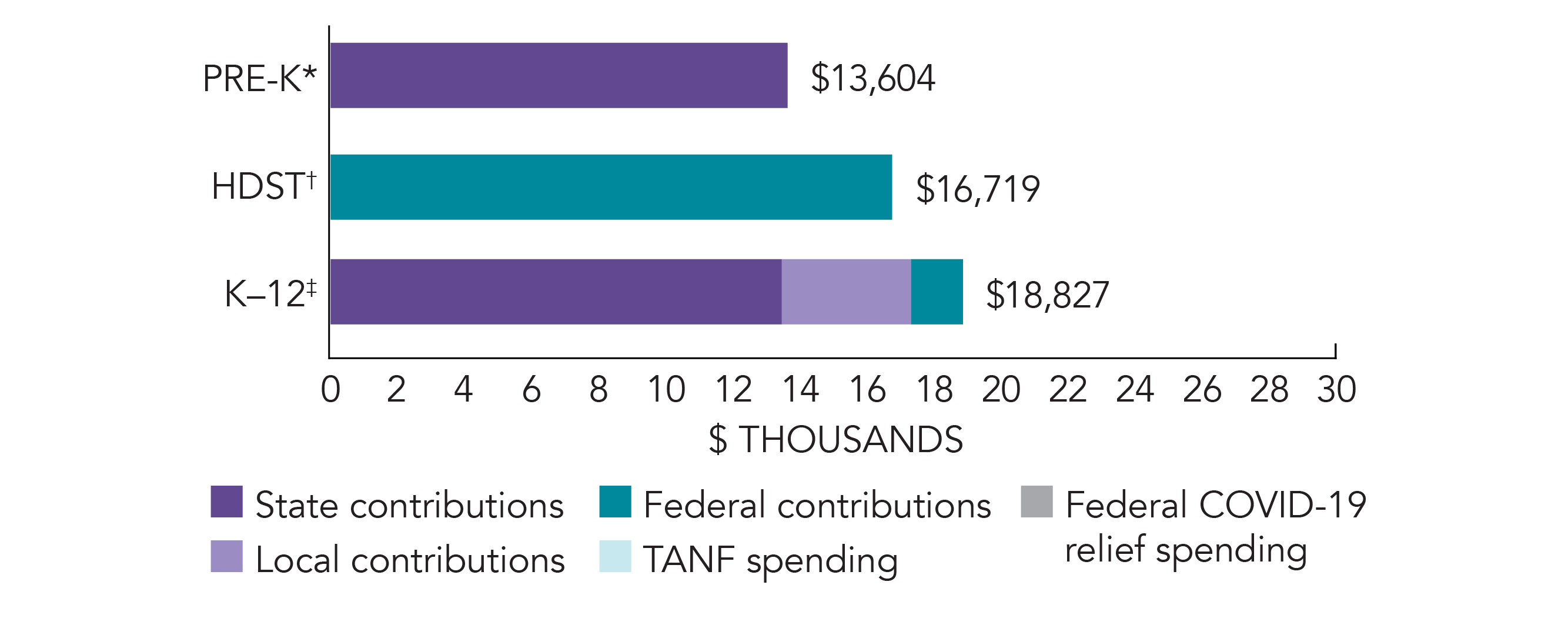
*Pre-K programs may receive additional funds from federal or local sources that are not included in this figure. †Head Start per-child spending includes funding only for 3- and 4-year-olds. ‡K–12 expenditures include capital spending as well as current operating expenditures.
Michigan Quality Standards Checklist
| Policy | Requirement | Benchmark | Meets Benchmark? |
|---|---|---|---|
For more information about the benchmarks, see the Executive Summary and the Roadmap to State pages. | 10*benchmarks met | ||
| Early Learning & Development Standards Benchmark | Comprehensive, aligned, supported, culturally sensitive | Comprehensive, aligned, supported, culturally sensitive | |
| Curriculum Supports Benchmark | Approval process & supports | Approval process & supports | |
| Teacher Degree Benchmark | BA* | BA | |
| Teacher Specialized Training Benchmark | ECE, CD, ECE SpEd | Specializing in pre-K | |
| Assistant Teacher Degree Benchmark | CDA or AA in ECE/CD | CDA or equivalent | |
| Staff Professional Development Benchmark | 16 hours/year; PD plans; Coaching | For teachers & assistants: At least 15 hours/year; individual PD plans; coaching | |
| Maximum Class Size Benchmark | 20 (4-year-olds) | 20 or lower | |
| Staff to Child Ratio Benchmark | 1:10 (4-year-olds) | 1:10 or better | |
| Screening & Referral Benchmark | Vision, hearing, health & more | Vision, hearing & health screenings; & referral | |
| Continuous Quality Improvement System Benchmark | Structured classroom observations; Data used for program improvement | Structured classroom observations; data used for program improvement | |
* Indicates that while policy meets the benchmark, it is not being implemented fully