State of Preschool
Maine
Access Rankings
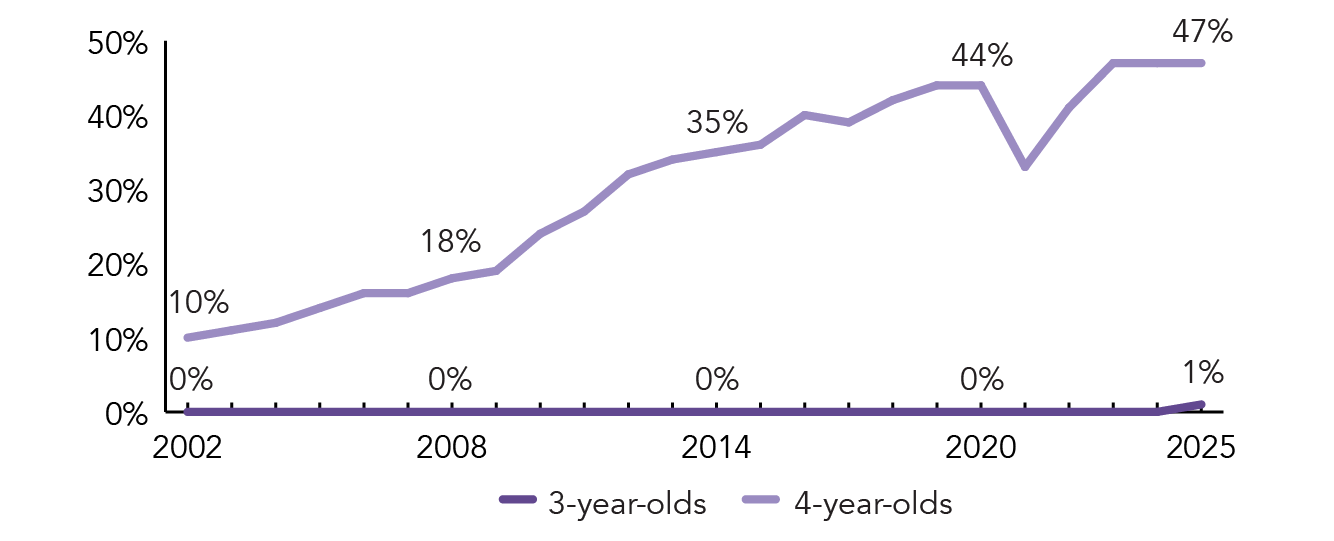
4-year-Olds
13
3-year-Olds
34
Resource Rankings
State spending
24
All reported spending
16
Total Benchmarks Met
Of 10 benchmarks possible
9
Overview
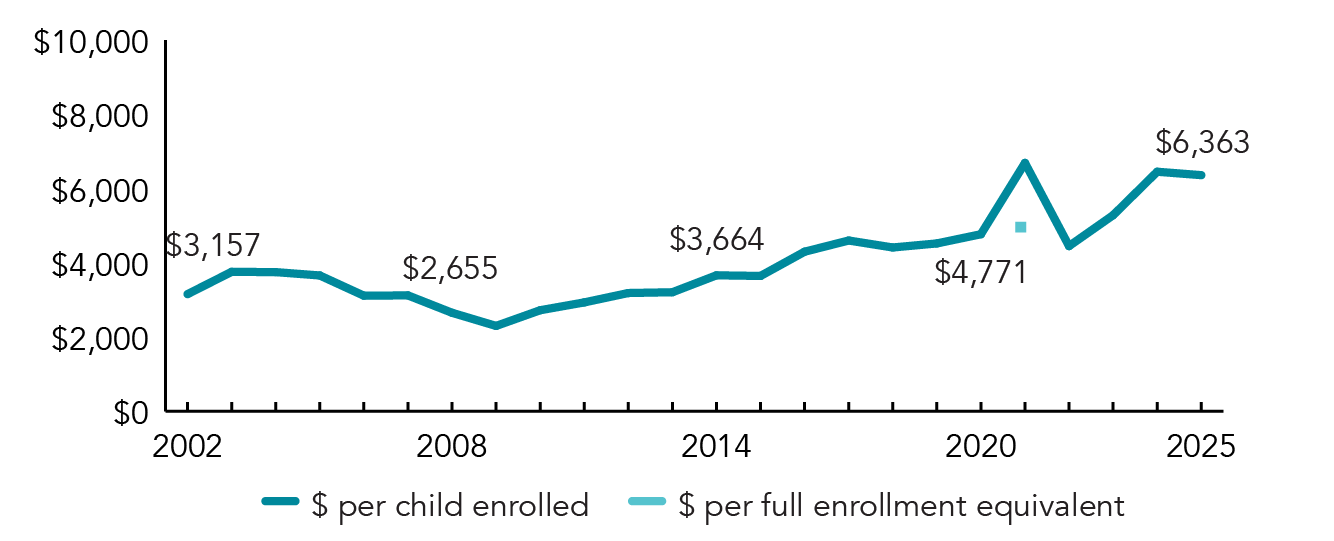
During the 2024-2025 school year, Maine preschool enrolled 6,445 children, an increase of 84 from the prior year. State spending totaled $39,812,310 with an additional $1,199,903 in federal recovery funds to support the program, down $49,661 (0.1%), adjusted for inflation, since last year. State spending per child (including federal recovery funds) equaled $6,363 in 2024-2025, down $92 from 2023-2024, adjusted for inflation. Maine met 9 of 10 quality standards benchmarks.
What's New
During the 2024-2025 school year, Maine began to legislatively shift responsibility for early childhood education (3- to 5-year-olds) to the public school system over a four-year period, with completion in the 2027-2028 school year. As this shift occurs, the state anticipates that more children with identified disabilities will receive services in a timely manner and that the state will continue to see steady public pre-k expansion.
In 2024-2025, some remaining COVID-19 relief funding and PDG renewal grant funding were utilized to support expansion of public pre-k funding, including partnerships with licensed child care providers. In addition, the PDG funding has supported a Pre-K Partnership Specialist position to assist with public pre-k partnership development efforts, and Covid-19 funding supported increased staff to provide technical assistance/professional learning to expansion grantees.
In December 2025, Maine was awarded a federal PDG B–5 Systems Building Grant totaling $1,933,007 to support system building and strengthen ECE programs in a mixed-delivery system, improve system efficiency and collaboration, and raise the overall quality of programs.
Background
Maine established its Two-Year Kindergarten initiative in 1983 by allocating resources to local districts through the school funding formula. Since 2007, state-funded programs for 4-year-olds have been separately defined as the Public Preschool Program (PPP), still funded through Maine’s school funding formula, with a distribution of funds to 178 of the 191 (93%) school administrative units (SAUs) that operate kindergarten.
PPP classrooms function as either stand-alone programs located in public schools or SAUs partner with licensed community-based childcare programs or Head Start agencies. Schools are required to provide a local match to draw down a per-pupil state subsidy. The required local match is part of the school funding formula based on property value.
Maine’s Public Preschool Program Standards, promulgated as a regulation in December 2014, outlined programmatic changes including reduced child-staff ratio and group size, the use of evidence-based curricula, and child screening and assessments.
Maine Public Preschool Program
Access
| |
| Total state pre-K enrollment | 6,445 |
| School districts that offer state program | 93% (eligible school administrative units) |
| Income requirement | No income requirement |
| Minimum hours of operation | 2 hours/day |
| Operating schedule | School or academic year |
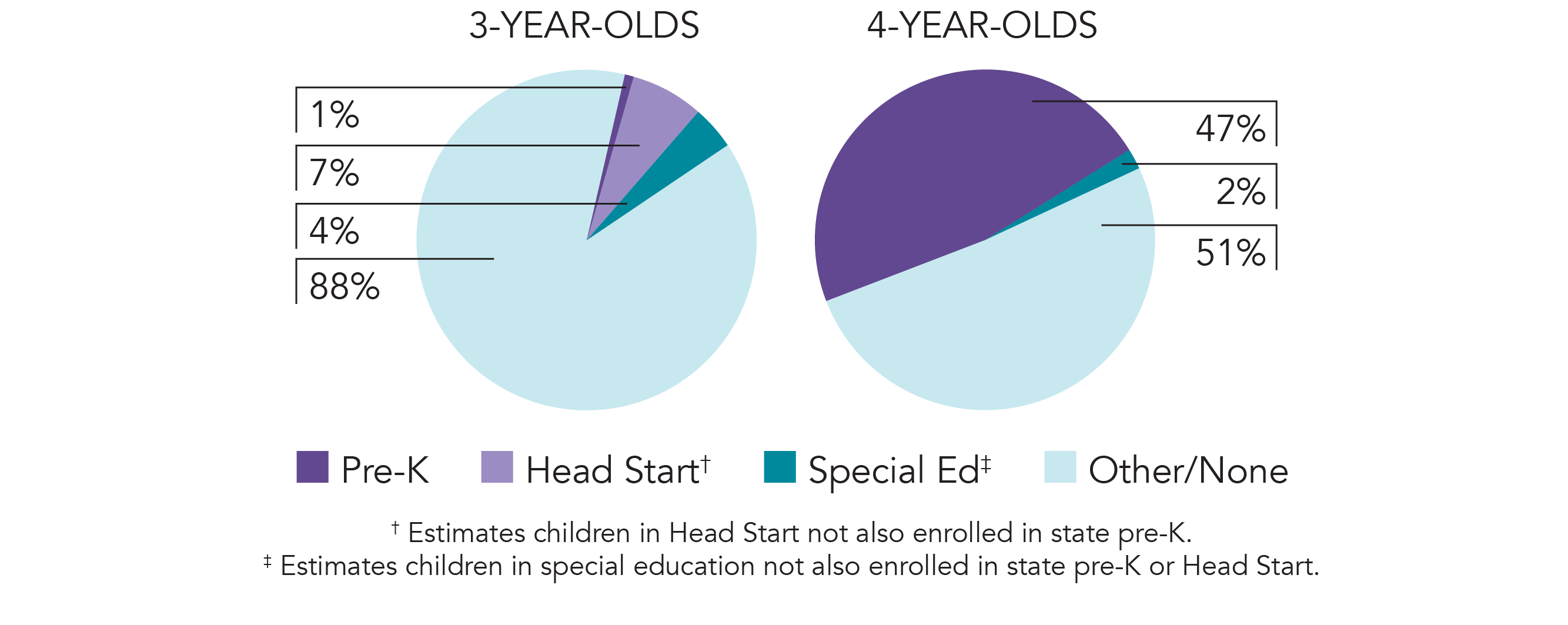
| Special education enrollment, ages 3 and 4 | 2,348 |
| Federally funded Head Start enrollment, ages 3 and 4 | 1,679 |
| State-funded Head Start enrollment, ages 3 and 4 | Not reported |
Resources
| Total state pre-K spending | $41,012,213 |
| Local match required? | Yes |
| State Head Start spending | $6,140,038 |
| State spending per child enrolled | $6,363 |
| All reported spending per child enrolled* | $10,752 |
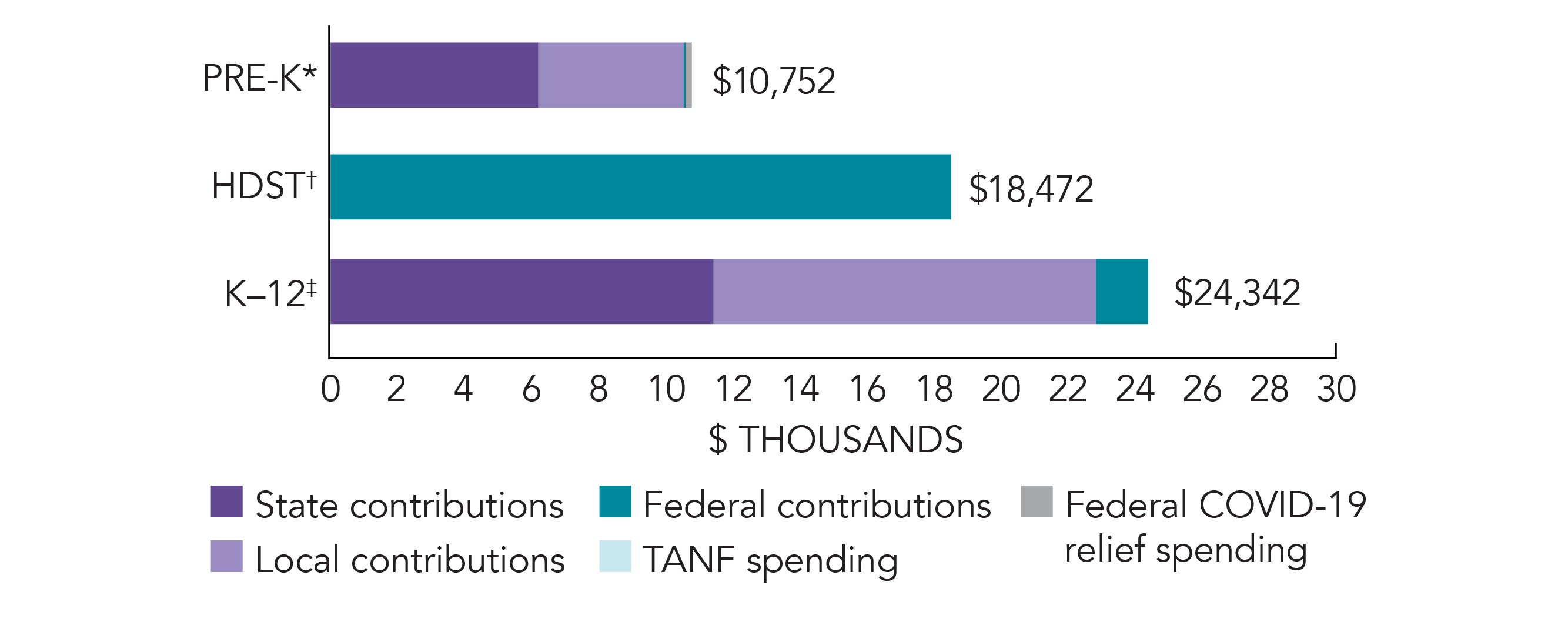
*Pre-K programs may receive additional funds from federal or local sources that are not included in this figure. †Head Start per-child spending includes funding only for 3- and 4-year-olds. ‡K–12 expenditures include capital spending as well as current operating expenditures.
Maine Quality Standards Checklist
| Policy | Requirement | Benchmark | Meets Benchmark? |
|---|---|---|---|
For more information about the benchmarks, see the Executive Summary and the Roadmap to State pages. | 9benchmarks met | ||
| Early Learning & Development Standards Benchmark | Comprehensive, aligned, supported, culturally sensitive | Comprehensive, aligned, supported, culturally sensitive | |
| Curriculum Supports Benchmark | Approval process & supports | Approval process & supports | |
| Teacher Degree Benchmark | BA | BA | |
| Teacher Specialized Training Benchmark | ECE | Specializing in pre-K | |
| Assistant Teacher Degree Benchmark | Educational Technician II (at least 9 ECE credits) | CDA or equivalent | |
| Staff Professional Development Benchmark | 6 credit hours/5 years (teachers), 3 credit hours/5 years (assistants) | For teachers & assistants: At least 15 hours/year; individual PD plans; coaching | |
| Maximum Class Size Benchmark | 16 (3- & 4-year-olds) | 20 or lower | |
| Staff to Child Ratio Benchmark | 1:8 (4-year-olds) | 1:10 or better | |
| Screening & Referral Benchmark | Vision, hearing, health & more | Vision, hearing & health screenings; & referral | |
| Continuous Quality Improvement System Benchmark | Structured classroom observations; Data used for program improvement | Structured classroom observations; data used for program improvement | |