State of Preschool
Georgia
Access Rankings
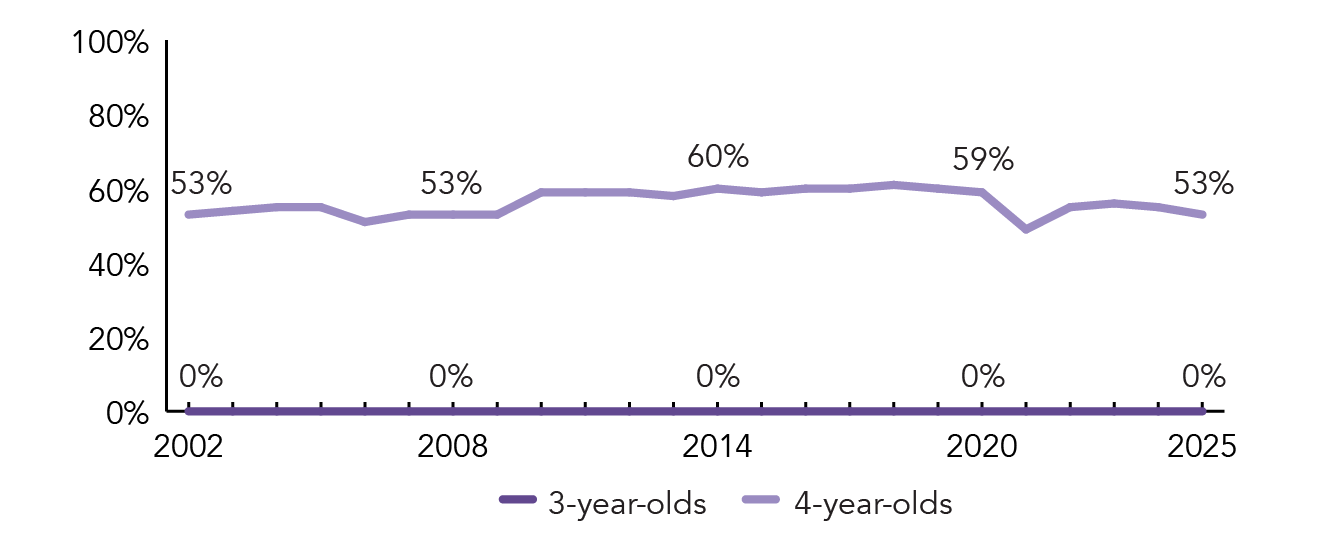
4-year-Olds
10
3-year-Olds
None Served
Resource Rankings
State spending
19
All reported spending
29
Total Benchmarks Met
Of 10 benchmarks possible
10
Overview
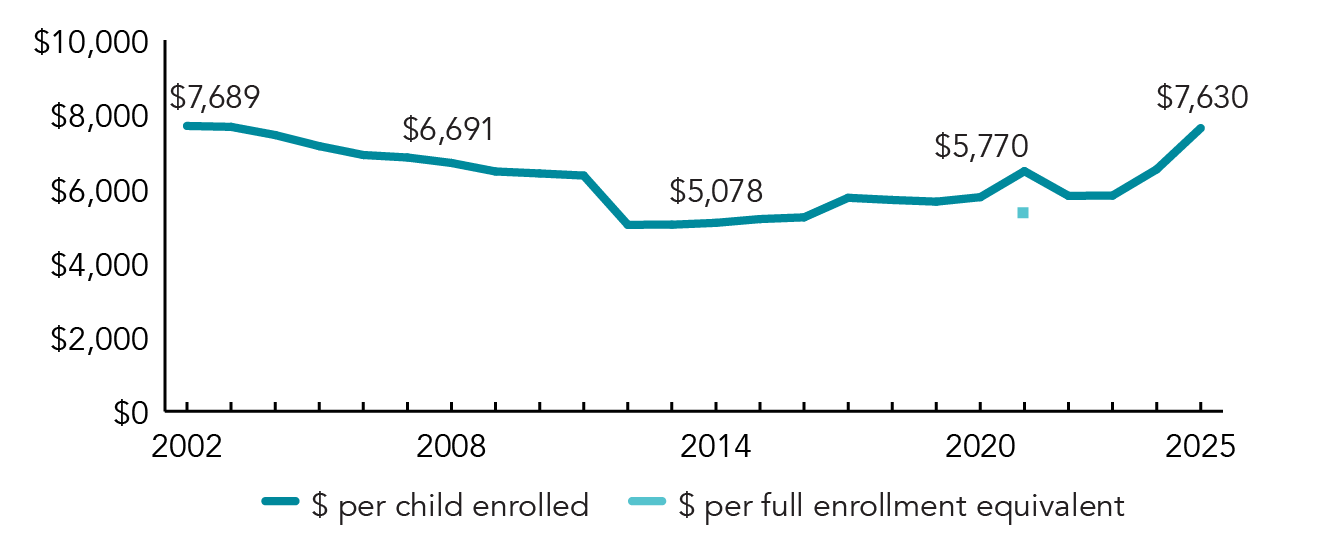
During the 2024-2025 school year, Georgia's Pre-K Program enrolled 70,572 children, a decrease of 954 from the prior year. State spending totaled $538,431,295, up $72,157,626 (15%), adjusted for inflation, since last year. State spending per child equaled $7,630 in 2024-2025, up $1,111 from 2023-2024, adjusted for inflation. Georgia met 10 of 10 quality standards benchmarks.
What's New
In 2024-2025, Georgia’s Pre-K Program received an additional $97.6 million in state funding, a 22% increase in the annual budget, with a commitment to continued yearly support. The funding is designated for both program quality and accessibility. Approximately $46 million is allocated to increase salaries for lead and assistant teachers. Salaries for Georgia’s Pre-K lead teachers were adjusted to match those of K-12 public school teachers, resulting in a 13% overall salary increase for lead teachers, with 77% receiving a raise (and no salaries decreased). The state salary schedule now includes extra steps for years of experience and advanced credentials (specialist and doctorate). Additionally, assistant teacher salaries rose by 27.5%, reaching $25,741 per year. To improve program quality and access, $9 million was provided to lower maximum class size to 20 students and fund 100 new classrooms.
An additional four million dollars was budgeted to support increased transportation for all students. Additional allocations to ensure program quality include: (1) $11.5 million in operating funds for private providers, (2) $3.2 million in benefits funding for local school systems, (3) $2 million in startup grants for new classrooms, raising the amount from $8,000 to $30,000 per classroom, (4) $11.5 million for classroom replenishment grants, providing $15,000 to continuation classrooms every five years (about 750 classrooms annually, based on start year). An additional $9 million was budgeted for the Pre-K Summer Transition Program to expand access. An additional $1.4 million was allocated in the Department budget for 3 Pre-K administrative positions, updates to the provider management system, COLA increase for Pre-K state staff, 2 additional Pre-K Specialists, and 1 additional Inclusion and Behavioral Supports Specialist.
The funding has been annualized and will be included in the state budget for the Pre-K Program. Additionally, over the next three years, funding for 100 new classrooms will be allocated each year, and an additional Pre-K Specialist is allocated for the next 2 years.
Background
Georgia’s Pre-K Program launched in 1992 as a small pilot program and expanded in 1995 to become the nation’s first state-funded universal preschool program for 4-year-olds. State lottery revenues generate funding for the program, which is provided in a variety of settings, including public schools, private child-care centers, faith-based organizations, Head Start agencies, state colleges and universities, and military facilities.
In 2011, the Georgia General Assembly authorized an evaluation of Georgia’s Pre-K Program. In response to the General Assembly, the Department of Early Care and Learning (DECAL) commissioned national experts at the Frank Porter Graham Child Development Institute at the University of North Carolina at Chapel Hill to conduct a series of studies to measure the impact of the state’s nationally renowned pre-K program. Reports include recent results from the Pre-K Longitudinal Study designed to examine the short- and long- term learning outcomes for children who attended Georgia’s Pre-K as well as the quality of their preschool and early elementary school experiences. Research reports with results through fourth grade can be accessed here.
Georgia's Pre-K Program
Access
| |
| Total state pre-K enrollment | 70,572 |
| School districts that offer state program | 100% (counties) |
| Income requirement | No income requirement |
| Minimum hours of operation | 6.5 hours/day; 5 days/week |
| Operating schedule | School or academic year |
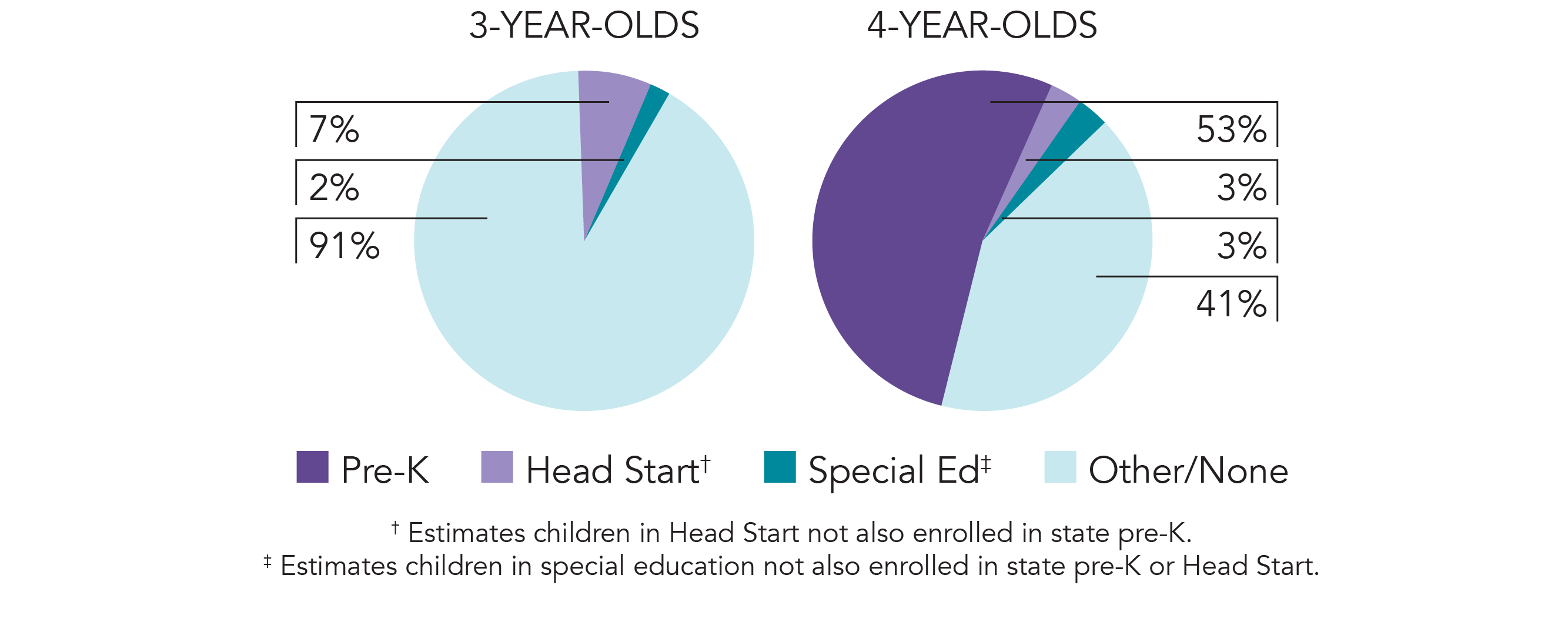
| Special education enrollment, ages 3 and 4 | 11,116 |
| Federally funded Head Start enrollment, ages 3 and 4 | 15,069 |
| State-funded Head Start enrollment, ages 3 and 4 | 0 |
Resources
| Total state pre-K spending | $538,431,295 |
| Local match required? | No |
| State Head Start spending | $0 |
| State spending per child enrolled | $7,630 |
| All reported spending per child enrolled* | $7,630 |
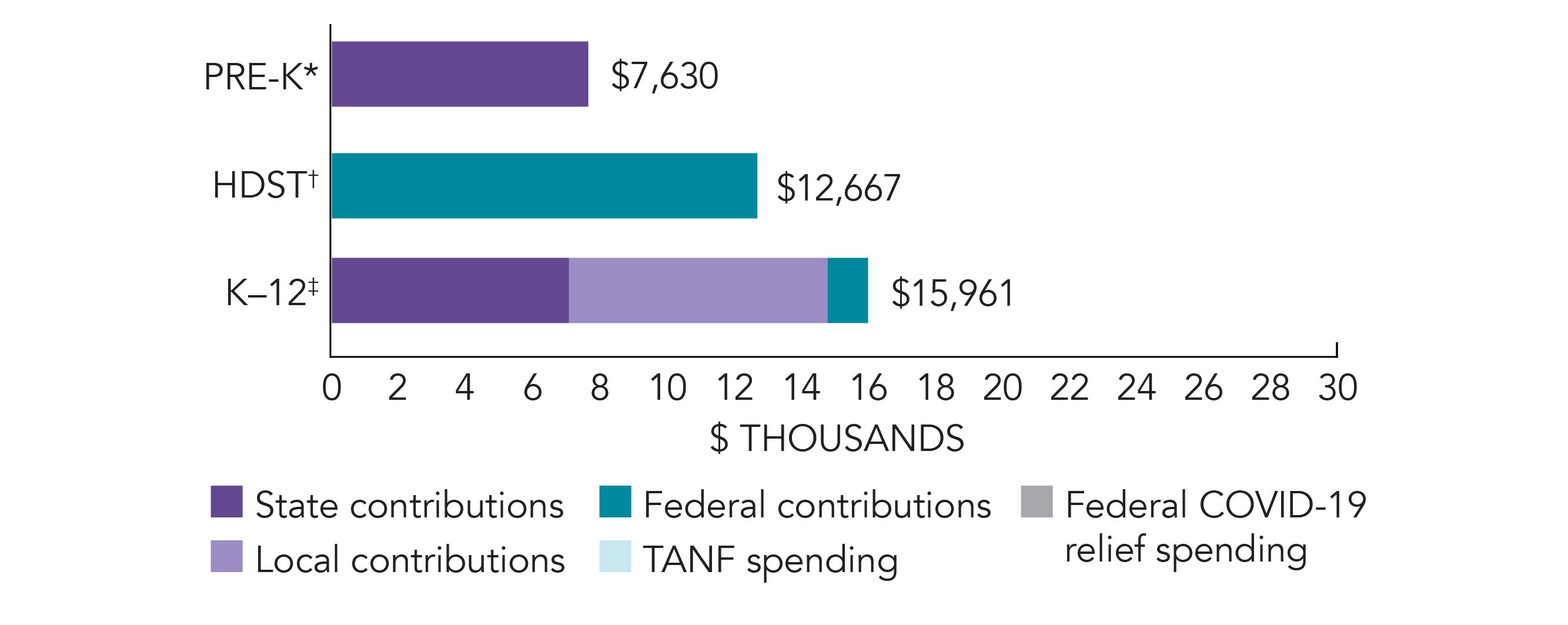
*Pre-K programs may receive additional funds from federal or local sources that are not included in this figure. †Head Start per-child spending includes funding only for 3- and 4-year-olds. ‡K–12 expenditures include capital spending as well as current operating expenditures.
Georgia Quality Standards Checklist
| Policy | Requirement | Benchmark | Meets Benchmark? |
|---|---|---|---|
For more information about the benchmarks, see the Executive Summary and the Roadmap to State pages. | 10benchmarks met | ||
| Early Learning & Development Standards Benchmark | Comprehensive, aligned, supported, culturally sensitive | Comprehensive, aligned, supported, culturally sensitive | |
| Curriculum Supports Benchmark | Approval process & supports | Approval process & supports | |
| Teacher Degree Benchmark | BA | BA | |
| Teacher Specialized Training Benchmark | ECE, CD, ECE SpEd | Specializing in pre-K | |
| Assistant Teacher Degree Benchmark | CDA | CDA or equivalent | |
| Staff Professional Development Benchmark | 15 hours/year; PD plans; Coaching | For teachers & assistants: At least 15 hours/year; individual PD plans; coaching | |
| Maximum Class Size Benchmark | 20 (4-year-olds) | 20 or lower | |
| Staff to Child Ratio Benchmark | 1:10 (4-year-olds) | 1:10 or better | |
| Screening & Referral Benchmark | Vision, hearing, health & more | Vision, hearing & health screenings; & referral | |
| Continuous Quality Improvement System Benchmark | Structured classroom observations; Data used for program improvement | Structured classroom observations; data used for program improvement | |