State of Preschool
Florida
Access Rankings
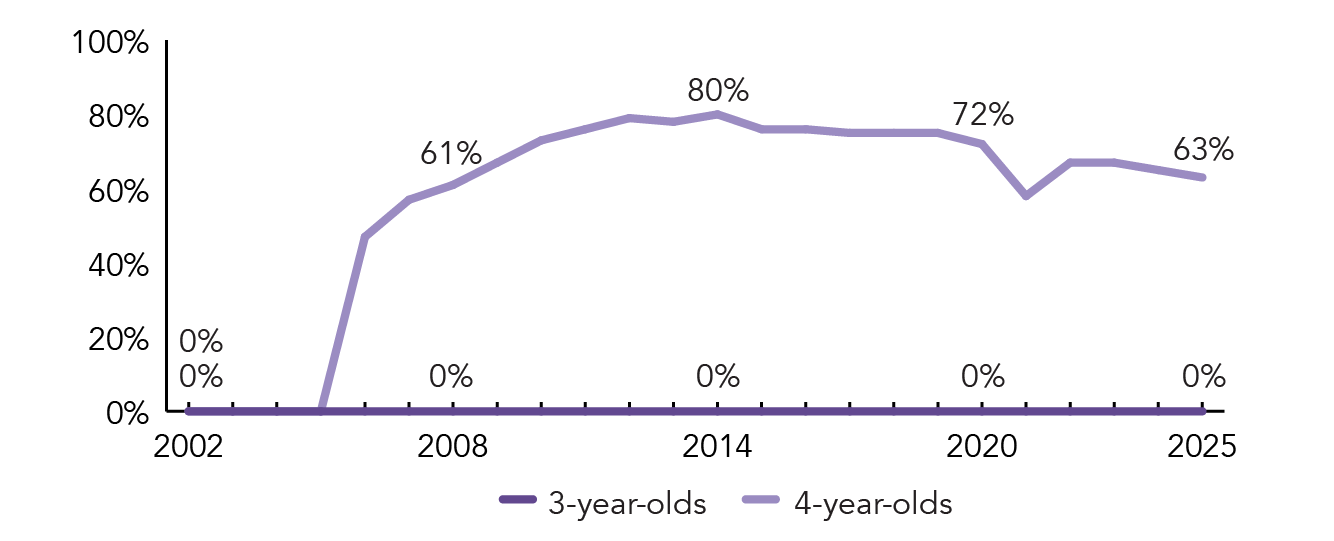
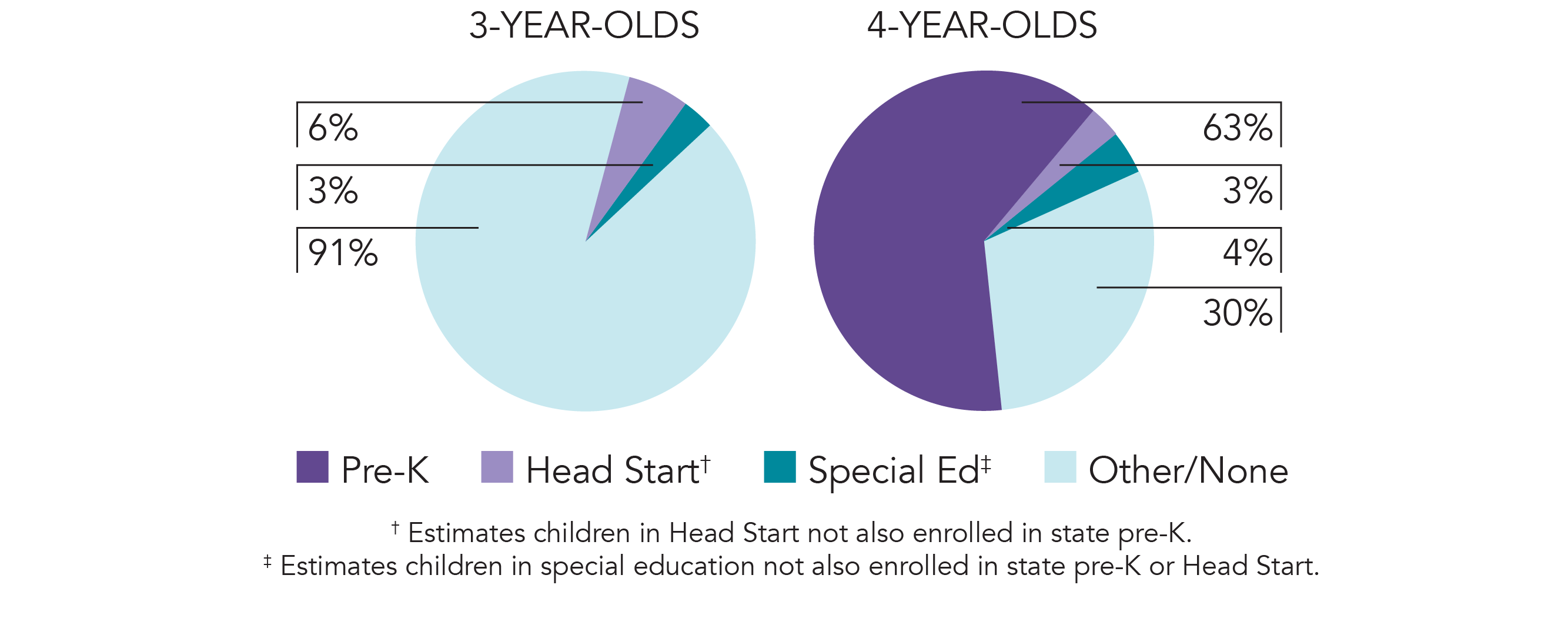
4-year-Olds
7
3-year-Olds
None Served
Resource Rankings
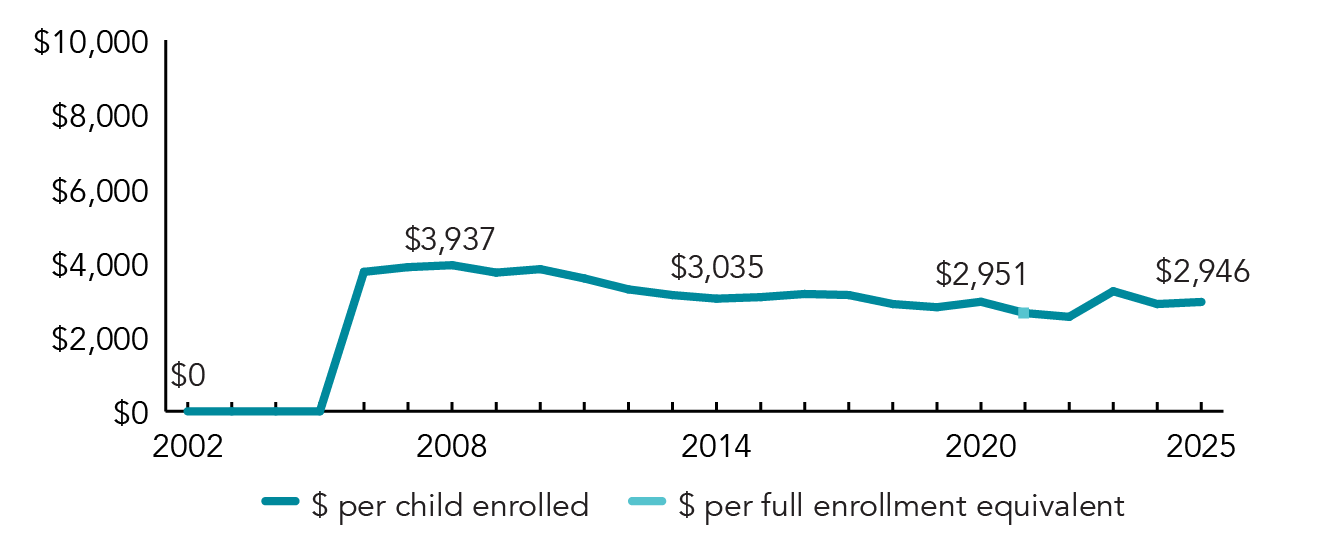
State spending
44
All reported spending
45
Total Benchmarks Met
Of 10 benchmarks possible
5
Overview
During the 2024-2025 school year, Florida preschool enrolled 150,607 children, a decrease of 2,270 from the prior year. State spending totaled $443,714,085, up $1,860,701 (0.4%), adjusted for inflation, since last year. State spending per child equaled $2,946 in 2024-2025, up $56 from 2023-2024, adjusted for inflation. Florida met 5 of 10 quality standards benchmarks.
What's New
During the 2023-2024 program year, the Florida Department of Education adopted a new methodology for calculating a Voluntary Prekindergarten (VPK) provider’s performance metric using a combination of data points which include program assessment composite scores, student learning gains from the initial and final progress monitoring results, and student learning outcomes. The VPK Provider Performance Metric and designations were applied for the first time at the end of the 2024-2025 program year and are used to determine the quality of VPK programs and how well they prepare students to enter Kindergarten ready for school. This data is used for targeted professional learning and coaching supports. Beginning in 2023-2024, VPK programs must receive CLASS observation score of 4.00 or higher to be eligible to contract in the following program year. In 2024-2025, 99% of participating VPK providers met this criterion.
Starting in 2024, summer VPK programs are required to assess children twice: at the beginning and end of the program (rather than 3 times). This policy change supports the administration of the coordinated screening and progress monitoring system in the summer program. A new round of one-year PDG B–5 Systems Building Grants were awarded to support states in building systems and strengthening their ECE programs that expand parental choice in a mixed-delivery system, improve system efficiency and collaboration, and raise the overall quality of programs. Florida received $14,751,000 to strengthen and modernize the statewide early learning information system, identify strategies to reduce administrative burden on early learning providers and advance implementation of the informal career pathway recommendations for educators.
Background
Florida’s Voluntary Prekindergarten Education Program (VPK) was launched in 2005 after voters in 2002 approved a constitutional amendment providing prekindergarten access for all 4-year-olds. The program is managed by the Florida Department of Education, Division of Early Learning (DEL). Age-eligible children are enrolled in either a 300-hour summer program, which every school district is mandated to offer, or a school-year program totaling 540 instructional hours. Teachers in the school-year program are required to have at least a CDA credential or equivalent credential. Teachers in the summer program are required to have a bachelor’s degree. VPK is provided in a variety of settings such as public schools, accredited nonpublic schools, licensed childcare centers, accredited faith-based centers, and licensed family childcare homes. Most children attend VPK in nonpublic school settings.
The New Worlds Reading Initiative provides a free book and activity each month to VPK students not yet reading on grade level. New Worlds Scholarship Accounts were available to VPK children who exhibited a substantial delay in early literacy or mathematics skills.
Florida’s School Readiness Program is a separate initiative, funded by CCDF, that offers financial assistance for childcare to eligible families. The School Readiness Plus (SRP) program was established in 2024 to provide support to families who exceed the School Readiness eligibility threshold. SRP allows families to continue to receive financial assistance for childcare services, promoting the economic stability of Florida families by providing a gradual progression off of social services. This report focuses solely on the VPK program.
Florida Voluntary Prekindergarten (VPK) Education Program
Access
| |
| Total state pre-K enrollment | 150,607 |
| School districts that offer state program | 100% (counties) |
| Income requirement | No income requirement |
| Minimum hours of operation | 3 hours/day |
| Operating schedule | Determined locally |
| Special education enrollment, ages 3 and 4 | 23,059 |
| Federally funded Head Start enrollment, ages 3 and 4 | 29,386 |
| State-funded Head Start enrollment, ages 3 and 4 | 0 |
Resources
| Total state pre-K spending | $443,714,085 |
| Local match required? | No |
| State Head Start spending | $0 |
| State spending per child enrolled | $2,946 |
| All reported spending per child enrolled* | $2,963 |
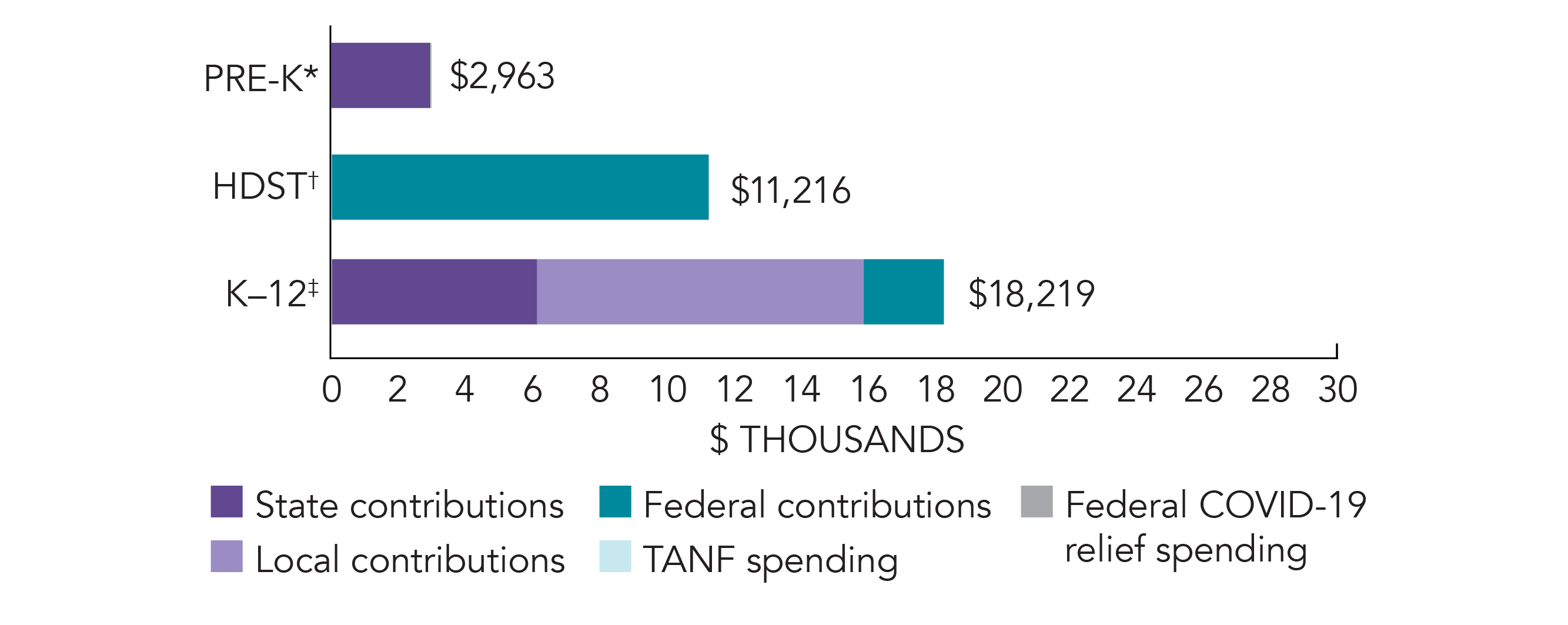
*Pre-K programs may receive additional funds from federal or local sources that are not included in this figure. †Head Start per-child spending includes funding only for 3- and 4-year-olds. ‡K–12 expenditures include capital spending as well as current operating expenditures.
Florida Quality Standards Checklist
| Policy | Requirement | Benchmark | Meets Benchmark? |
|---|---|---|---|
For more information about the benchmarks, see the Executive Summary and the Roadmap to State pages. | 5benchmarks met | ||
| Early Learning & Development Standards Benchmark | Comprehensive, aligned, supported, culturally sensitive | Comprehensive, aligned, supported, culturally sensitive | |
| Curriculum Supports Benchmark | Approval process & supports | Approval process & supports | |
| Teacher Degree Benchmark | BA (summer); CDA or equivalent + specified training (school year) | BA | |
| Teacher Specialized Training Benchmark | ECE, Elem. Ed., Other (summer); CDA (school year) | Specializing in pre-K | |
| Assistant Teacher Degree Benchmark | None | CDA or equivalent | |
| Staff Professional Development Benchmark | 15 hours in 1st year, 5 hours/5 years after 1st year (teachers only); PD plans (teachers & assistants on probation) | For teachers & assistants: At least 15 hours/year; individual PD plans; coaching | |
| Maximum Class Size Benchmark | 12 (summer); 20 (school year) | 20 or lower | |
| Staff to Child Ratio Benchmark | 1:12 (summer); 1:11 or 2:12-20 (school-year) | 1:10 or better | |
| Screening & Referral Benchmark | Vision, hearing, health & more | Vision, hearing & health screenings; & referral | |
| Continuous Quality Improvement System Benchmark | Structured classroom observations; Data used for program improvement | Structured classroom observations; data used for program improvement | |