State of Preschool
District of Columbia
Access Rankings
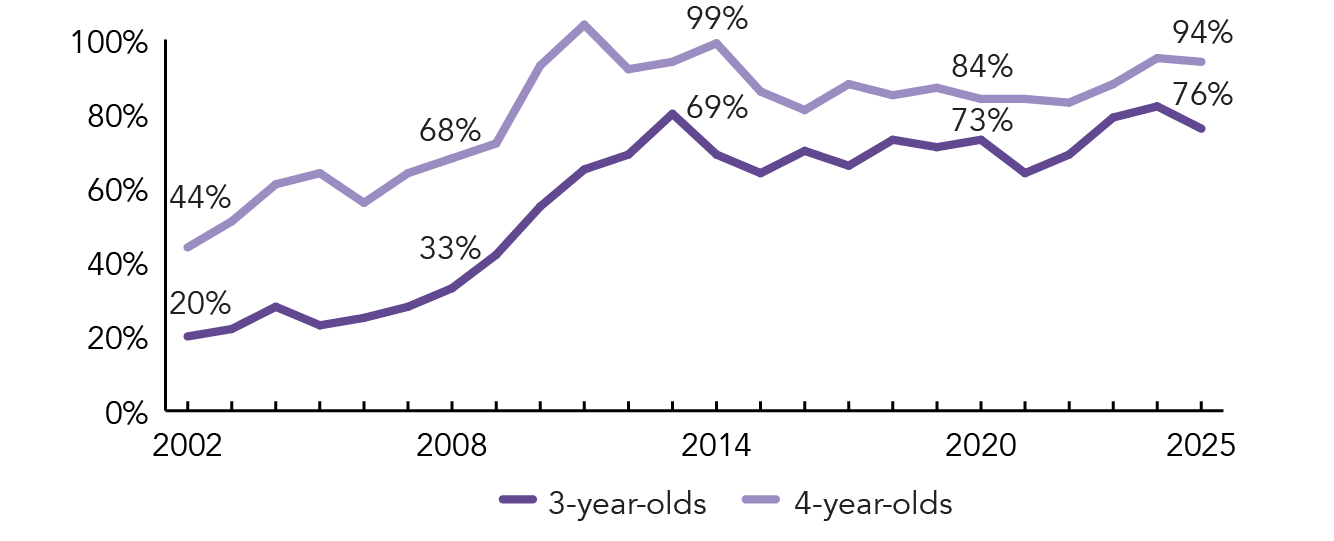
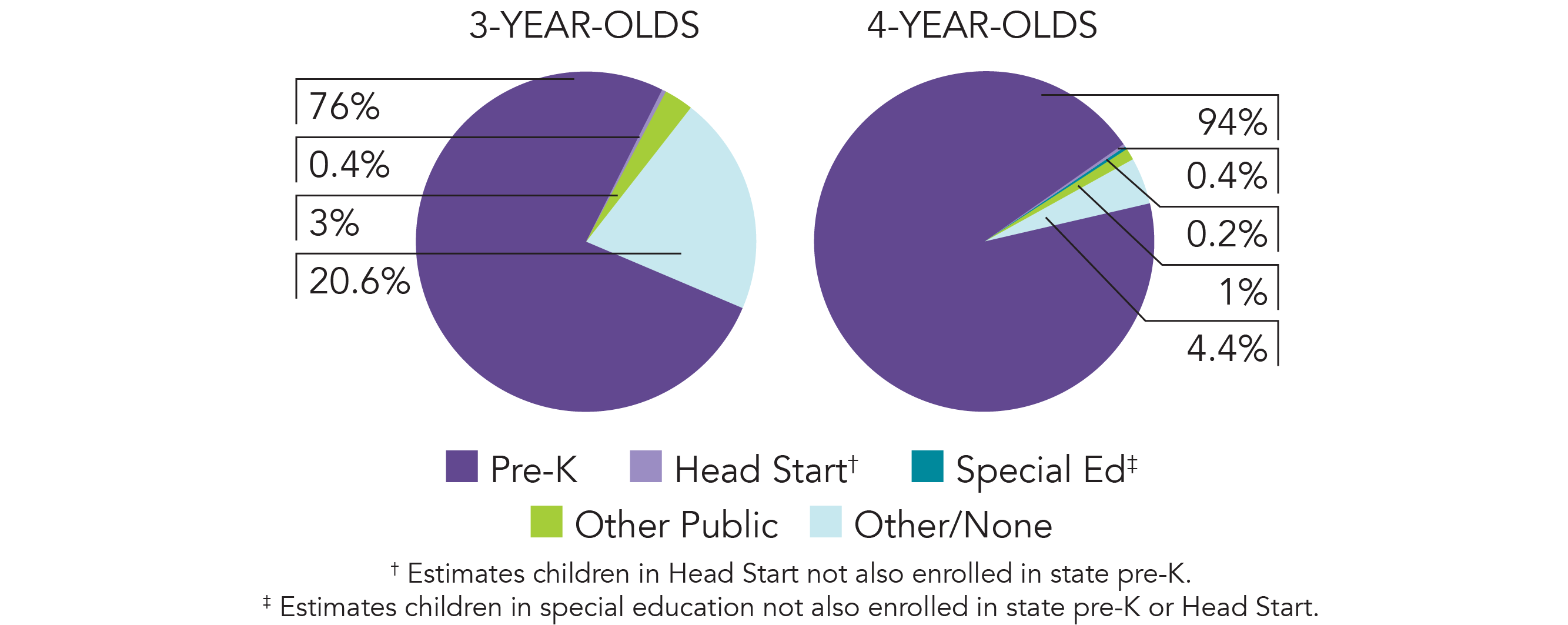
4-year-Olds
1
3-year-Olds
1
Resource Rankings
State spending
1
All reported spending
1
Total Benchmarks Met
Of 10 benchmarks possible
4
Overview
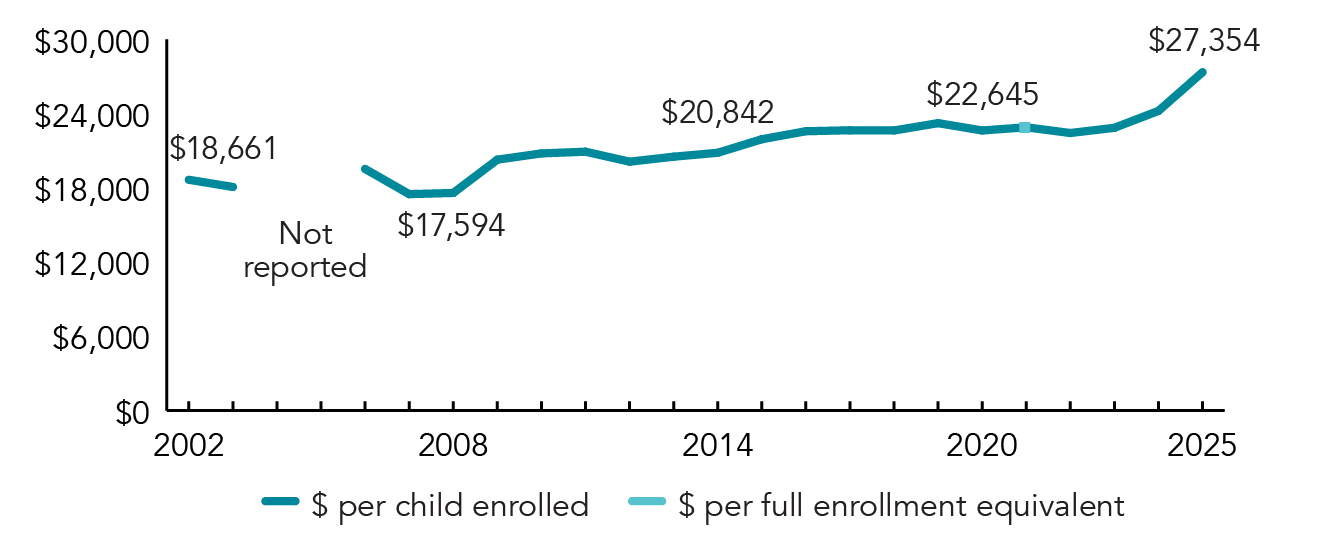
During the 2024-2025 school year, the District of Columbia preschool enrolled 13,040 children, a slight decrease of 179 from the prior year. Spending totaled $356,697,970, up $36,444,483 (11%), adjusted for inflation, since last year. Spending per child equaled $27,354 in 2024-2025, up $3,127 from 2023-2024, adjusted for inflation. The District of Columbia met 4 of 10 quality standards benchmarks.
What's New
Despite navigating an unprecedented period of fiscal challenges due to Congressional budget actions and reductions to the federal workforce, the District of Columbia continues to prioritize the needs of young children. In addition to investing over $350 million in the Universal Pre-K Program, the District continues to invest in the Early Childhood Educator Pay Equity Fund. This initiative increases wages of educators in licensed child development facilities.
Background
Among the first in the nation to invest in early education, the District has offered pre-K since the 1960s. The District began to bolster its investment in pre-K significantly through the Pre-K Enhancement and Expansion (PKEEP) Amendment Act of 2008 (Pre-K Act). The Pre-K Act provides public, quality, universally accessible pre-K via a mixed-delivery system in the District of Columbia Public Schools (DCPS), Public Charter Schools (PCS), and publicly-funded Community Based Organizations (CBOs) that participate in PKEEP. The Office of the State Superintendent of Education (OSSE) oversees the District’s Universal Pre-K Program, including programs in DCPS and CBOs. PCSs are authorized and monitored by the DC Public Charter School Board (PCSB). Additionally, the District’s Head Start
and Early Head Start grantees serve thousands of children and their families; all District Head Start grantees also participate in the universal pre-K system, but may also serve children not eligible for public pre-K.
Pre-K programs operate a minimum of 6.5 hours per day, five days a week, 180 instructional days per year. Given the high availability and participation, this program can be considered universal. Funding for public pre-K programs is based on the Uniform Per Student Funding Formula.
Program quality is measured using the CLASS Pre-K, which informs a school rating that is included on each school’s DC School Report Card. The PCSB also uses CLASS Pre-K in its Performance Management Framework, which provides all PCS with an annual score. For CBOs, CLASS Pre-K assessments are used for Capital Quality, the District’s QRIS. In the 2024-2025 school year, CLASS observations were conducted in 977 pre-K classrooms. CLASS scores continued to show strong results in the Emotional Support and Classroom Organization domains, and more opportunity for growth in the Instructional Support domain. CLASS scores across all domains remain higher since the 2017-2018 school year, demonstrating a trend of improvement over time. While domain-level average CLASS scores varied across the pre-K sector, DCPS, PCS, PKEEP CBOs, and Child Development Facilities all had programs that were providing high-
quality early learning experiences for children.
District of Columbia Universal Pre-K
Access
| |
| Total state pre-K enrollment | 13,040 |
| School districts that offer state program | 100% (wards) |
| Income requirement | No income requirement |
| Minimum hours of operation | 6.5 hours/day; 5 days/week |
| Operating schedule | School or academic year |
| Special education enrollment, ages 3 and 4 | 1,797 |
| Federally funded Head Start enrollment, ages 3 and 4 | 376 |
| State-funded Head Start enrollment, ages 3 and 4 | 0 |
Resources
| Total state pre-K spending | $356,697,970 |
| Local match required? | No |
| State Head Start spending | $0 |
| State spending per child enrolled | $27,354 |
| All reported spending per child enrolled* | $27,354 |
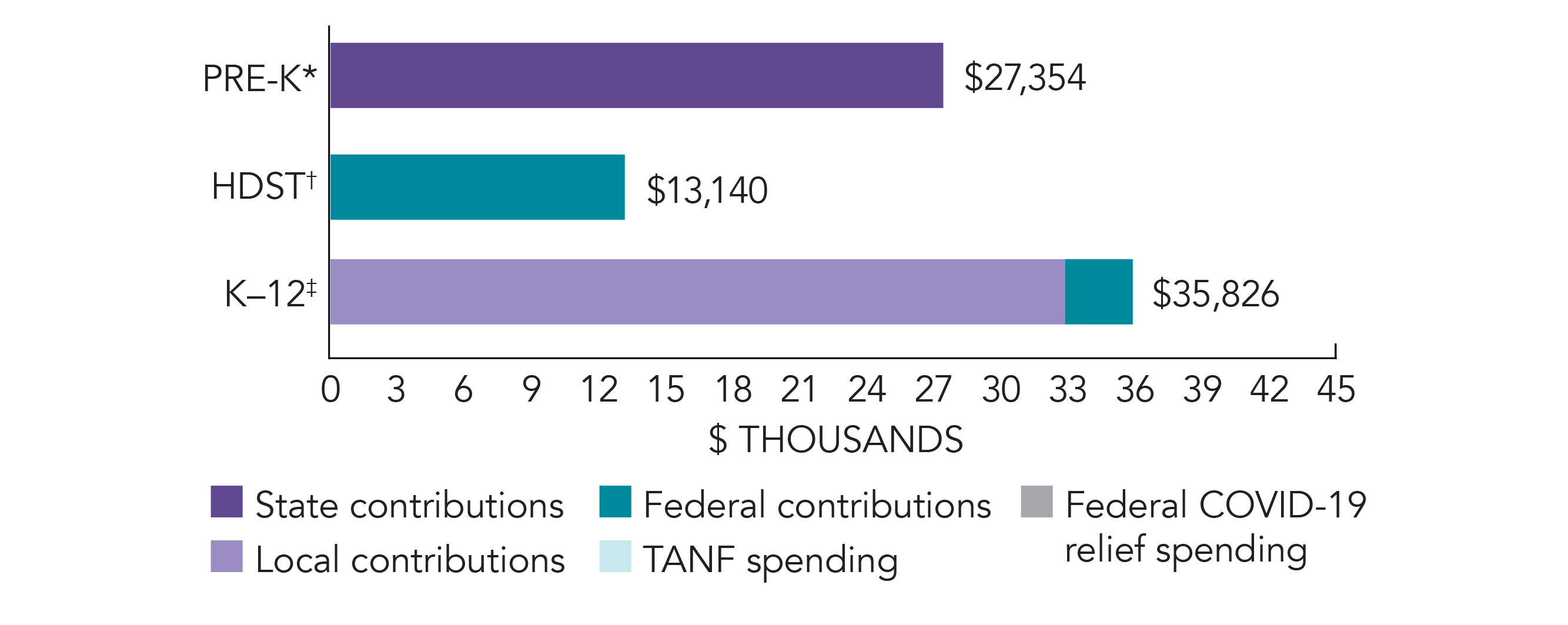
*Pre-K programs may receive additional funds from federal or local sources that are not included in this figure. †Head Start per-child spending includes funding only for 3- and 4-year-olds. ‡K–12 expenditures include capital spending as well as current operating expenditures.
District of Columbia Quality Standards Checklist
| Policy | Requirement | Benchmark | Meets Benchmark? |
|---|---|---|---|
For more information about the benchmarks, see the Executive Summary and the Roadmap to State pages. | 4benchmarks met | ||
| Early Learning & Development Standards Benchmark | Comprehensive, aligned, supported, culturally sensitive | Comprehensive, aligned, supported, culturally sensitive | |
| Curriculum Supports Benchmark | Approval process & supports | Approval process & supports | |
| Teacher Degree Benchmark | BA (DCPS & CBO); Determined locally (PCS) | BA | |
| Teacher Specialized Training Benchmark | ECE, CD, Elem. Ed., (DCPS); ECE or related field (CBO); Determined locally (PCS) | Specializing in pre-K | |
| Assistant Teacher Degree Benchmark | AA or Paraprofessional Certification (DCPS); AA (CBO); Determined locally (PCS) | CDA or equivalent | |
| Staff Professional Development Benchmark | 57 hours/year (DCPS); 21 hours/year (CBO); PD plans (Head Start teachers & CBO teachers & assistants); Coaching (DCPS) | For teachers & assistants: At least 15 hours/year; individual PD plans; coaching | |
| Maximum Class Size Benchmark | DCPS & CBO only: 16 (3-year-olds); 20 (4-year-olds) | 20 or lower | |
| Staff to Child Ratio Benchmark | DCPS & CBO only: 1:8 (3-year-olds); 1:10 (4-year-olds) | 1:10 or better | |
| Screening & Referral Benchmark | Vision, hearing, health & more | Vision, hearing & health screenings; & referral | |
| Continuous Quality Improvement System Benchmark | Structured classroom observations; Data used for program improvement | Structured classroom observations; data used for program improvement | |