State of Preschool
Connecticut
Access Rankings
4-year-Olds
37
3-year-Olds
12
Resource Rankings
State spending
9
All reported spending
20
Total Benchmarks Met
Of 10 benchmarks possible
5.1
Overview
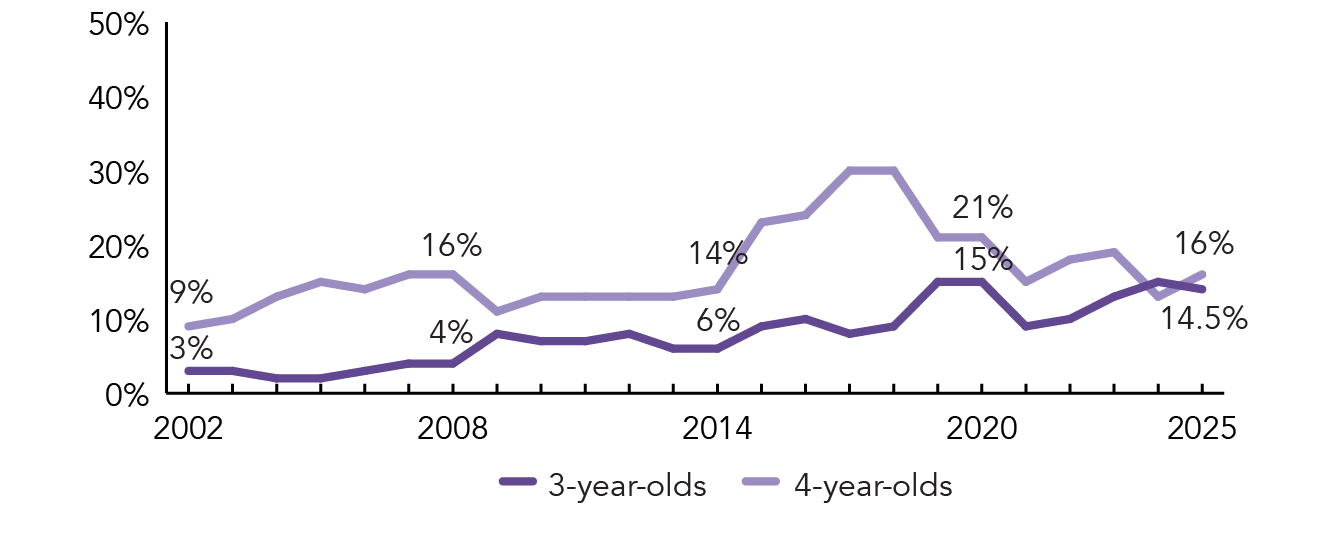
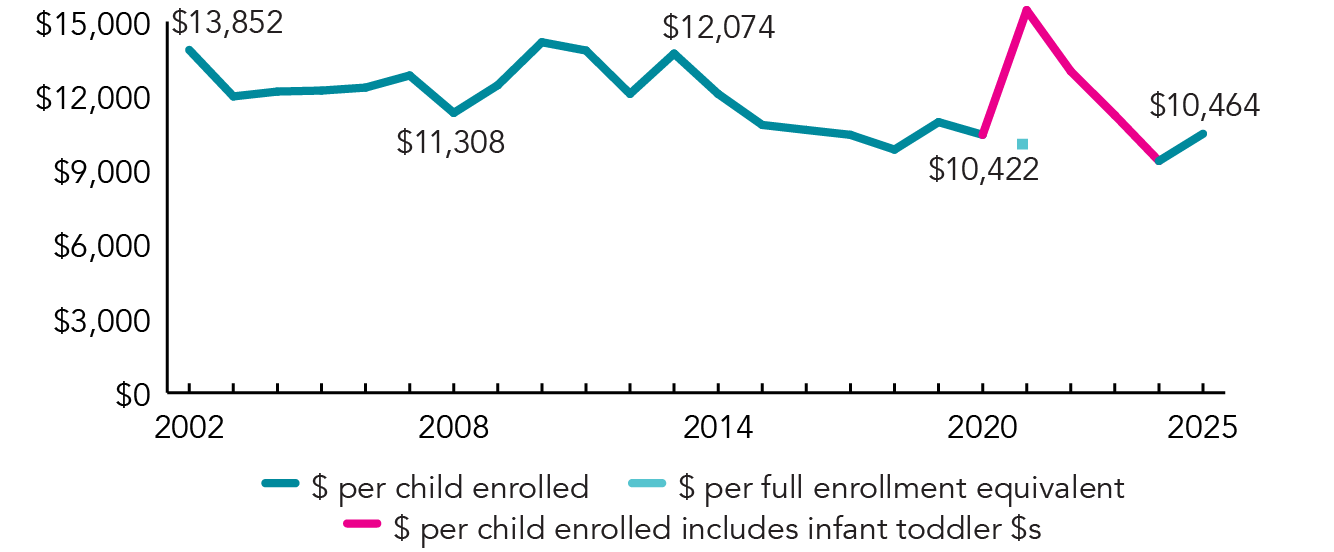
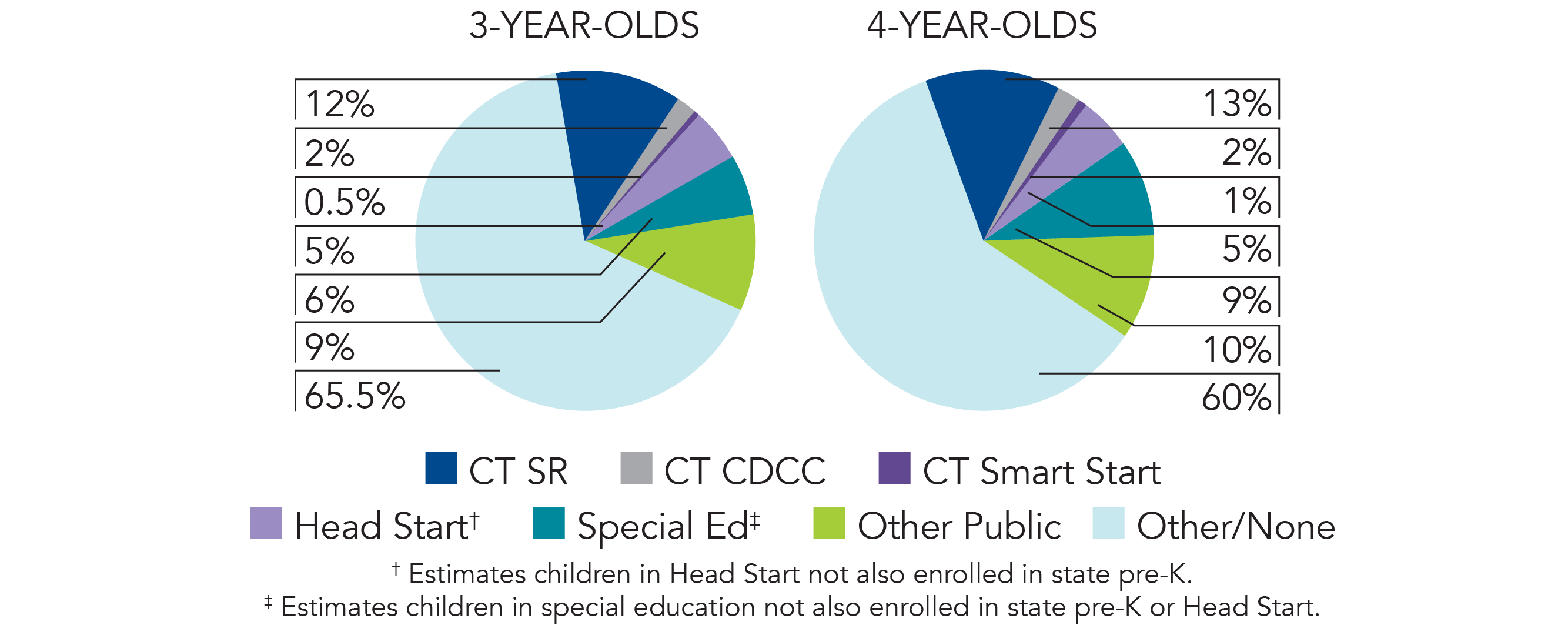
During the 2024-2025 school year, Connecticut preschool enrolled 12,724 children, an increase of 391 from the prior year. State spending totaled $133,143,028, up $17,646,563 (15%), adjusted for inflation, since last year. State spending per child equaled $10,464 in 2024-2025, up $1,099 from 2023-2024, adjusted for inflation. Connecticut met an average of 5.1 of 10 quality standards benchmarks. The pink colored line on the spending per child enrolled figure reflects the years in which spending reported for the CDCC program included infant and toddler slots.
What's New
Early Start CT launched in July 2025 combining previous separate programs, School Readiness, Child Day Care Contracts, and State Head Start Supplement, into one funding system. In June 2025, the CT legislature also passed a historic investment in Early Childhood funding with the passage of the Early Childhood Education Endowment. The Governor set up an endowment to fund early childhood education that will grow over time. There are milestones, rules, and an advisory board to guide how the funds will be used. Starting in July 2025, the endowment will provide the first year of funding, up to $36 million, to support the early care system for CT. Funding from the endowment in year 1 will increase access to families with an additional 1,000 spaces funded through the Endowment to expand Early Start CT. This funding will provide a rate payment increase to providers and create additional spaces. Each year, the Endowment funds will add spaces. In July of 2027, the Endowment will provide free family fees for families participating in Early Start CT and making less than $100,000 a year, and low-cost family fees for families making up $150,000.
Background
Connecticut serves prekindergarten children in three state-funded programs: School Readiness Program (SR), Child Day Care Contracts (CDCC), and Smart Start, all supervised by the Office of Early Childhood (OEC). Non-Head Start SR, CDCC, and Smart Start programs have three years to become NAEYC accredited. Programs not NAEYC accredited or Head Start approved are required to have annual Early Childhood Environment Rating Scale (ECERS) ratings by state-approved raters to help prepare them for accreditation.
Connecticut has provided funding for CDCC for over 40 years through a purchase-of-service contracting system. The services provided through the CDCC are supported through state funds and must operate for at least 10 hours per day. Eligibility requirements target children with household incomes below 75% SMI for state funding CDCC programs, which must be licensed as a child care facility by the state, may operate under the contract held by an elementary or secondary school, nursery school, preschool, day care center, group child care home, family child care home, family resource center, Head Start program, or local or regional board of education.
School Readiness was founded in 1997 to expand access to early childhood programs for 3- and 4-year-olds. Financial support is available to 21 Priority School Readiness districts, as defined by legislation, and 46 Competitive School Readiness municipalities that have at least one school in which 40% or more of children are eligible for free or reduced-price lunch or fall within the 50 lowest wealth-ranked towns in the state. Any family can apply for School Readiness spaces in designated Priority or Competitive municipalities; however, 60% of children enrolled in each municipality must meet the income guideline of at-or-below 75% of the SMI.
Smart Start was created during the 2014 legislative session to expand publicly funded preschool in public school settings. Funding is distributed to local or regional boards of education through a competitive grant process.
-
Access

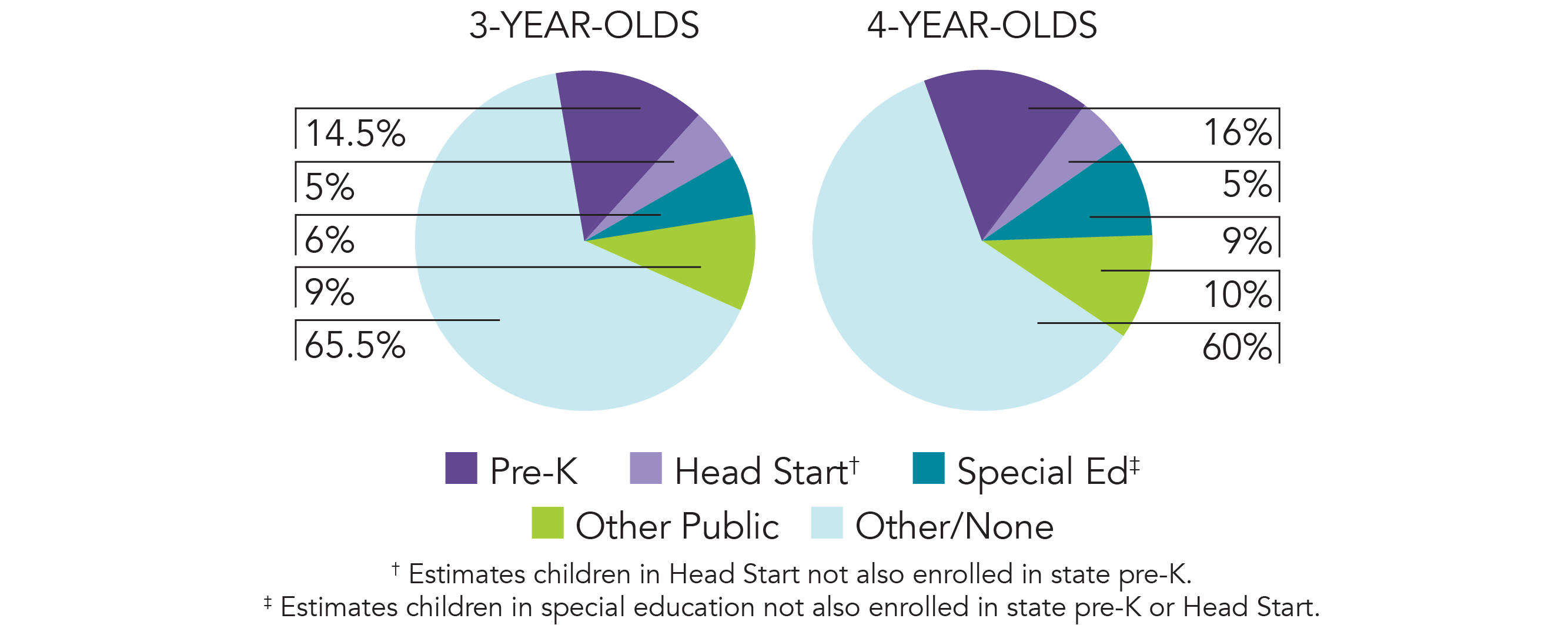
Total state pre-K enrollment 12,724 Special education enrollment, ages 3 and 4 7,423 Federally funded Head Start enrollment, ages 3 and 4 3,443 State-funded Head Start enrollment, ages 3 and 4 545 Resources
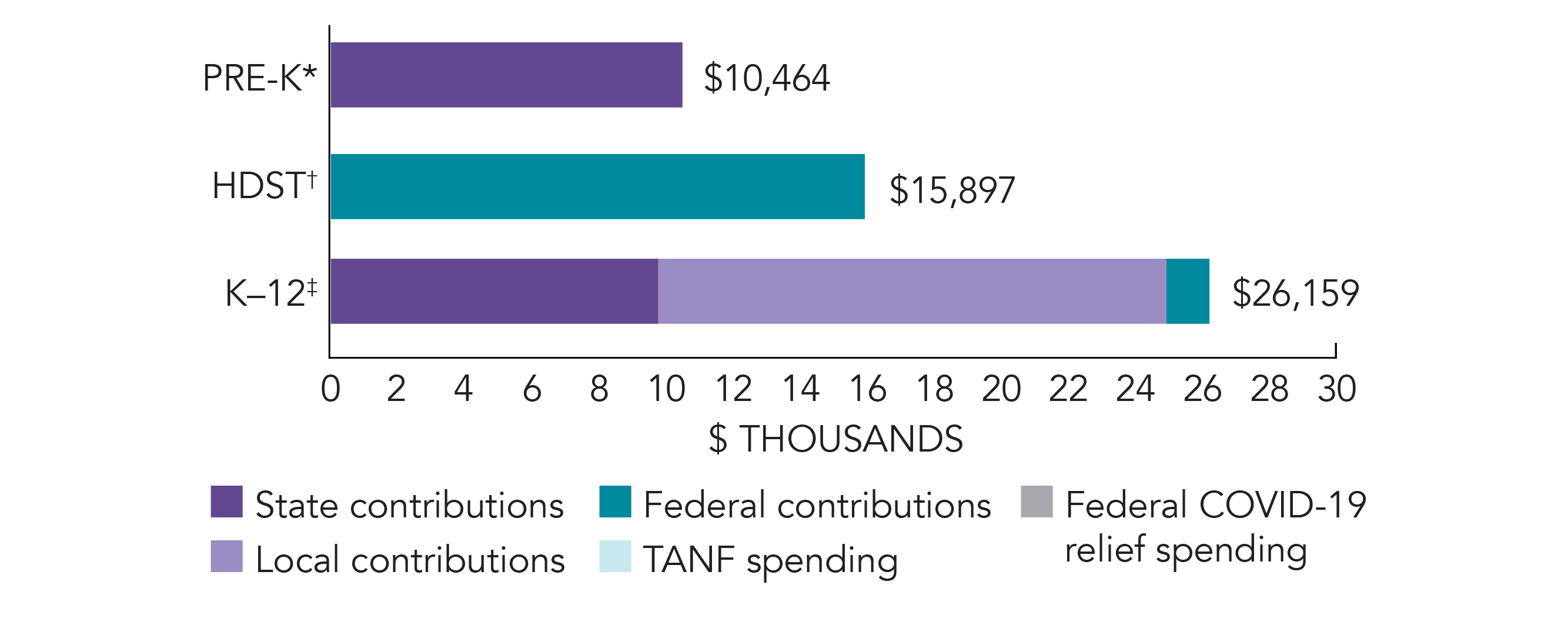
Total state pre-K spending $133,143,028 State Head Start spending $5,083,238 State spending per child enrolled $10,464 All reported spending per child enrolled* $10,464 
*Pre-K programs may receive additional funds from federal or local sources that are not included in this figure. †Head Start per-child spending includes funding only for 3- and 4-year-olds. ‡K–12 expenditures include capital spending as well as current operating expenditures.
-
Access

Total state pre-K enrollment 1,644 School districts that offer state program 28% (towns/communities) Income requirement 75% SMI (60% families) Minimum hours of operation 10 hours/day; 5 days/week Operating schedule Full calendar year Resources
Total state pre-K spending $17,064,040 Local match required? No State spending per child enrolled $10,380 All reported spending per child enrolled* $10,380 
*Pre-K programs may receive additional funds from federal or local sources that are not included in this figure. †Head Start per-child spending includes funding only for 3- and 4-year-olds. ‡K–12 expenditures include capital spending as well as current operating expenditures.
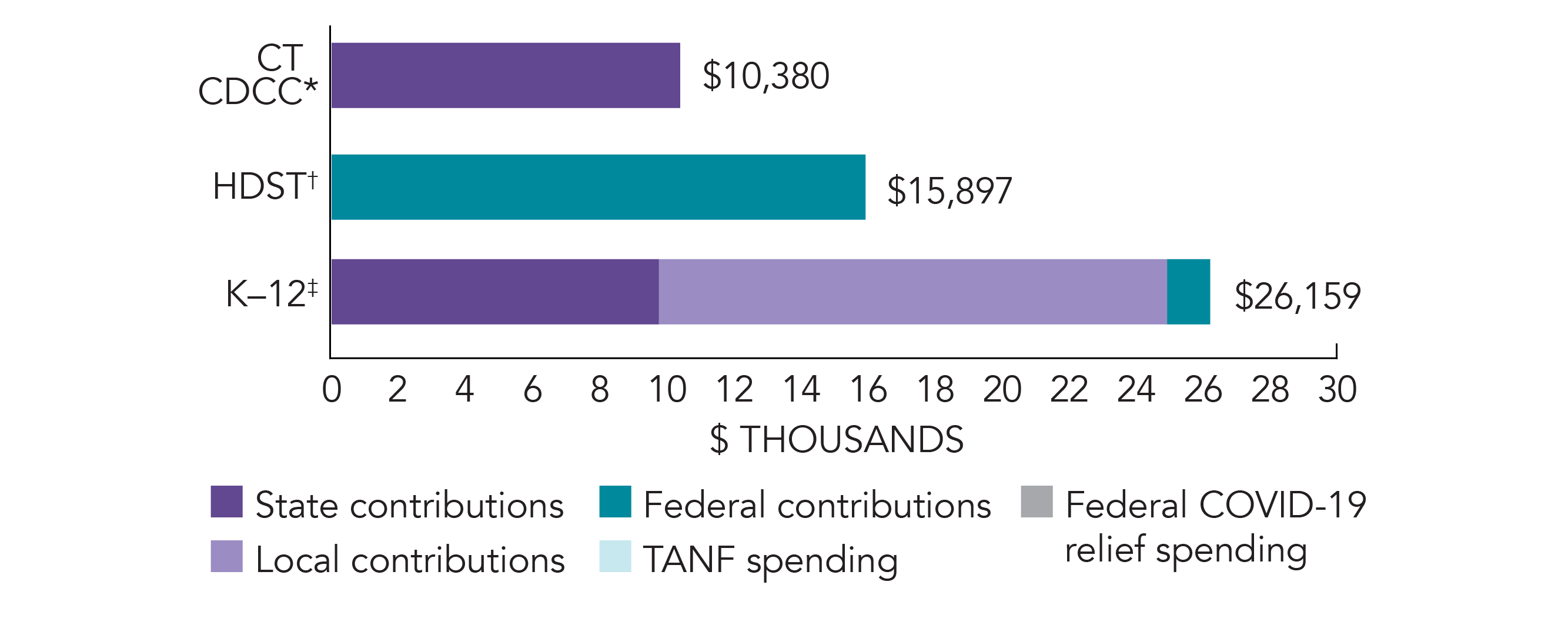
Connecticut Child Day Care Contracts (CDCC) Quality Standards Checklist
| Policy | CT CDCC Requirement | Benchmark | Meets Benchmark? |
|---|---|---|---|
For more information about the benchmarks, see the Executive Summary and the Roadmap to State pages. | 5benchmarks met | ||
| Early Learning & Development Standards Benchmark | Comprehensive, aligned, supported, culturally sensitive | Comprehensive, aligned, supported, culturally sensitive | |
| Curriculum Supports Benchmark | Approval process & supports | Approval process & supports | |
| Teacher Degree Benchmark | AA in ECE (at least 50% of teachers); CDA plus 12 ECE credits (other teachers) | BA | |
| Teacher Specialized Training Benchmark | AA in ECE (at least 50% of teachers); CDA plus 12 ECE credits (other teachers) | Specializing in pre-K | |
| Assistant Teacher Degree Benchmark | No minimum education degree | CDA or equivalent | |
| Staff Professional Development Benchmark | PD: 1% of total work hours; PD plans (some teachers) | For teachers & assistants: At least 15 hours/year; individual PD plans; coaching | |
| Maximum Class Size Benchmark | 20 (3- & 4-year-olds) | 20 or lower | |
| Staff to Child Ratio Benchmark | 1:10 (3- & 4-year-olds) | 1:10 or better | |
| Screening & Referral Benchmark | Vision, hearing, health & more; Referrals not required | Vision, hearing & health screenings; & referral | |
| Continuous Quality Improvement System Benchmark | Structured classroom observations (per Head Start and NAEYC accreditation requirements); Data used for program improvement | Structured classroom observations; data used for program improvement | |
-
Access
Total state pre-K enrollment 10,440 School districts that offer state program 40% (towns/communities) Income requirement 75% SMI (60% families) Minimum hours of operation 2.5 hours/day; 5 days/week Operating schedule Determined locally Resources
Total state pre-K spending $112,829,449 Local match required? No State spending per child enrolled $10,807 All reported spending per child enrolled* $10,807 
*Pre-K programs may receive additional funds from federal or local sources that are not included in this figure. †Head Start per-child spending includes funding only for 3- and 4-year-olds. ‡K–12 expenditures include capital spending as well as current operating expenditures.
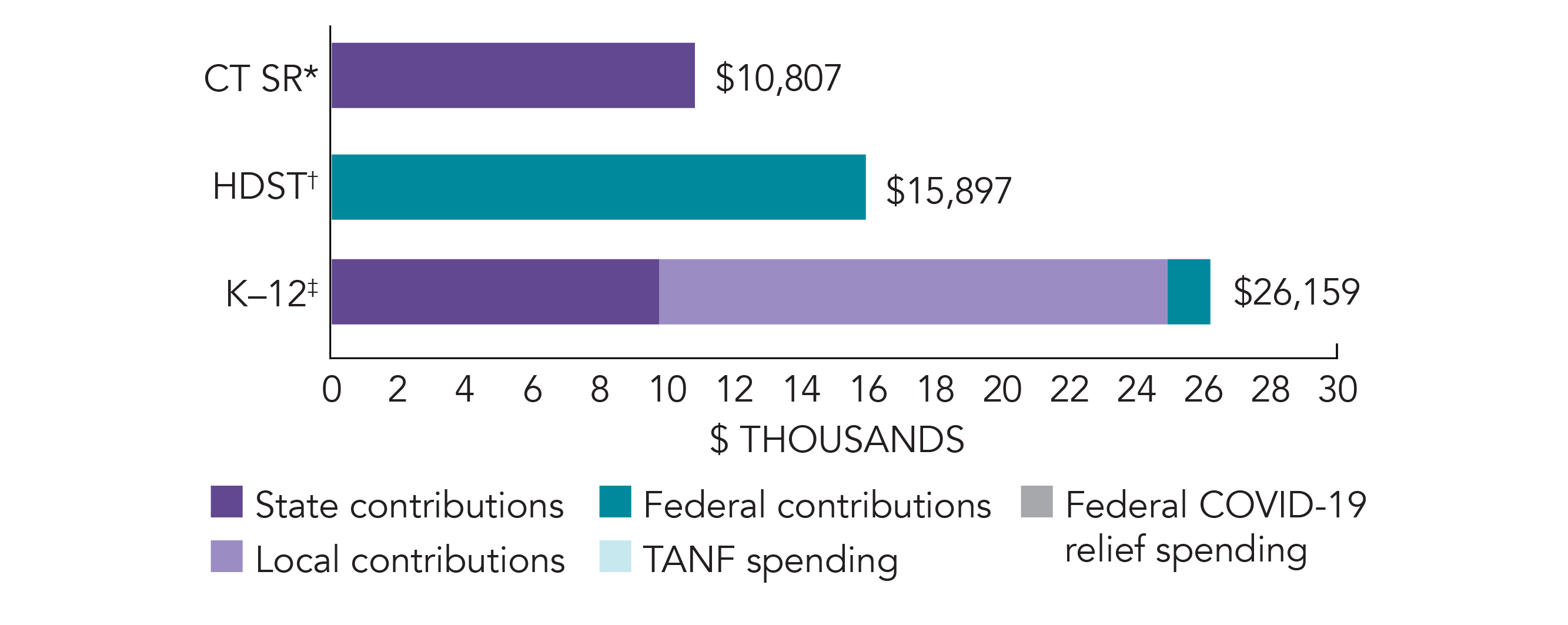
Connecticut School Readiness (SR) Quality Standards Checklist
| Policy | CT SR Requirement | Benchmark | Meets Benchmark? |
|---|---|---|---|
For more information about the benchmarks, see the Executive Summary and the Roadmap to State pages. | 5benchmarks met | ||
| Early Learning & Development Standards Benchmark | Comprehensive, aligned, supported, culturally sensitive | Comprehensive, aligned, supported, culturally sensitive | |
| Curriculum Supports Benchmark | Approval process & supports | Approval process & supports | |
| Teacher Degree Benchmark | AA in ECE (at least 50% of teachers); CDA plus 12 ECE credits (other teachers) | BA | |
| Teacher Specialized Training Benchmark | AA in ECE (at least 50% of teachers); CDA plus 12 ECE credits (other teachers) | Specializing in pre-K | |
| Assistant Teacher Degree Benchmark | No minimum education degree | CDA or equivalent | |
| Staff Professional Development Benchmark | PD: 1% of total work hours; PD plans (some teachers) | For teachers & assistants: At least 15 hours/year; individual PD plans; coaching | |
| Maximum Class Size Benchmark | 20 (3- & 4-year-olds) | 20 or lower | |
| Staff to Child Ratio Benchmark | 1:10 (3- & 4-year-olds) | 1:10 or better | |
| Screening & Referral Benchmark | Vision, hearing, health & more; Referrals not required | Vision, hearing & health screenings; & referral | |
| Continuous Quality Improvement System Benchmark | Structured classroom observations (per Head Start and NAEYC accreditation requirements); Data used for program improvement | Structured classroom observations; data used for program improvement | |
-
Access
Total state pre-K enrollment 640 School districts that offer state program 14% (towns/communities) Income requirement 75% SMI (60% of families) Minimum hours of operation 6 hours/day; 5 days/week Operating schedule School or academic year Resources
Total state pre-K spending $3,249,539 Local match required? No State spending per child enrolled $5,077 All reported spending per child enrolled* $5,077 
*Pre-K programs may receive additional funds from federal or local sources that are not included in this figure. †Head Start per-child spending includes funding only for 3- and 4-year-olds. ‡K–12 expenditures include capital spending as well as current operating expenditures.
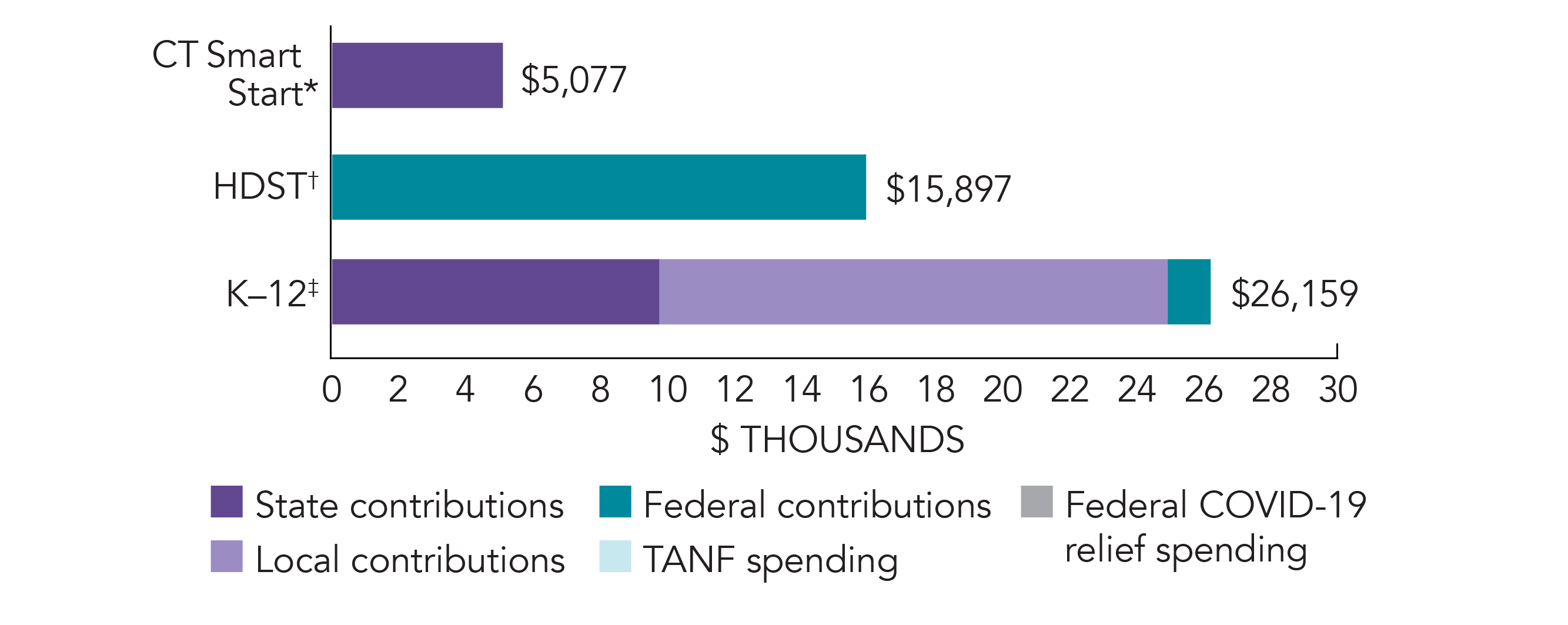
Connecticut Smart Start Quality Standards Checklist
| Policy | CT Smart Start Requirement | Benchmark | Meets Benchmark? |
|---|---|---|---|
For more information about the benchmarks, see the Executive Summary and the Roadmap to State pages. | 6benchmarks met | ||
| Early Learning & Development Standards Benchmark | Comprehensive, aligned, supported, culturally sensitive | Comprehensive, aligned, supported, culturally sensitive | |
| Curriculum Supports Benchmark | Approval process & supports | Approval process & supports | |
| Teacher Degree Benchmark | BA | BA | |
| Teacher Specialized Training Benchmark | ECE, ECE SpEd | Specializing in pre-K | |
| Assistant Teacher Degree Benchmark | HSD | CDA or equivalent | |
| Staff Professional Development Benchmark | PD plans (teachers only) | For teachers & assistants: At least 15 hours/year; individual PD plans; coaching | |
| Maximum Class Size Benchmark | 18 (3- & 4-year-olds) | 20 or lower | |
| Staff to Child Ratio Benchmark | 1:9 (3- & 4-year-olds) | 1:10 or better | |
| Screening & Referral Benchmark | Vision, hearing, health & more; Referrals not required | Vision, hearing & health screenings; & referral | |
| Continuous Quality Improvement System Benchmark | Structured classroom observations (per Head Start and NAEYC accreditation requirements); Data used for program improvement | Structured classroom observations; data used for program improvement | |