State of Preschool
Colorado
Access Rankings
4-year-Olds
3
3-year-Olds
5
Resource Rankings
State spending
29
All reported spending
37
Total Benchmarks Met
Of 10 benchmarks possible
2
Overview
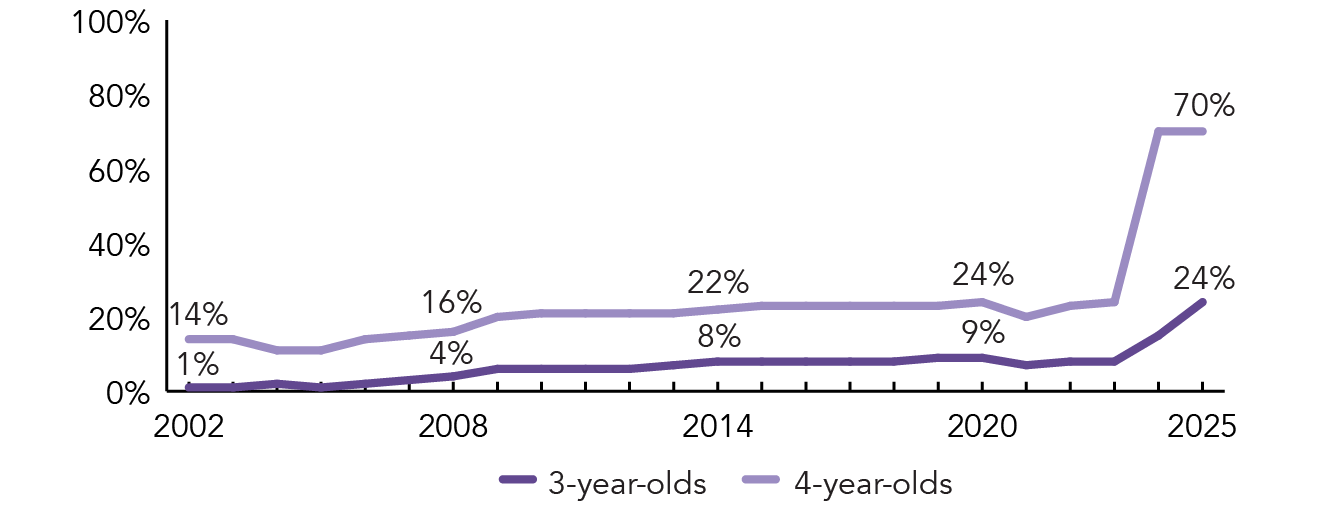
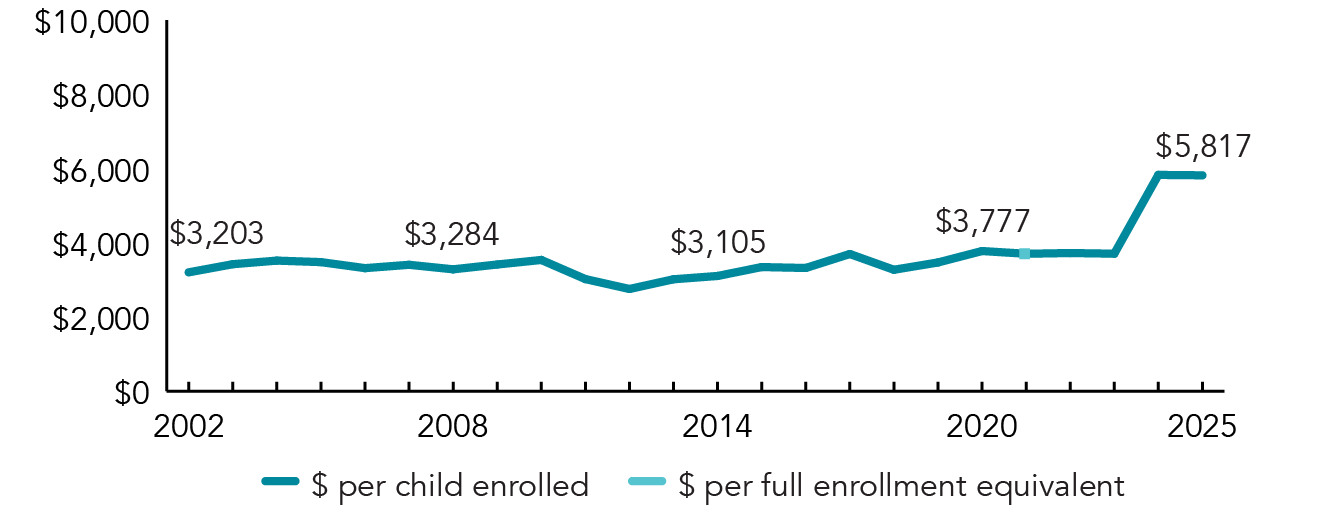
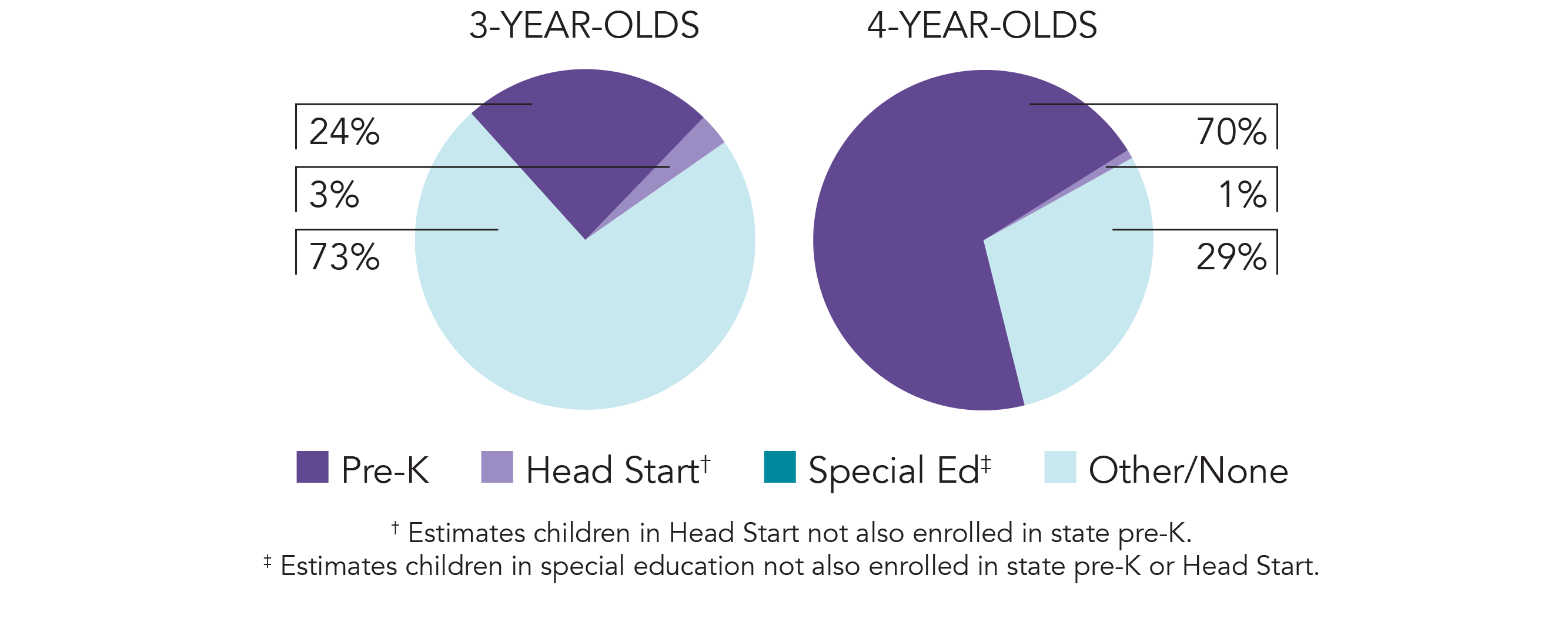
During the 2024-2025 school year, Colorado preschool enrolled 58,107 children, an increase of 5,490 from the prior year. State spending totaled $338,023,799, up $31,380,217 (10%), adjusted for inflation, since last year. State spending per child equaled $5,817 in 2024-2025, down $11 from 2023-2024, adjusted for inflation. Colorado met 2 of 10 quality standards benchmarks but may meet additional benchmarks once their new program’s standards are fully in place.
What's New
The passage of Proposition EE in November 2020 and related laws (e.g., HB22-1295) in 2022 established the Colorado Department of Early Childhood (CDEC) and the Colorado Universal Preschool program. The new statewide universal preschool program launched July 1, 2023, at which time the Colorado Preschool Program sunsetted. The new Colorado Universal Preschool program is administered by the CDEC using a mixed delivery model, and in collaboration with Local Coordinating Organizations rather than local school districts. It is funded primarily by a nicotine and tobacco tax. The Colorado Department of Education continues to administer federal and state funding for special education in accordance with IDEA and Exceptional Children’s Educational Act (ECEA) for children ages three through five.
The CDEC’s Universal Preschool Program Resource Bank was launched in June 2025 which includes resources related to instructional practices (e.g., curricula), family and community engagement, and healthy development.
Background
The Colorado Preschool Program (CPP) launched in 1988 for 4-year-olds who needed language development support. It became a permanent program in 1992 and expanded eligibility to young children lacking overall school readiness due to family risk factors. The 2022-2023 school year was the last year of CPP.
The Colorado Universal Preschool program began operating in the 2023-2024 school year and is administered by the new CDEC. The new program uses a mixed delivery model where funding goes directly to providers based on enrollment and services provided. Families can choose a licensed community-based program, a school-based program, or a licensed home-based provider. All four- year-olds in the state are eligible to attend the program and receive up to 15 hours of preschool each week. Depending on available funding, families may qualify for 30 hours (full-day) for their 4-year-old if they are low-income and meet at least one qualifying factor that may impact their future academic achievement. Three-year-olds with a qualifying factor (including an IEP, low-income status, non-
English home language, in foster care, experiencing homelessness) can also attend the program for a minimum of 10 hours per week. The program is offered for a 10-month school year.
As of the second year of the Colorado Universal Preschool Program, CDEC is still developing several policies for the program which will be implemented over the next few years.
Colorado Universal Program
Access
| |
| Total state pre-K enrollment | 58,107 |
| School districts that offer state program | 100% (counties) |
| Income requirement | No income requirement (4-year-olds); 270% FPL (3-year-olds) |
| Minimum hours of operation | 10 hours/week |
| Operating schedule | School or academic year |
| Special education enrollment, ages 3 and 4 | 9,588 |
| Federally funded Head Start enrollment, ages 3 and 4 | 5,116 |
| State-funded Head Start enrollment, ages 3 and 4 | 0 |
Resources
| Total state pre-K spending | $388,023,799 |
| Local match required? | No |
| State Head Start spending | $0 |
| State spending per child enrolled | $5,817 |
| All reported spending per child enrolled* | $5,817 |
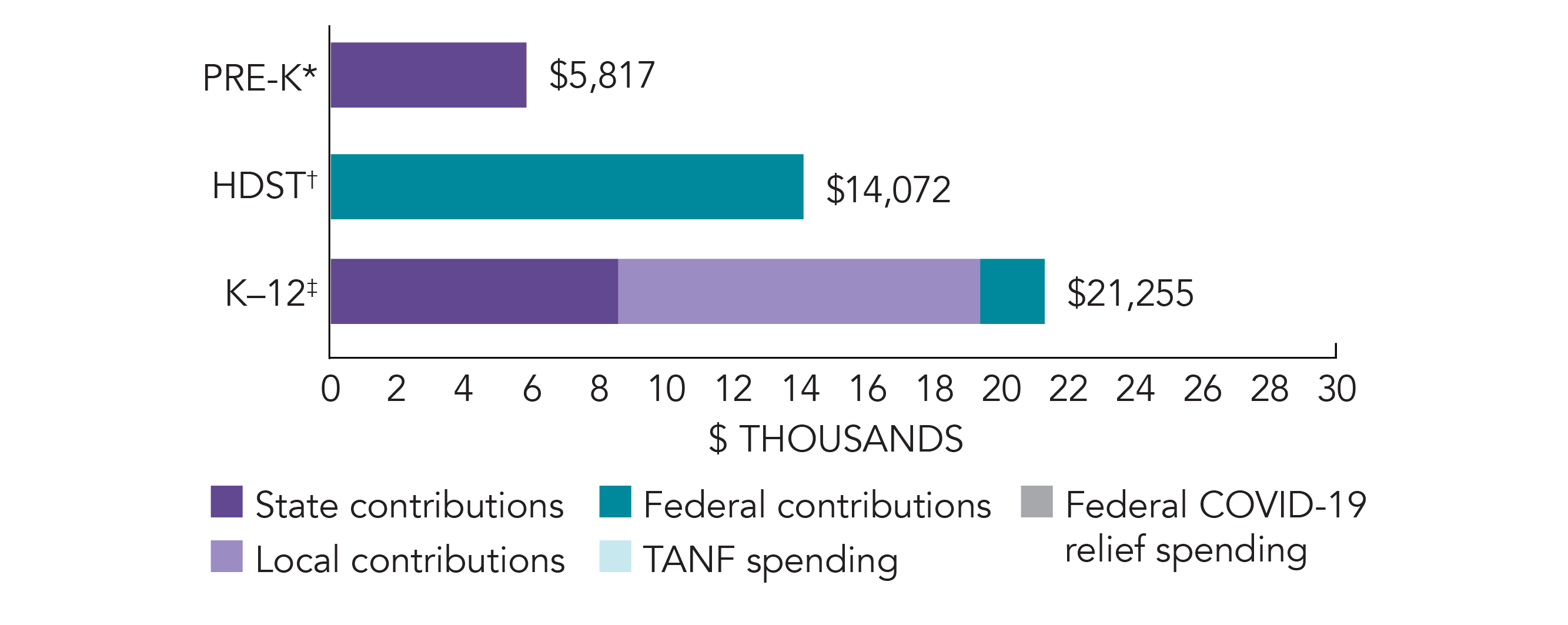
*Pre-K programs may receive additional funds from federal or local sources that are not included in this figure. †Head Start per-child spending includes funding only for 3- and 4-year-olds. ‡K–12 expenditures include capital spending as well as current operating expenditures.
Colorado Quality Standards Checklist
| Policy | Requirement | Benchmark | Meets Benchmark? |
|---|---|---|---|
For more information about the benchmarks, see the Executive Summary and the Roadmap to State pages. | 2benchmarks met | ||
| Early Learning & Development Standards Benchmark | Comprehensive, aligned, supported, culturally sensitive | Comprehensive, aligned, supported, culturally sensitive | |
| Curriculum Supports Benchmark | Approval process & supports | Approval process & supports | |
| Teacher Degree Benchmark | Other | BA | |
| Teacher Specialized Training Benchmark | Other | Specializing in pre-K | |
| Assistant Teacher Degree Benchmark | Other | CDA or equivalent | |
| Staff Professional Development Benchmark | 15 hours/year | For teachers & assistants: At least 15 hours/year; individual PD plans; coaching | |
| Maximum Class Size Benchmark | 20 (3-year-olds); 24 (4-year-olds) | 20 or lower | |
| Staff to Child Ratio Benchmark | 1:10 (3-year-olds); 1:12 (4-year-olds) | 1:10 or better | |
| Screening & Referral Benchmark | Immunizations & Full physical exam; Referrals recommended | Vision, hearing & health screenings; & referral | |
| Continuous Quality Improvement System Benchmark | Structured classroom observations per QRIS | Structured classroom observations; data used for program improvement | |