State of Preschool
California
Access Rankings
4-year-Olds
14
3-year-Olds
15
Resource Rankings
State spending
4
All reported spending
5
Total Benchmarks Met
Of 10 benchmarks possible
4.1
Overview
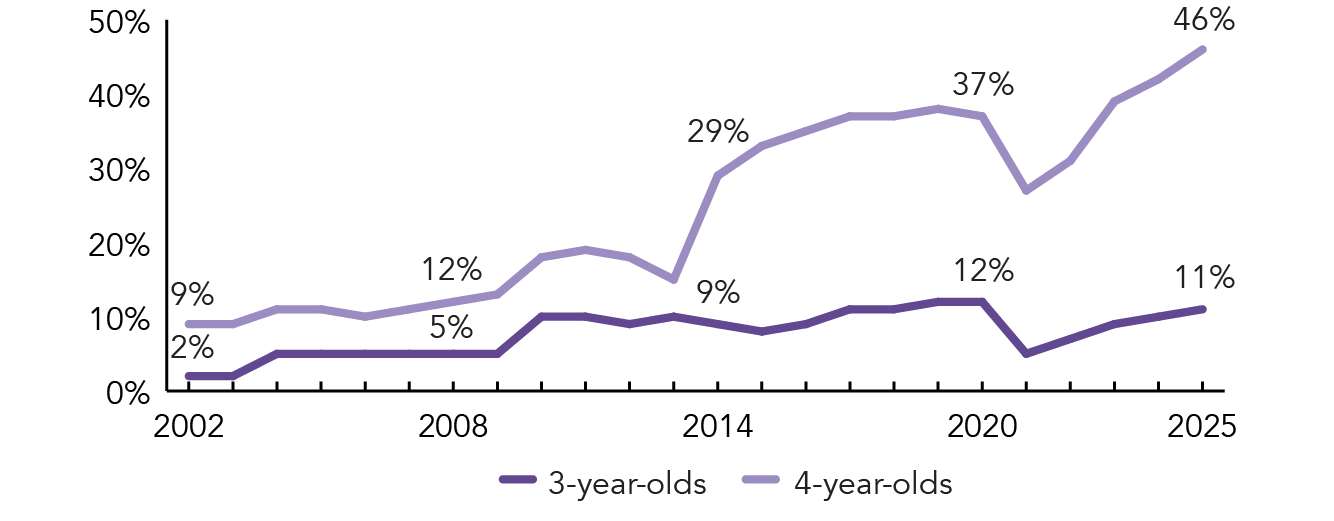
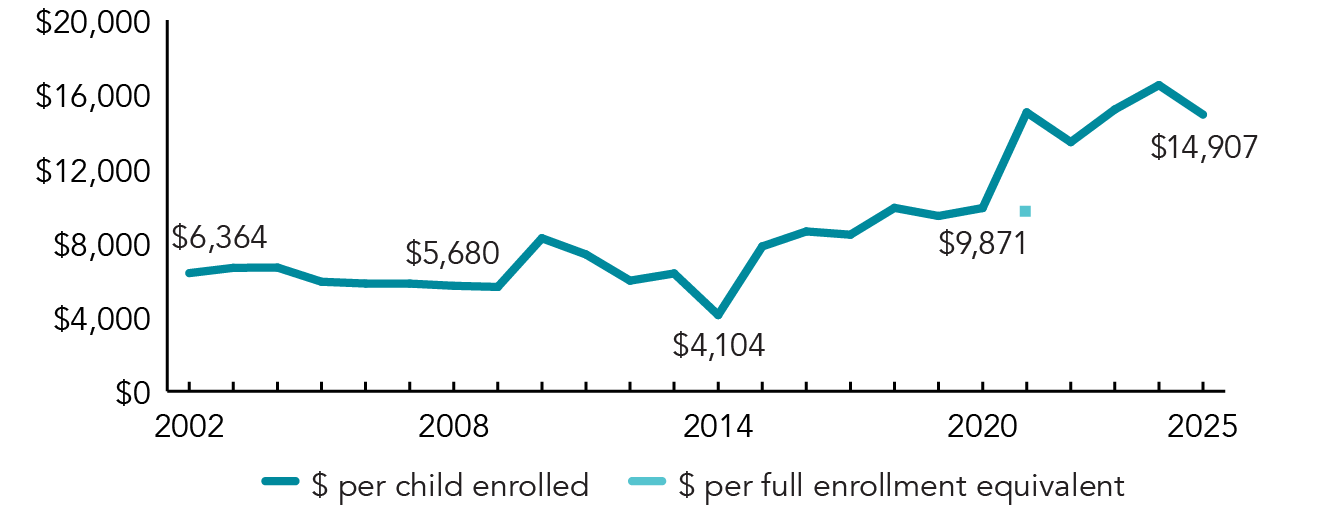
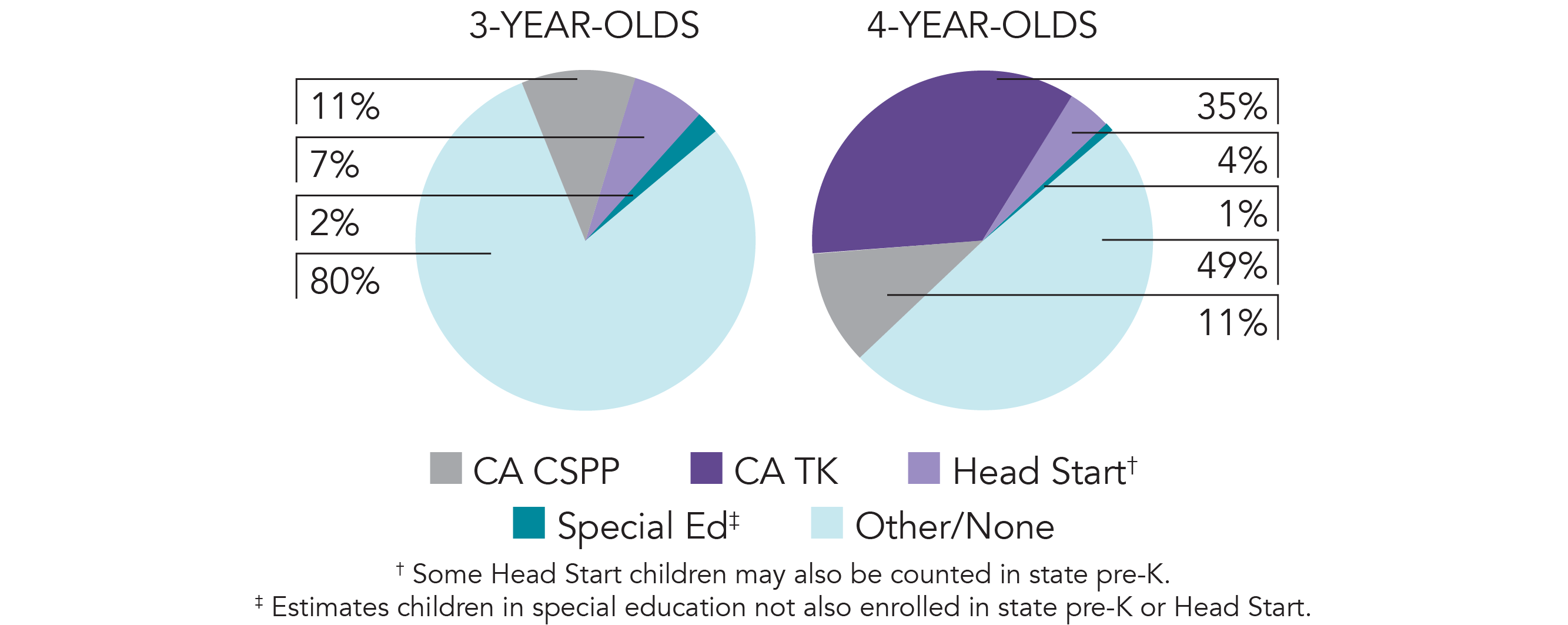
During the 2024-2025 school year, California Department of Education’s (CDE) two preschool programs, California State Preschool Program (CSPP) and Transitional Kindergarten (TK), together enrolled 278,273 children, an increase of 25,447 from the prior year. State spending for the two programs totaled $4,148,114,798, down $21,873,301 (1%), adjusted for inflation, since last year. State spending per child averaged $14,907 in 2024-2025, down $1,587 from 2023-2024, adjusted for inflation. In 2024-2025, state spending per child was $19,186 for CSPP and $12,480 for TK. The CSPP met 6 of 10 quality standards benchmarks, and TK met 3 of 10.
What's New
California’s FY 2026 budget included a total of $6.2 billion of early education funding: $2.9 billion for CSPP and $3.3 billion for Universal Transitional Kindergarten (UTK). CDE updated the Preschool Learning Foundations by creating the Preschool/Transitional Kindergarten Learning Foundations (PTKLF). The updated PTKLF includes a greater emphasis on diversity, equity, and inclusion. Beginning July 1, 2025, CSPP contractors are required to implement the PTKLF to guide curriculum and lesson planning.
Beginning January 1, 2024, all CSPP centers and represented family childcare providers received a cost of care plus rate once per month per child for children served who are enrolled in subsidized early learning and care. Beginning with the 2024-2025 school year, all CSPP contractors are required to implement the CLASS Second Edition Pre-K-3rd and CLASS Environment.
In 2024-2025, California was in the third year of ramping up its full implementation of universal TK, and the state in the FY 2026 budget will spend $2.1 billion to support the full implementation of UTK so that all children turning four years old by September 1 of the 2025-26 school year can enroll in TK. An additional $1.2 billion in the FY 2026 budget supported reducing the average child to teacher ratio from 12 to 10 children per 1 adult in TK classrooms during the 2025-26 school year. The maximum average TK class size remains 24 children.
In 2024-2025, local educational agencies (LEAs) continued to expend the $500 million in the Universal Prekindergarten Planning and Implementation Grant funds allocated in prior budget years to support planning and implementation costs to expand access to classroom-based prekindergarten programs at LEAs. The expenditure date of these grants has been extended to June 30, 2028.
Background
In 2008, the California State Preschool Program Act created the CSPP by consolidating several early childhood initiatives into one funding stream. CSPP provides part- and full-day preschool to 2-, 3-, and 4-year-old children. In addition to meeting eligibility requirements for CSPP (now 100% SMI), families are prioritized for full-day services if they have established at least one of the following: employment/seeking employment, education or vocational training, homelessness, or parental incapacity. CSPP awards funding through a competitive application process to school districts, private and faith-based agencies, Head Start programs, higher education institutions, counties, cities, and tribal organizations. Once deemed eligible, a family is eligible to remain in full-day CSPP for at least 24 months provided the child continues to meet age-eligibility requirements. A family is eligible for part-day CSPP services for the remainder of the current program year and the following program year, provided the child continues to meet age eligibility requirements. Teachers are required to have California Child Development Associate Teacher Permits and can receive grants for professional learning.
California TK began during the 2012-2013 school year when the kindergarten age eligibility shifted from December 2 to September 1. In June 2015, an amendment to state law allowed children turning 5 years old after December 2 to attend TK at the beginning of the school year, at the discretion of the local educational agency. In 2024-2025, TK served children turning five between September 2 and June 2. By the 2025-2026 school year, TK will be available to all 4-year-olds in the state. TK differs from kindergarten by requiring smaller class size, adult to child ratios, and requirements for teachers to have child development/early education and/or experience.
Late in 2023-24, the requirement to assess TK children using the English Language Proficiency Assessment for California (ELPAC) was rescinded for all future academic years. The 2025-26 budget includes $10 million for CDE to select developmentally appropriate screening instruments to measure the extent to which TK multilingual learners will benefit from additional support in English by screening their English language listening and speaking skills.
Beginning in the 2018-2019 school year, CSPP- and TK-enrolled children can be served in the same classroom. Classrooms consisting of commingled CSPP and TK children are intended to support student transition, allow school districts and charter schools to braid funding streams, and support the overall quality of the programs by requiring that standards from both programs are met.
-
Access

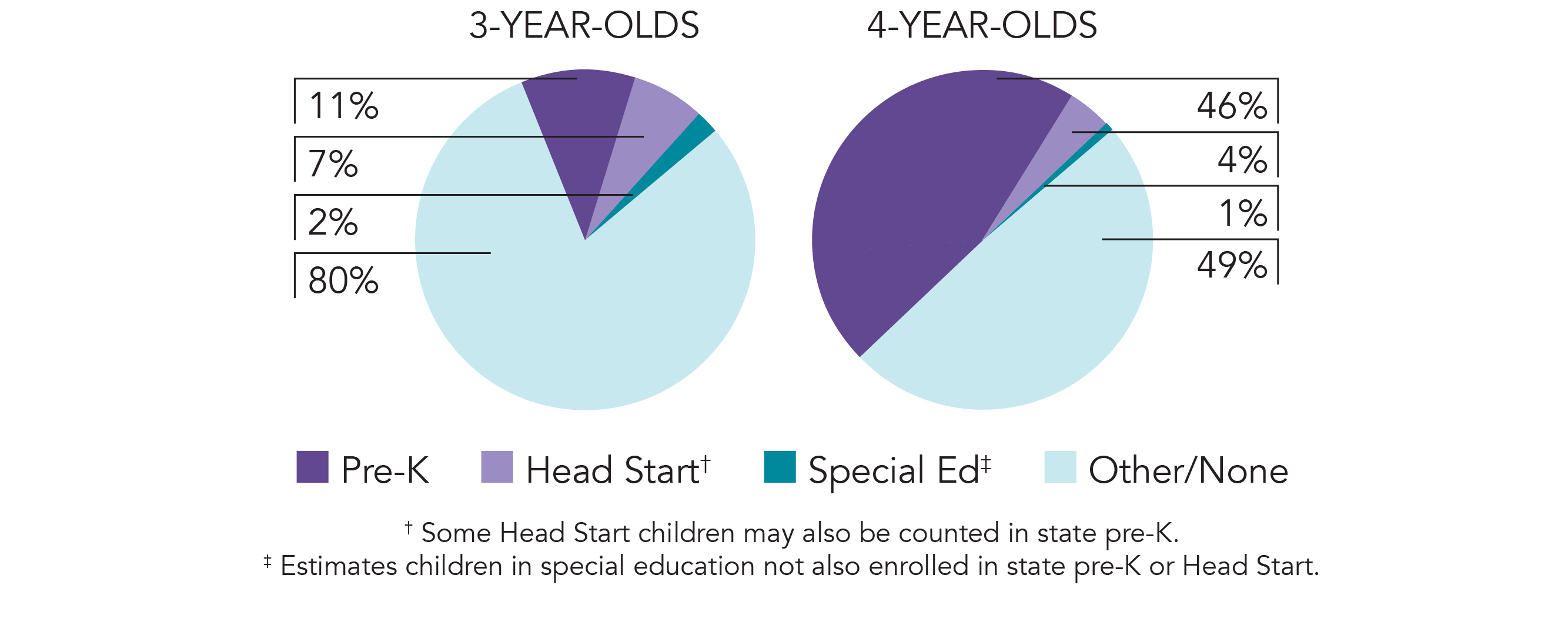
Total state pre-K enrollment 278,273 Special education enrollment, ages 3 and 4 46,893 Federally funded Head Start enrollment, ages 3 and 4 44,009 State-funded Head Start enrollment, ages 3 and 4 0 Resources
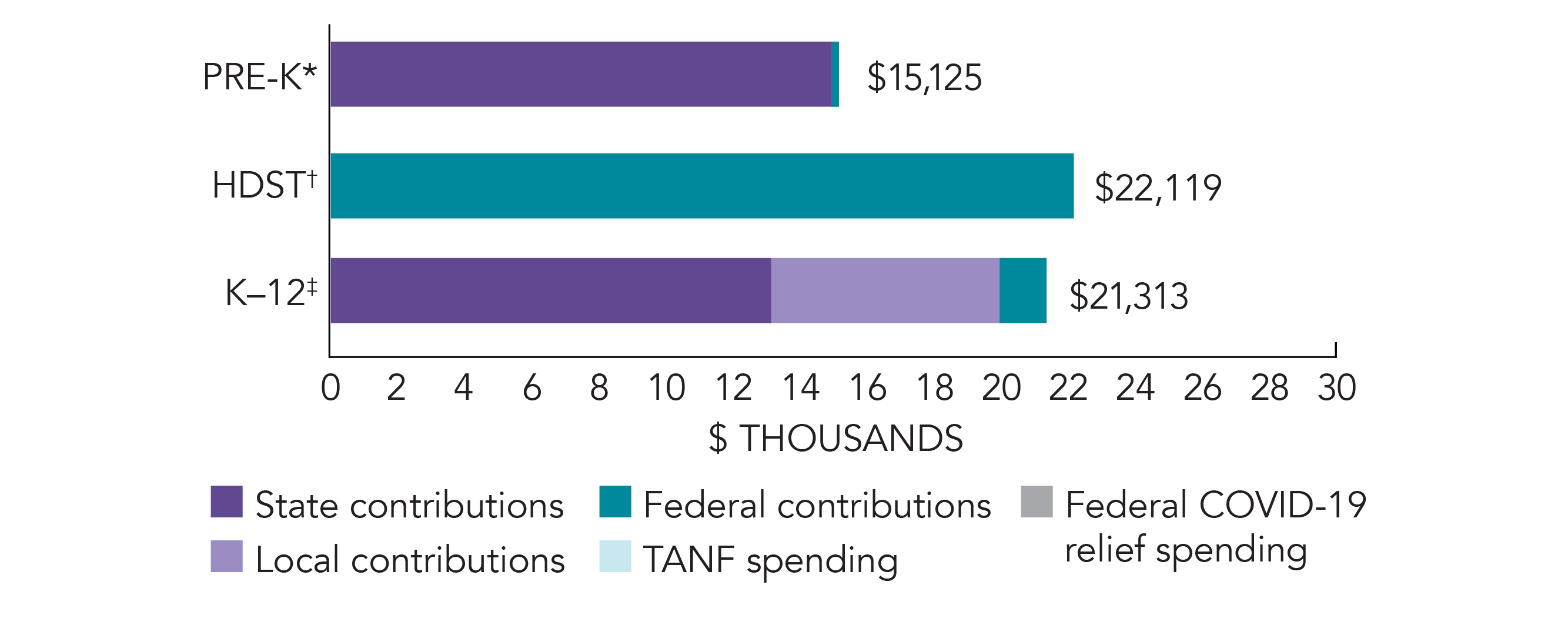
Total state pre-K spending $4,148,114,798 State Head Start spending $0 State spending per child enrolled $14,907 All reported spending per child enrolled* $15,125 
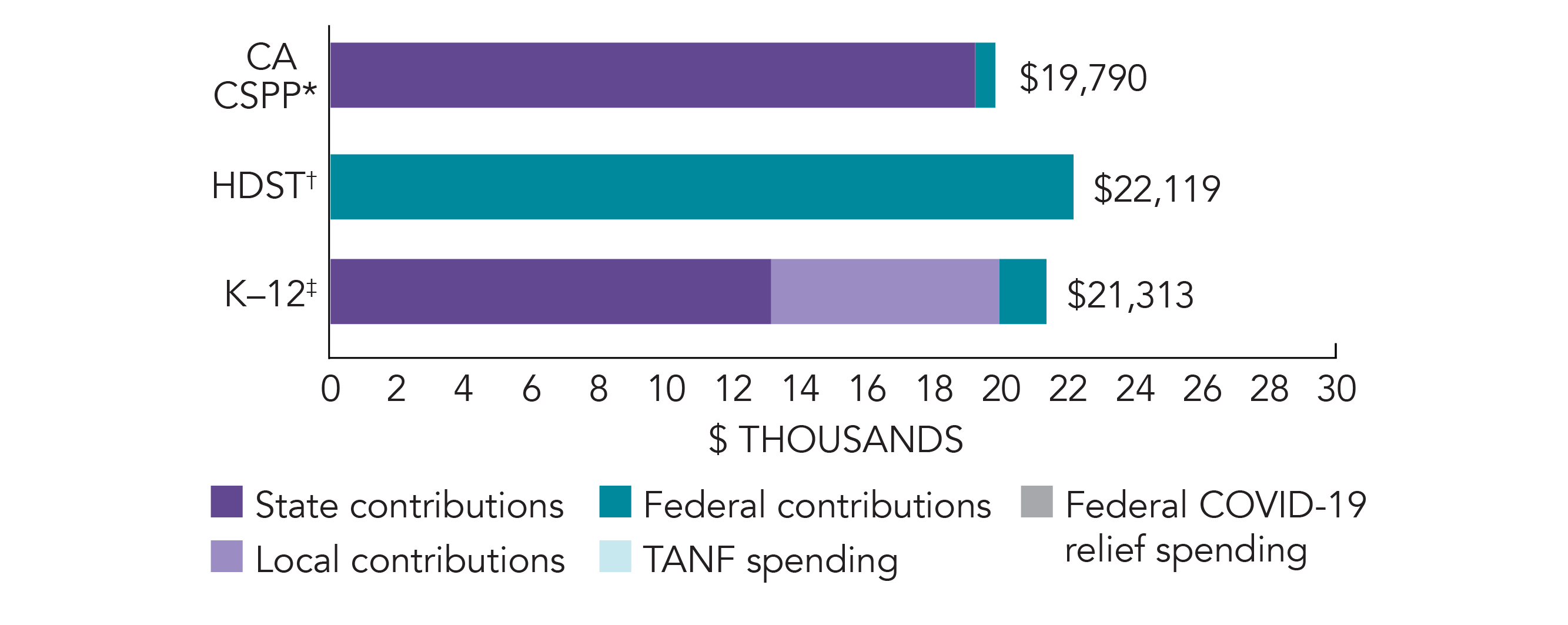
*Pre-K programs may receive additional funds from federal or local sources that are not included in this figure. †Head Start per-child spending includes funding only for 3- and 4-year-olds. ‡K–12 expenditures include capital spending as well as current operating expenditures.
-
Access

Total state pre-K enrollment 100,705 School districts that offer state program 97% (counties) Income requirement 100% SMI Minimum hours of operation 3 hours/day; 5 days/week Operating schedule Determined locally Resources
Total state pre-K spending $1,932,114,798 Local match required? Yes State spending per child enrolled $19,186 All reported spending per child enrolled* $19,790 
*Pre-K programs may receive additional funds from federal or local sources that are not included in this figure. †Head Start per-child spending includes funding only for 3- and 4-year-olds. ‡K–12 expenditures include capital spending as well as current operating expenditures.
California State Preschool Program (CSPP) Quality Standards Checklist
| Policy | CA CSPP Requirement | Benchmark | Meets Benchmark? |
|---|---|---|---|
For more information about the benchmarks, see the Executive Summary and the Roadmap to State pages. | 6benchmarks met | ||
| Early Learning & Development Standards Benchmark | Comprehensive, aligned, supported, culturally sensitive | Comprehensive, aligned, supported, culturally sensitive | |
| Curriculum Supports Benchmark | Approval process & supports | Approval process & supports | |
| Teacher Degree Benchmark | California Child Development Associate Teacher Permit | BA | |
| Teacher Specialized Training Benchmark | ECE, CD | Specializing in pre-K | |
| Assistant Teacher Degree Benchmark | None | CDA or equivalent | |
| Staff Professional Development Benchmark | 105 hours/5 years; PD plans (Determined locally) | For teachers & assistants: At least 15 hours/year; individual PD plans; coaching | |
| Maximum Class Size Benchmark | No limit (3- & 4-year-olds) | 20 or lower | |
| Staff to Child Ratio Benchmark | 1:8 (3- & 4-year-olds) | 1:10 or better | |
| Screening & Referral Benchmark | Vision, hearing, health & more | Vision, hearing & health screenings; & referral | |
| Continuous Quality Improvement System Benchmark | Structured classroom observations; Data used for program improvement | Structured classroom observations; data used for program improvement | |
-
Access
Total state pre-K enrollment 177,568 School districts that offer state program 100% (counties) Income requirement No income requirement Minimum hours of operation 3 hours/day; 5 days/week Operating schedule Determined locally Resources
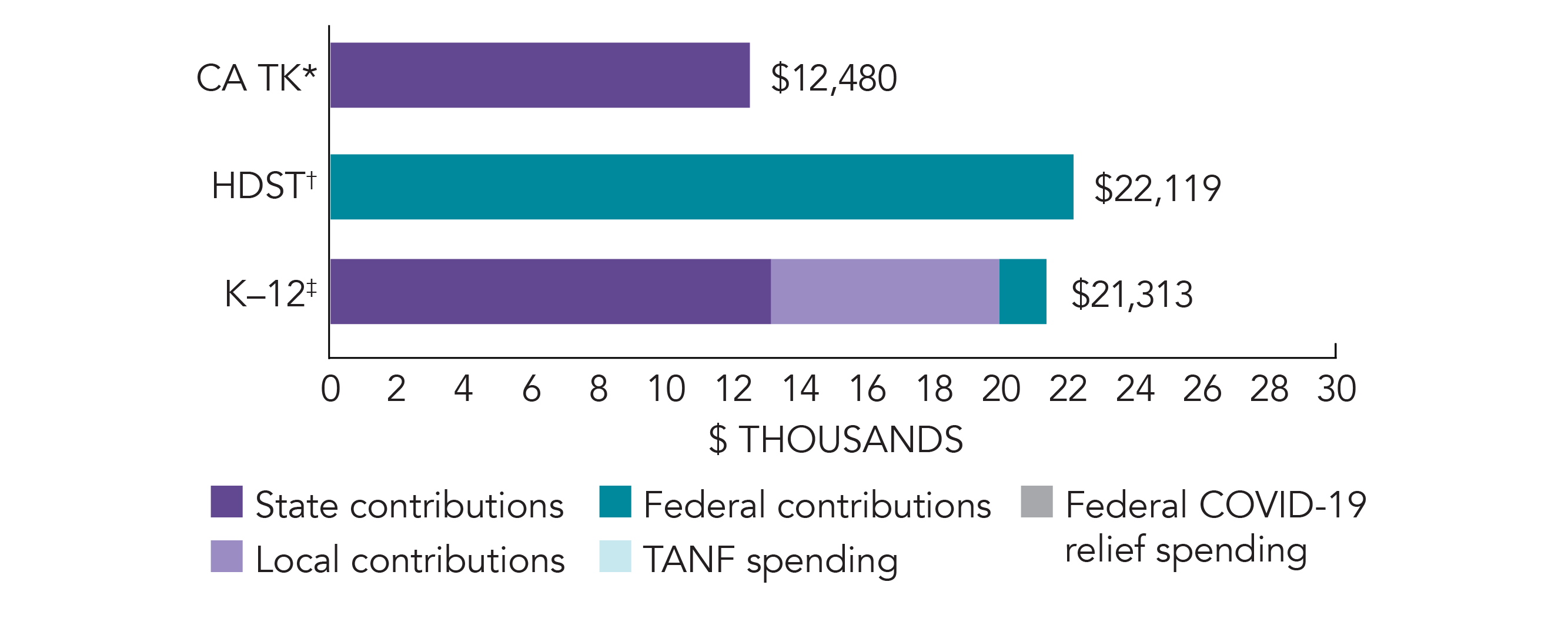
Total state pre-K spending $2,216,000,000 Local match required? No State spending per child enrolled $12,480 All reported spending per child enrolled* $12,480 
*Pre-K programs may receive additional funds from federal or local sources that are not included in this figure. †Head Start per-child spending includes funding only for 3- and 4-year-olds. ‡K–12 expenditures include capital spending as well as current operating expenditures.
California Transitional Kindergarten (TK) Program Quality Standards Checklist
| Policy | CA TK Requirement | Benchmark | Meets Benchmark? |
|---|---|---|---|
For more information about the benchmarks, see the Executive Summary and the Roadmap to State pages. | 3benchmarks met | ||
| Early Learning & Development Standards Benchmark | Comprehensive, aligned, supported, culturally sensitive | Comprehensive, aligned, supported, culturally sensitive | |
| Curriculum Supports Benchmark | Approval process & supports | Approval process & supports | |
| Teacher Degree Benchmark | BA | BA | |
| Teacher Specialized Training Benchmark | ECE, CD, Elem. Ed. | Specializing in pre-K | |
| Assistant Teacher Degree Benchmark | HSD | CDA or equivalent | |
| Staff Professional Development Benchmark | PD hours based on type of credential/permit & determined locally; PD plans (Determined locally) | For teachers & assistants: At least 15 hours/year; individual PD plans; coaching | |
| Maximum Class Size Benchmark | 24 (4-year-olds) | 20 or lower | |
| Staff to Child Ratio Benchmark | 1:12 (average, 4-year-olds) | 1:10 or better | |
| Screening & Referral Benchmark | Vision, hearing, health & more; Referrals not required | Vision, hearing & health screenings; & referral | |
| Continuous Quality Improvement System Benchmark | Structured classroom observations only in TK classes comingled with CSPP | Structured classroom observations; data used for program improvement | |