State of Preschool
Arkansas
Access Rankings
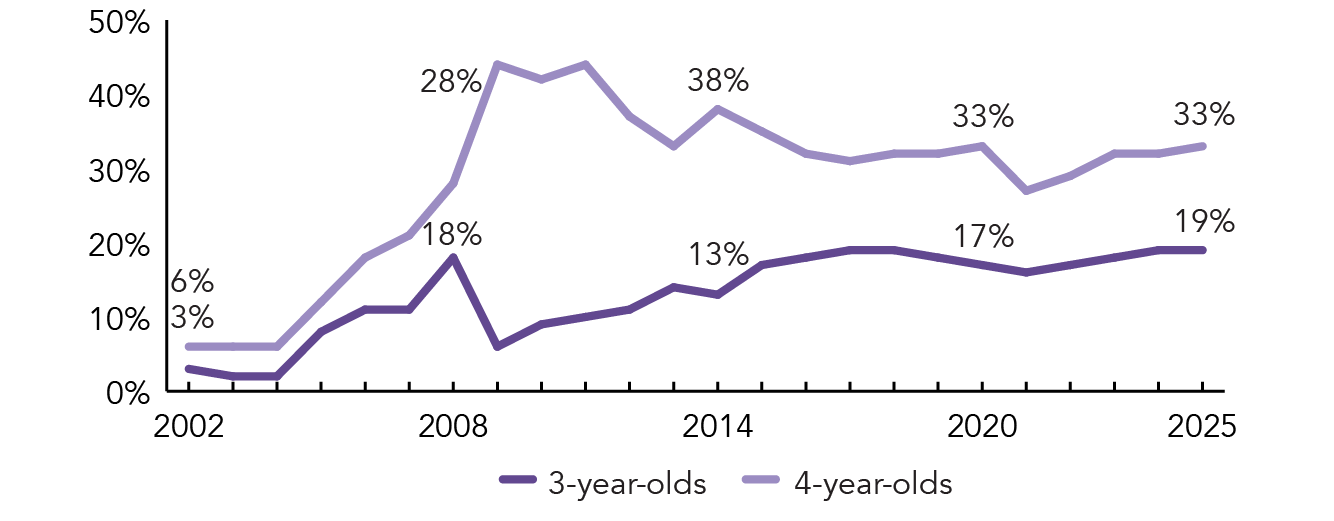
4-year-Olds
24
3-year-Olds
8
Resource Rankings
State spending
26
All reported spending
19
Total Benchmarks Met
Of 10 benchmarks possible
8
Overview
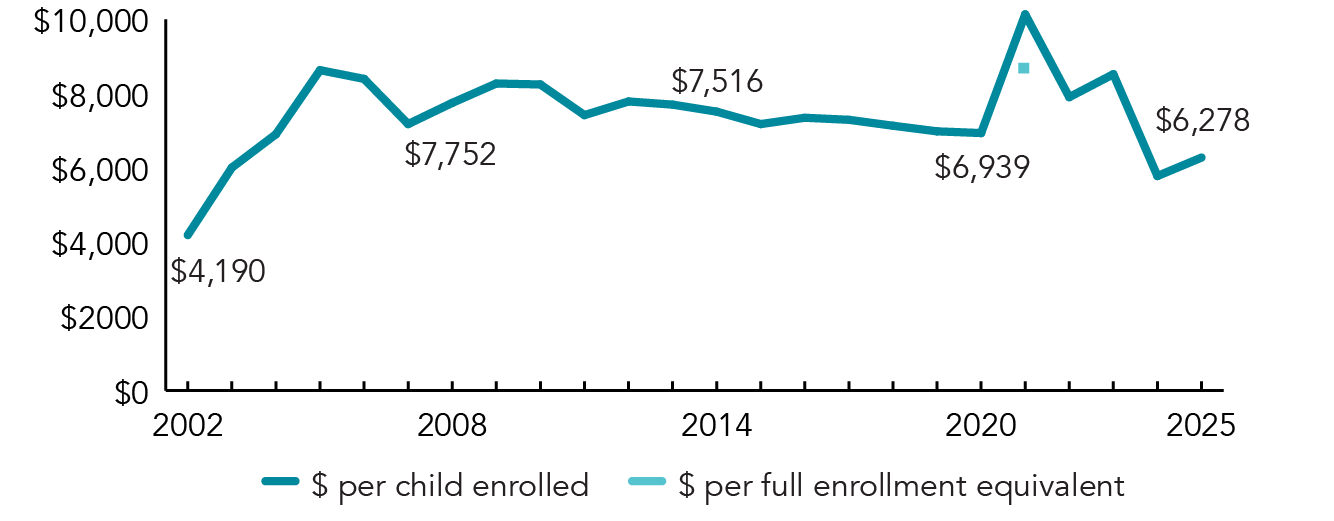
During the 2024-2025 school year, Arkansas preschool enrolled 20,327 children, an increase of 16 from the prior year. State spending totaled $106,072,095 and an additional $7,500,000 in TANF funds and $14,045,035 in federal recovery funds supported the program, up $10,203,845 (9%), adjusted for inflation, since last year. State spending per child (including TANF and federal recovery funds) equaled $6,278 in 2024-2025, up $497 from 2023-2024, adjusted for inflation. Arkansas met 8 of 10 quality standards benchmarks.
What's New
In 2025, Act 504 (Expansion of Arkansas Better Chance Early Childhood Eligibility) merged Arkansas Better Chance (ABC) and Arkansas Better Chance School Success, allowing all ABC programs to serve infants and toddlers. This new legislation will also allow for more child qualifying factors for all programs. Previously, all Arkansas Better Chance for School Success recipients could only use age and income when qualifying children and families. Now all ABC programs can qualify children with the following characteristics: family has gross income not exceeding 200% FPL; parents without a high school diploma or GED; low birth weight (below 5 lbs., 9 oz); parent is under 18 years of age at child’s birth; immediate family member has a history of substance abuse and or addiction; has a demonstrable developmental delay as identified through screening; eligible for services under IDEA; income eligible for Title I programs; limited English proficiency; or parent has history of abuse of neglect or is a victim of abuse or neglect.
Additionally, in December 2025, Arkansas was awarded a federal PDG B–5 Systems Building Grant totaling $14,751,000 to support system building and strengthen ECE programs in a mixed-delivery system, improve system efficiency and collaboration, and raise the overall quality of programs.
Background
The Arkansas Better Chance (ABC) program began in 1991 as part of a statewide education reform initiative, with funding ($10 million) earmarked to serve children birth to 5 years old based on family income, developmental, and/or economic risk factors. In 2003, legislation known as Arkansas Better Chance for School Success (ABCSS) set priorities for funding, supporting 3- and 4-year-olds in households with incomes up to 200% of the federal poverty level. School districts with 75% or more of their students scoring below proficient in literacy and math on the State Assessment, and children in schools designated as “school improvement status” receive prioritized funding.
ABC/ABCSS components intended to ensure quality include: one teacher with at least a bachelor’s degree per every three classrooms at a site and teachers with an associate degree in the other two classrooms; teacher assistants paraprofessionals with a minimum of a CDA or equivalent; low teacher-to-child ratios (1:10); health and development screenings; parent involvement and community engagement; statewide child assessment (Work Sampling); an approved list of curriculum aligned with the 2016 Arkansas Child Development and Early Learning Standards; and classroom quality observations to inform technical assistance; and an evaluation of child outcomes through a longitudinal study.
Arkansas Better Chance/Arkansas Better Chance for School Success
Access
| |
| Total state pre-K enrollment | 20,327 |
| School districts that offer state program | 100% (counties) |
| Income requirement | 200% FPL |
| Minimum hours of operation | 7 hours/day |
| Operating schedule | School or academic year |
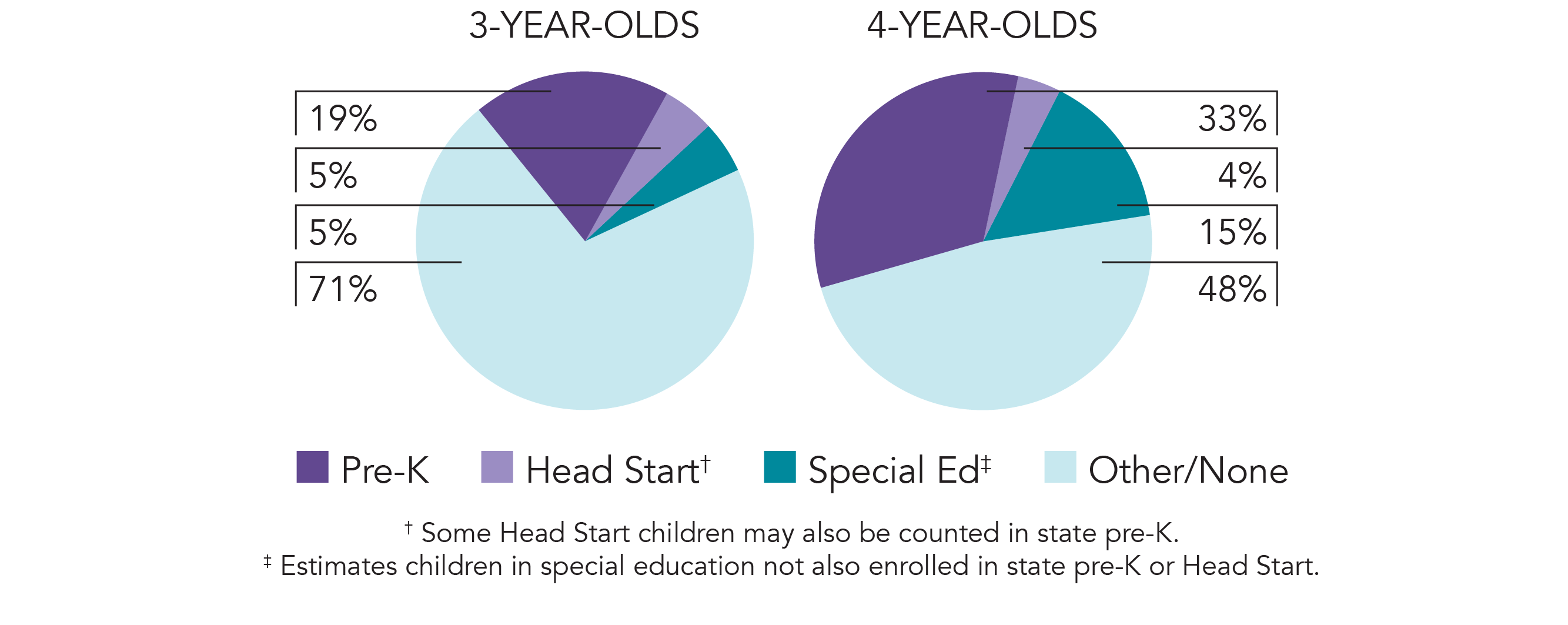
| Special education enrollment, ages 3 and 4 | 9,662 |
| Federally funded Head Start enrollment, ages 3 and 4 | 3,471 |
| State-funded Head Start enrollment, ages 3 and 4 | 0 |
Resources
| Total state pre-K spending | $127,617,130 |
| Local match required? | Yes |
| State Head Start spending | $0 |
| State spending per child enrolled | $6,278 |
| All reported spending per child enrolled* | $10,637 |
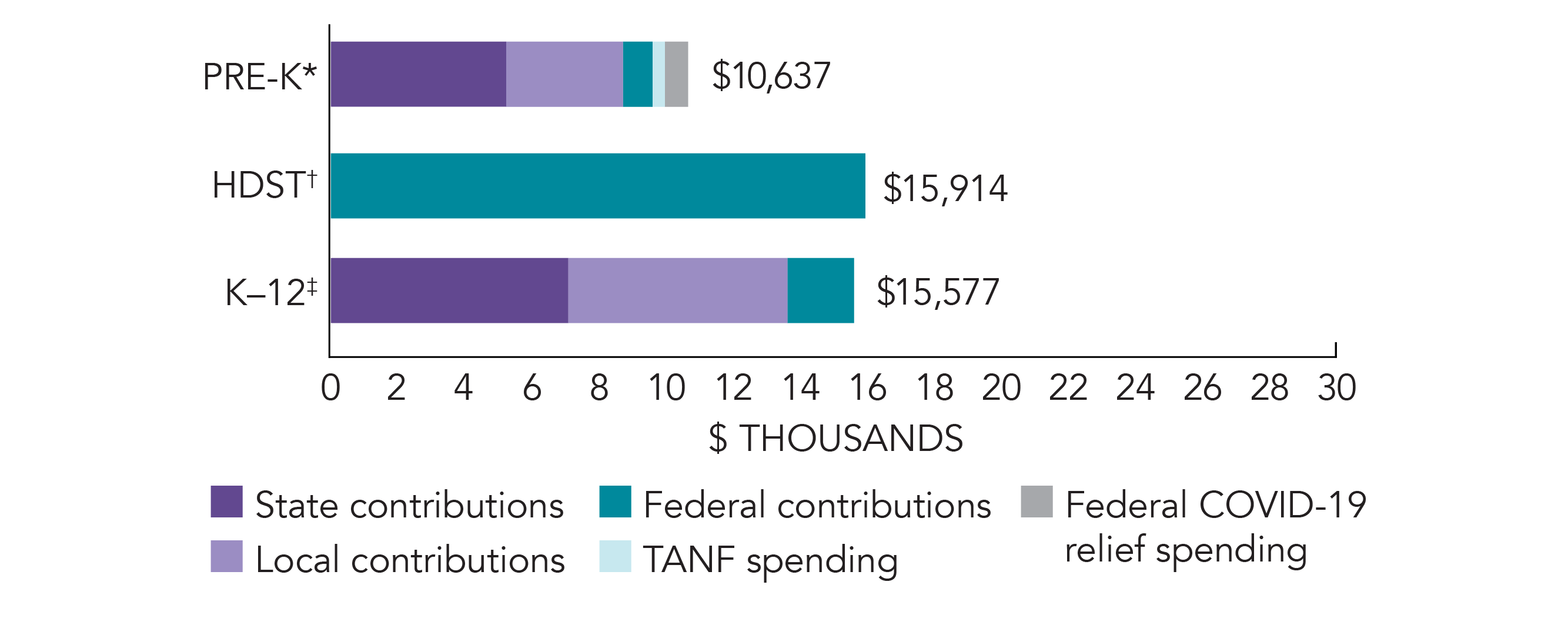
*Pre-K programs may receive additional funds from federal or local sources that are not included in this figure. †Head Start per-child spending includes funding only for 3- and 4-year-olds. ‡K–12 expenditures include capital spending as well as current operating expenditures.
Arkansas Quality Standards Checklist
| Policy | Requirement | Benchmark | Meets Benchmark? |
|---|---|---|---|
For more information about the benchmarks, see the Executive Summary and the Roadmap to State pages. | 8benchmarks met | ||
| Early Learning & Development Standards Benchmark | Comprehensive, aligned, supported, culturally sensitive | Comprehensive, aligned, supported, culturally sensitive | |
| Curriculum Supports Benchmark | Approval process & supports | Approval process & supports | |
| Teacher Degree Benchmark | One BA per 3 classrooms; AA for other 2 classrooms | BA | |
| Teacher Specialized Training Benchmark | ECE, CD, ECE SpEd | Specializing in pre-K | |
| Assistant Teacher Degree Benchmark | CDA | CDA or equivalent | |
| Staff Professional Development Benchmark | 30 hours/year; PD plans; Coaching for novice teachers | For teachers & assistants: At least 15 hours/year; individual PD plans; coaching | |
| Maximum Class Size Benchmark | 20 (3- & 4-year-olds) | 20 or lower | |
| Staff to Child Ratio Benchmark | 1:10 (3- & 4-year-olds) | 1:10 or better | |
| Screening & Referral Benchmark | Vision, hearing, health & more | Vision, hearing & health screenings; & referral | |
| Continuous Quality Improvement System Benchmark | Structured classroom observations; Data used for program improvement | Structured classroom observations; data used for program improvement | |