State of Preschool
Arizona
Access Rankings
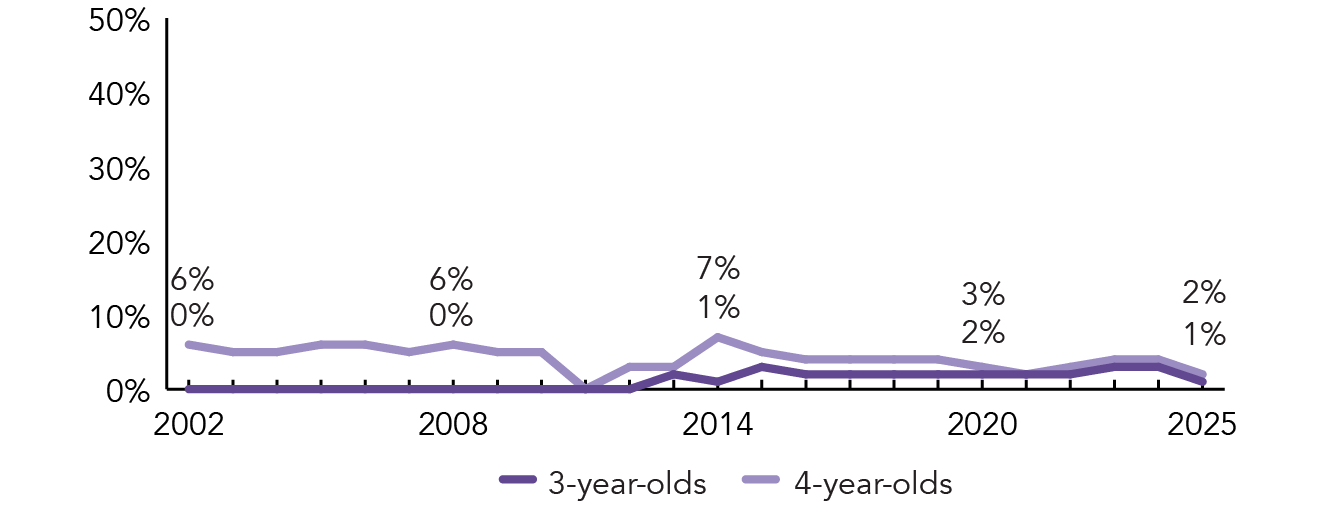
4-year-Olds
45
3-year-Olds
30
Resource Rankings
State spending
14
All reported spending
25
Total Benchmarks Met
Of 10 benchmarks possible
3
Overview
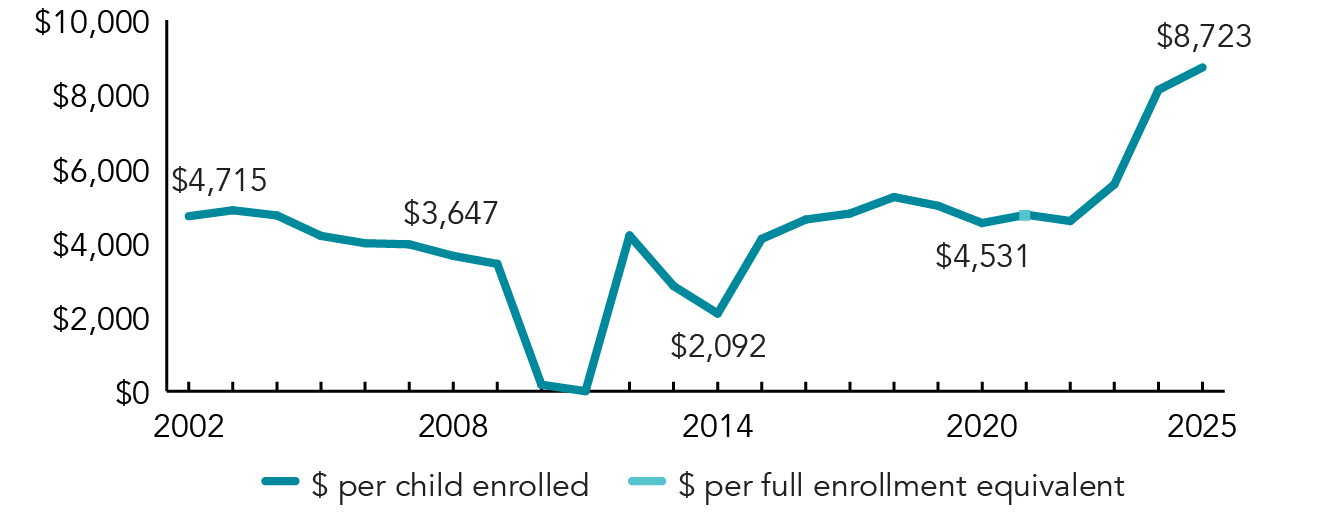
During the 2024-2025 school year, Arizona preschool enrolled 3,081 children, a decrease of 3,242 from the prior year. State spending totaled $21,794,604, and an additional $5,080,674 in federal recovery funds supported the program, down $24,464,419 (48%), adjusted for inflation, since last year. State spending per child (including federal recovery funds) equaled $8,723 in 2024-2025, up $603 from 2023-2024, adjusted for inflation. Arizona met 3 of 10 quality standards benchmarks.
What's New
Federal COVID-19 relief funds were used to support Quality First (QF) Scholarships by increasing reimbursement rates to the cost of quality, increasing the eligibility threshold to 300% FPL, as well as increasing the number of scholarships available. The First Things First (FTF) Board approved the maintenance of the increased reimbursement rate for QF Scholarships starting in state fiscal year 2025, which began July 1, 2024. While the increase is positive, it negatively impacted enrollment. Tobacco revenue, the state funding source for QF Scholarships, has been declining and may impact future state funding. The state recently invested $45M in state general funds to support the state subsidy system, the Department of Economic Security Child Care Assistance Program.
In December 2025, Arizona was awarded a federal PDG B–5 Systems Building Grant totaling $8,428,558, when added to the existing PDG B-5 award, brought the new total amount to $50.4 million. These funds will be used to support system building and strengthen ECE programs in a mixed-delivery system, improve system efficiency and collaboration, and raise the overall quality of programs.
Background
Arizona began funding preschool programs in 1991 along with supplemental services for preschool, full-day kindergarten, and first through third grade education supported by the federal Early Childhood Block Grant (ECBG) from 1996 until 2010 when that funding ended.
In 2006, Arizona voters earmarked certain tobacco tax revenues for early childhood development and health programs, and created the Early Childhood Development and Health Board, known as First Things First (FTF), to oversee those funds. FTF allocates funds to communities based on the birth to age 5 population and percentage of young children in poverty. Volunteer regional councils recommend early childhood strategies to fund, including QF Scholarships serving children birth to age 5 (before kindergarten) living at or below 300% FPL. Programs are eligible to receive QF Scholarships as long as they participate in QIRS and have met at least a three-star rating on the QIRS quality standards. During 2023-2024, the QIRS model was revised so that quality improvement supports are more individualized to the needs of the participating programs. Lower-rated programs receive more supports, while higher-rated programs receive fewer supports. QF Scholarship reimbursement rates vary by age of child (infants, toddlers, preschoolers).
Dramatic decreases in tobacco tax revenues have resulted in a $76.2 million drop in annual revenues as of SFY25 (46.2% less than the baseline year of 2008). Despite ongoing decreases in tobacco revenue, FTF’s commitment to QF Scholarships has grown, increasing from $35 million in FY16 to $45.2 million in FY25 in all settings (center-based and home-based) and for all ages birth through 5 (before kindergarten). FTF collaborates with the state to meet federal match requirements and preserve about $47 million per year in federal Child Care and Development Fund (CCDF) funds. In the 13 years this partnership has been in place, Arizona has been able to leverage $605.7 million in federal subsidy dollars that otherwise would have been lost.
Quality First Scholarships
Access
| |
| Total state pre-K enrollment | 3,081 |
| School districts that offer state program | 79% (Regional Partnership Councils) |
| Income requirement | 300% FPL |
| Minimum hours of operation | 34 hours/month |
| Operating schedule | Determined locally |
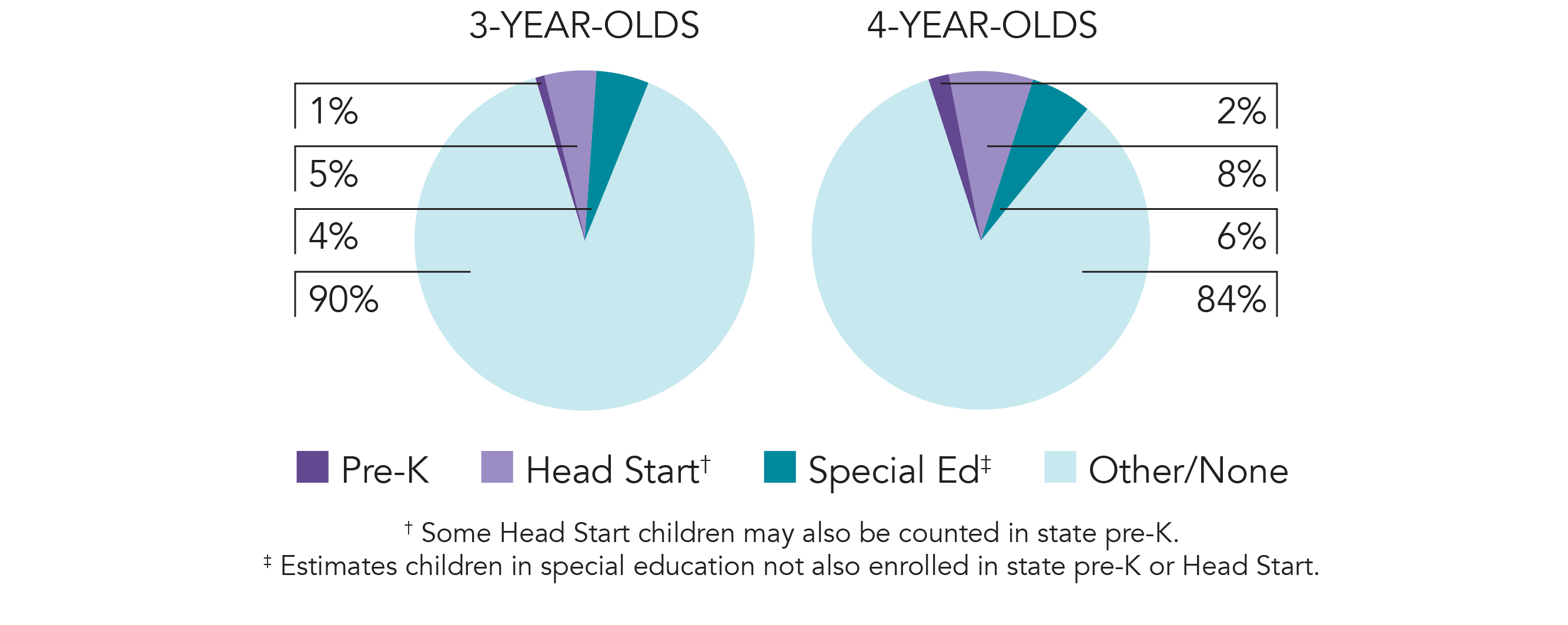
| Special education enrollment, ages 3 and 4 | 9,409 |
| Federally funded Head Start enrollment, ages 3 and 4 | 10,344 |
| State-funded Head Start enrollment, ages 3 and 4 | 0 |
Resources
| Total state pre-K spending | $26,875,278 |
| Local match required? | No |
| State Head Start spending | $0 |
| State spending per child enrolled | $8,723 |
| All reported spending per child enrolled* | $8,723 |
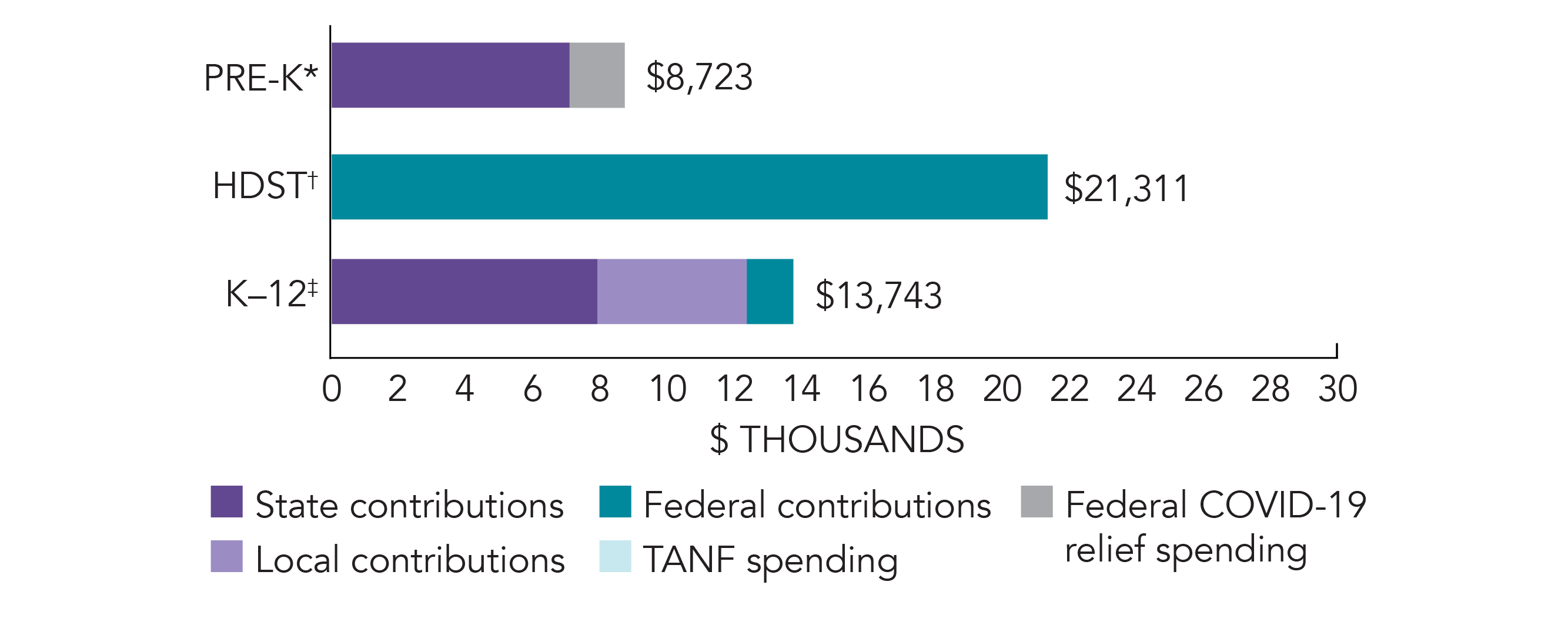
*Pre-K programs may receive additional funds from federal or local sources that are not included in this figure. †Head Start per-child spending includes funding only for 3- and 4-year-olds. ‡K–12 expenditures include capital spending as well as current operating expenditures.
Arizona Quality Standards Checklist
| Policy | Requirement | Benchmark | Meets Benchmark? |
|---|---|---|---|
For more information about the benchmarks, see the Executive Summary and the Roadmap to State pages. | 3benchmarks met | ||
| Early Learning & Development Standards Benchmark | Comprehensive, aligned, supported, culturally sensitive | Comprehensive, aligned, supported, culturally sensitive | |
| Curriculum Supports Benchmark | Approval process & supports | Approval process & supports | |
| Teacher Degree Benchmark | HSD | BA | |
| Teacher Specialized Training Benchmark | None | Specializing in pre-K | |
| Assistant Teacher Degree Benchmark | None | CDA or equivalent | |
| Staff Professional Development Benchmark | 18 hours/year | For teachers & assistants: At least 15 hours/year; individual PD plans; coaching | |
| Maximum Class Size Benchmark | 26 (3-year-olds); 30 (4-year-olds) | 20 or lower | |
| Staff to Child Ratio Benchmark | 1:13 (3-year-olds); 1:15 (4-year-olds) | 1:10 or better | |
| Screening & Referral Benchmark | Immunizations | Vision, hearing & health screenings; & referral | |
| Continuous Quality Improvement System Benchmark | Structured classroom observations; Data used for program improvement | Structured classroom observations; data used for program improvement | |