State of Preschool
Alaska
Access Rankings
4-year-Olds
39
3-year-Olds
36
Resource Rankings
State spending
20
All reported spending
30
Total Benchmarks Met
Of 10 benchmarks possible
2.3
Overview
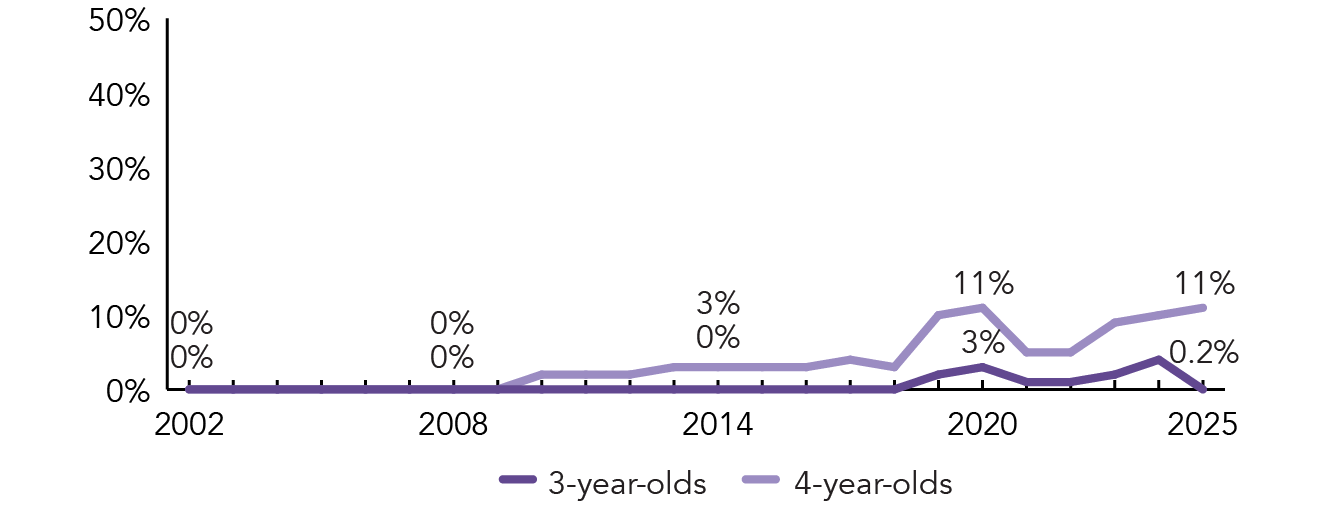
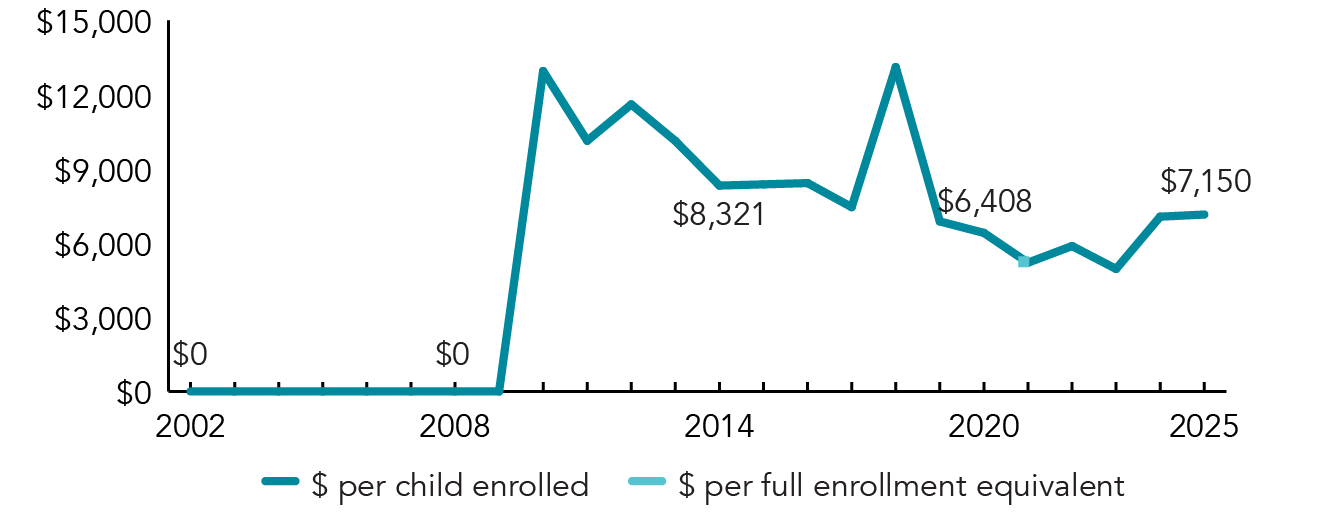
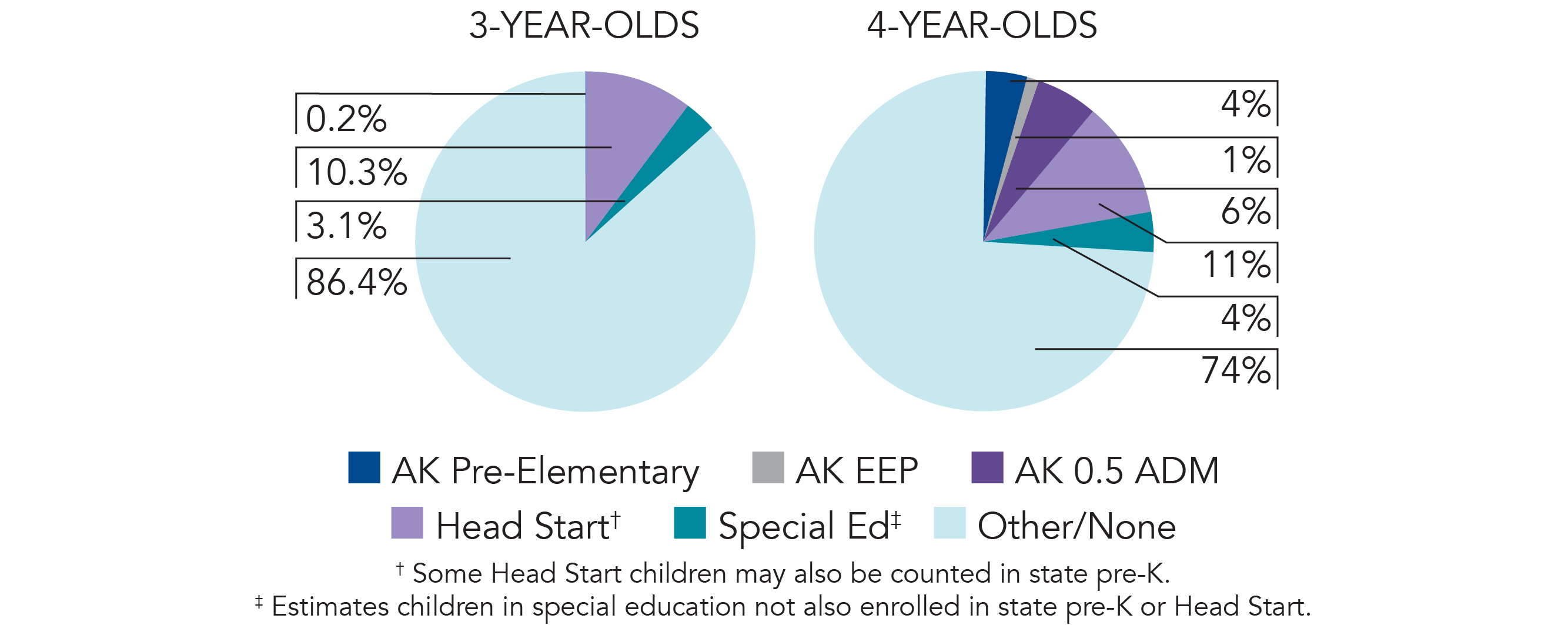
During the 2024-2025 school year, Alaska preschool enrolled 1,141 children, a decrease of 176 from the prior year. State spending totaled $8,158,561, down $1,145,285 (12%), adjusted for inflation, since last year. State spending per child equaled $7,150 in 2024-2025, up $86 from 2023-2024, adjusted for inflation. Alaska met an average of 2.3 of 10 quality standards benchmarks.
What's New
The Governor’s fiscal year 2026 budget includes funding for the Alaska Pre-Elementary program, so the preschool program will remain intact for the 2026-27 school year.
In December 2025, Alaska was awarded a federal PDG B–5 Systems Building Grant totaling $4,917,000 to support system building and strengthen ECE programs in a mixed-delivery system, improve system efficiency and collaboration, and raise the overall quality of programs.
Background
Since the 1980s, Alaska has supplemented federal funding for Head Start programs in an effort to enhance school readiness and professional development and expand opportunities for children and families. During the 2024-2025 program year, the state provided $13 million to support Head Start and Early Head Start programs in Alaska.
In 2009-2010, the state launched the Alaska Pre-Kindergarten pilot program for school districts, now known as the Alaska Pre-Elementary program. In 2015, the state changed the way competitive grants were offered to include two types of grantees. Districts new to the program would apply for a 3-year Pre-Elementary Development Grant geared toward strategic planning to begin implementing or supporting existing Pre-Elementary goals. Previously funded grantees could apply for three-year renewal grants to support the program while the districts worked towards sustainability of the program once the state grant funding ended. Development grants were geared toward strategic planning to begin implementing or supporting existing Pre-Elementary goals until they could be switched to renewal grants.
Starting in the 2020-2021 school year, the Department posted a request for applications for a three-year Pre-Elementary Grant. Any school district was eligible to apply for this competitive grant. Seventeen districts were awarded a Pre-Elementary Grant for the three-year grant cycle starting on July 1, 2020, and ending June 30, 2023. A new application was posted in Spring of 2023, open to all school districts to either start a preschool program or continue and improve their existing program for children ages three to five years. Starting July 1, 2023, nine school districts were awarded the Pre-Elementary Grant. Dependent upon annual legislative funding of $3.2 million, the districts will receive grant funding through June 30, 2027. The financial support is part of an effort to promote school readiness and positive outcomes for participating 3-to-5-year-old children. The funds also offer admission to additional children and families whenever possible.
Starting with the 2023-24 school year, the state awarded Early Education Program (EEP) Grants to seven districts, on a 3-year cycle. These districts are working towards meeting Alaska’s Early Education Program Standards. One district, Anchorage, was included in the 0.5 ADM Approval Pre-K program, which includes stable funding through Alaska’s base student allocation formula for 4- and 5-year-old pre-elementary students at 0.5 Average Daily Membership (ADM). In 2024-25, two EEP districts moved to the 0.5 ADM Approval Pre-K Program and two additional districts moved into EEP. EEP districts will continue to shift into the 0.5 ADM program as they meet all the quality components.
-
Access

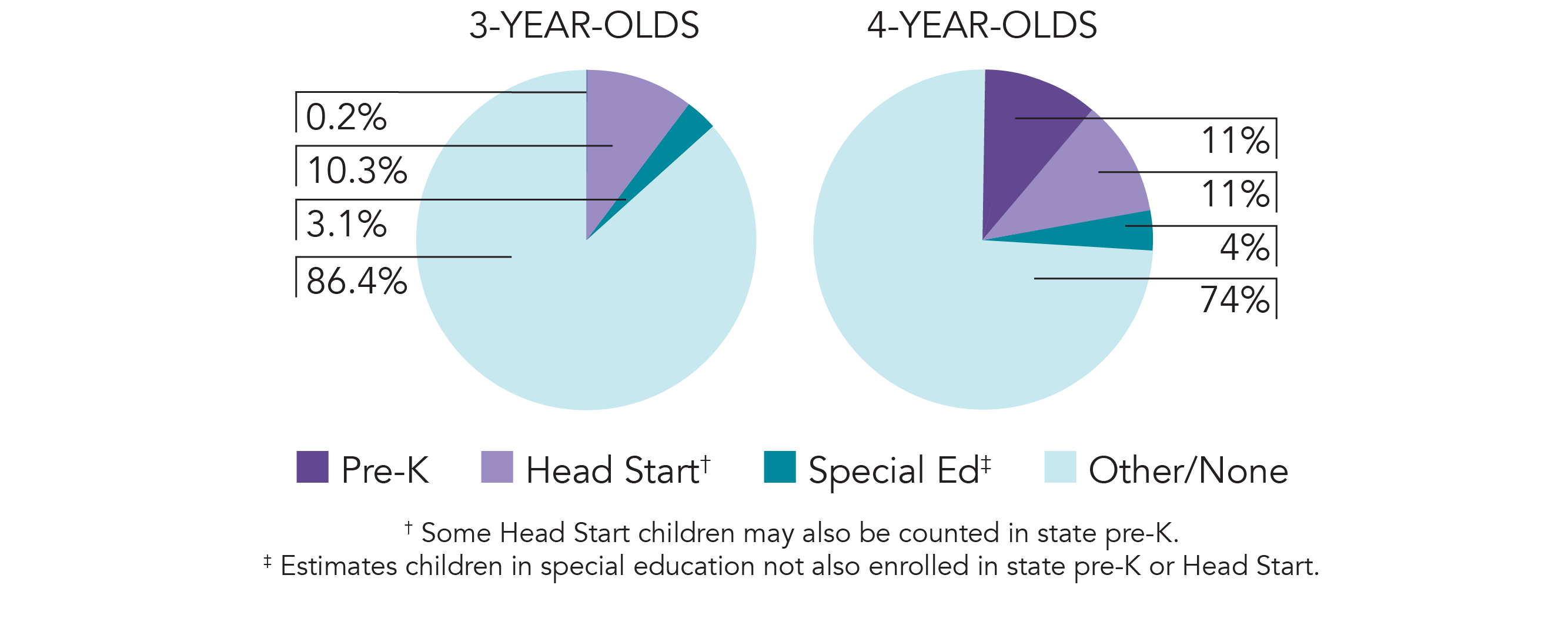
Total state pre-K enrollment 1,141 Special education enrollment, ages 3 and 4 1,035 Federally funded Head Start enrollment, ages 3 and 4 1,963 State-funded Head Start enrollment, ages 3 and 4 Not reported Resources
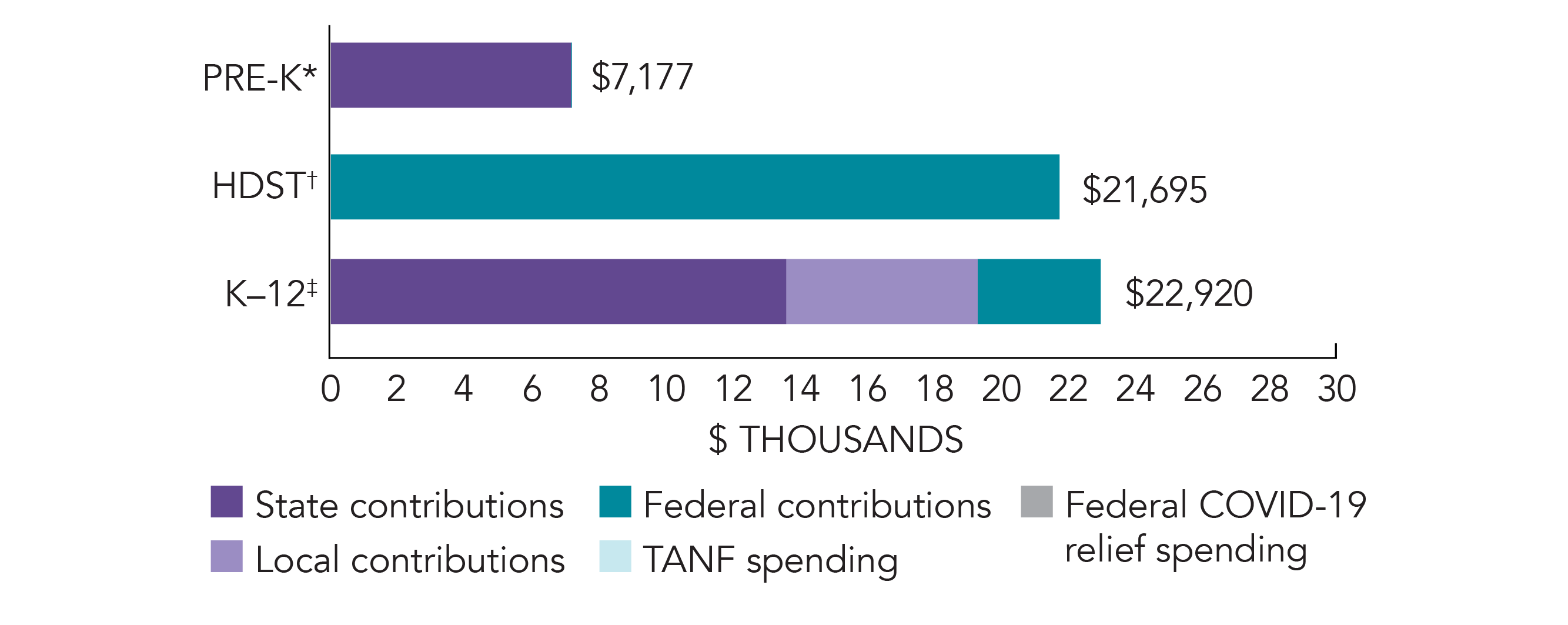
Total state pre-K spending $8,158,561 State Head Start spending Not reported State spending per child enrolled $7,150 All reported spending per child enrolled* $7,177 
*Pre-K programs may receive additional funds from federal or local sources that are not included in this figure. †Head Start per-child spending includes funding only for 3- and 4-year-olds. ‡K–12 expenditures include capital spending as well as current operating expenditures.
-
Access

Total state pre-K enrollment 363 School districts that offer state program 31% Income requirement No income requirement Minimum hours of operation Determined locally Operating schedule Determined locally Resources
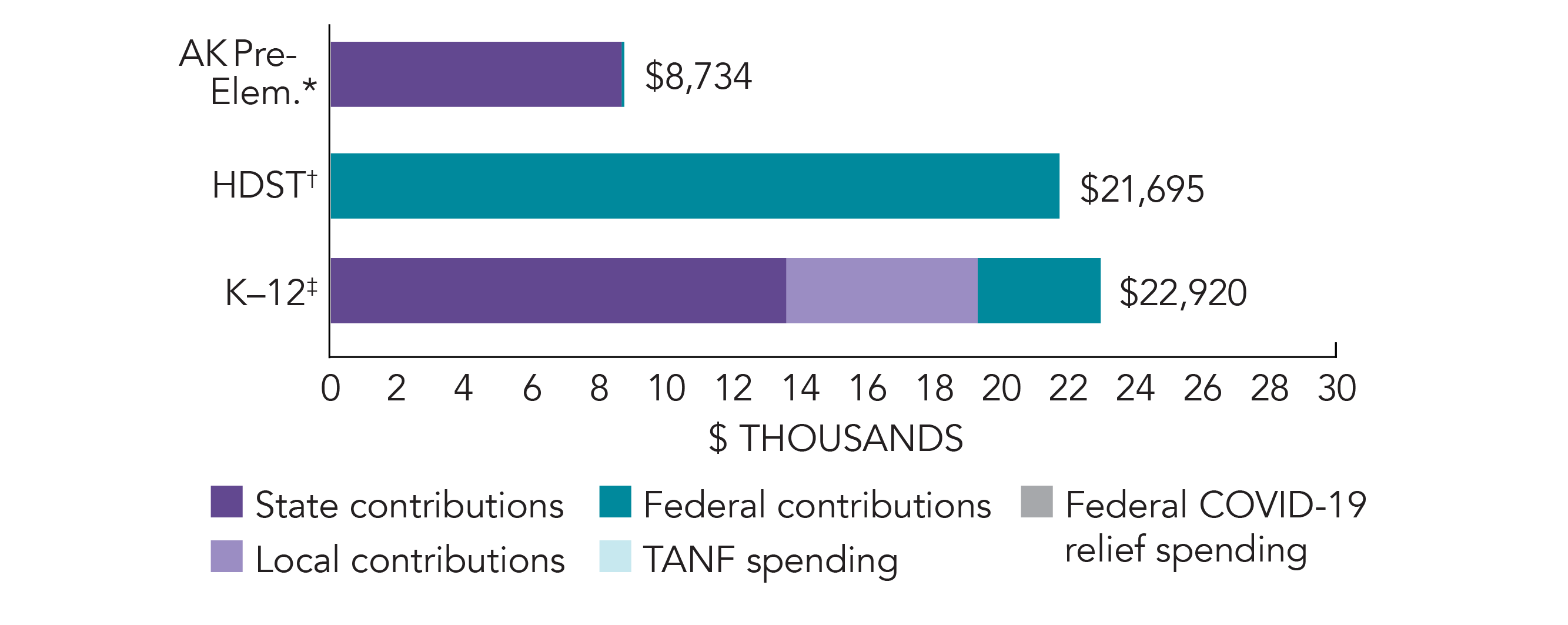
Total state pre-K spending $3,140,615 Local match required? No State Head Start spending $8,652 All reported spending per child enrolled* $8,734 
*Pre-K programs may receive additional funds from federal or local sources that are not included in this figure. †Head Start per-child spending includes funding only for 3- and 4-year-olds. ‡K–12 expenditures include capital spending as well as current operating expenditures.
Alaska Pre-Elementary Programs Quality Standards Checklist
| Policy | AK Pre-Elementary Requirement | Benchmark | Meets Benchmark? |
|---|---|---|---|
For more information about the benchmarks, see the Executive Summary and the Roadmap to State pages. | 1benchmarks met | ||
| Early Learning & Development Standards Benchmark | Comprehensive, aligned, supported, culturally sensitive | Comprehensive, aligned, supported, culturally sensitive | |
| Curriculum Supports Benchmark | Approval process | Approval process & supports | |
| Teacher Degree Benchmark | BA (lead teacher); HSD (classroom teacher) | BA | |
| Teacher Specialized Training Benchmark | Alaska Teaching Certificate | Specializing in pre-K | |
| Assistant Teacher Degree Benchmark | HSD | CDA or equivalent | |
| Staff Professional Development Benchmark | 6 credit hours/5 years (lead teacher only); PD plans (some teachers) | For teachers & assistants: At least 15 hours/year; individual PD plans; coaching | |
| Maximum Class Size Benchmark | Determined locally | 20 or lower | |
| Staff to Child Ratio Benchmark | Determined locally | 1:10 or better | |
| Screening & Referral Benchmark | Immunizations, Developmental; Referrals recommended | Vision, hearing & health screenings; & referral | |
| Continuous Quality Improvement System Benchmark | None | Structured classroom observations; data used for program improvement | |
-
Access
Total state pre-K enrollment 197 School districts that offer state program 17% Income requirement No income requirement Minimum hours of operation 2 hours/day; 5 days/week Operating schedule Determined locally Resources
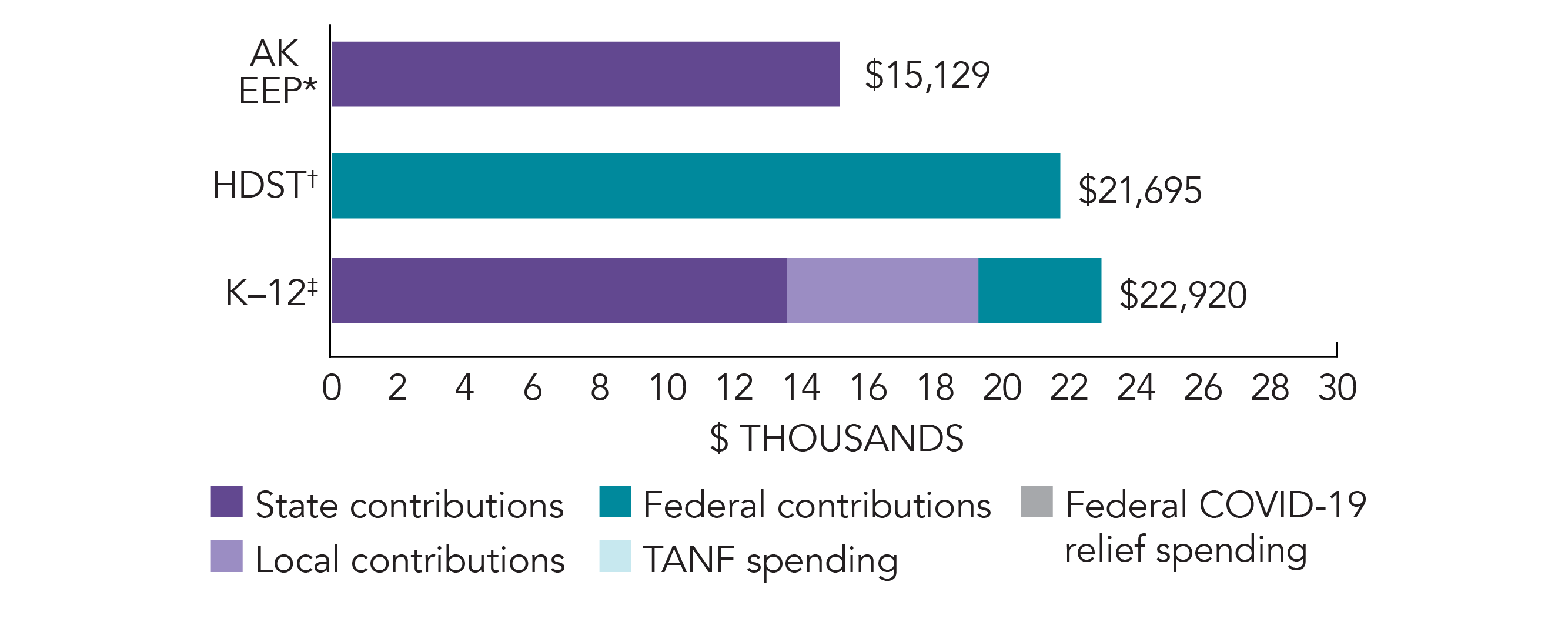
Total state pre-K spending $2,989,364 Local match required? No State Head Start spending $15,129 All reported spending per child enrolled* $15,129 
*Pre-K programs may receive additional funds from federal or local sources that are not included in this figure. †Head Start per-child spending includes funding only for 3- and 4-year-olds. ‡K–12 expenditures include capital spending as well as current operating expenditures.
Alaska Early Education Program Grant (EEP) Quality Standards Checklist
| Policy | AK EEP Requirement | Benchmark | Meets Benchmark? |
|---|---|---|---|
For more information about the benchmarks, see the Executive Summary and the Roadmap to State pages. | 3benchmarks met | ||
| Early Learning & Development Standards Benchmark | Comprehensive, aligned, supported, culturally sensitive | Comprehensive, aligned, supported, culturally sensitive | |
| Curriculum Supports Benchmark | Approval process | Approval process & supports | |
| Teacher Degree Benchmark | BA (lead teacher); HSD (classroom teacher) | BA | |
| Teacher Specialized Training Benchmark | 6 ECE credits within 2 years of hire (Lead teacher only); None (classroom teacher) | Specializing in pre-K | |
| Assistant Teacher Degree Benchmark | HSD | CDA or equivalent | |
| Staff Professional Development Benchmark | 6 credit hours/5 years (lead teacher only); PD plans (some teachers) | For teachers & assistants: At least 15 hours/year; individual PD plans; coaching | |
| Maximum Class Size Benchmark | 20 (4-year-olds) | 20 or lower | |
| Staff to Child Ratio Benchmark | 2:20 (4-year-olds) | 1:10 or better | |
| Screening & Referral Benchmark | Developmental; Referrals | Vision, hearing & health screenings; & referral | |
| Continuous Quality Improvement System Benchmark | None | Structured classroom observations; data used for program improvement | |
-
Access
Total state pre-K enrollment 581 School districts that offer state program 6% Income requirement No income requirement Minimum hours of operation 2 hours/day; 5 days/week Operating schedule Determined locally Resources
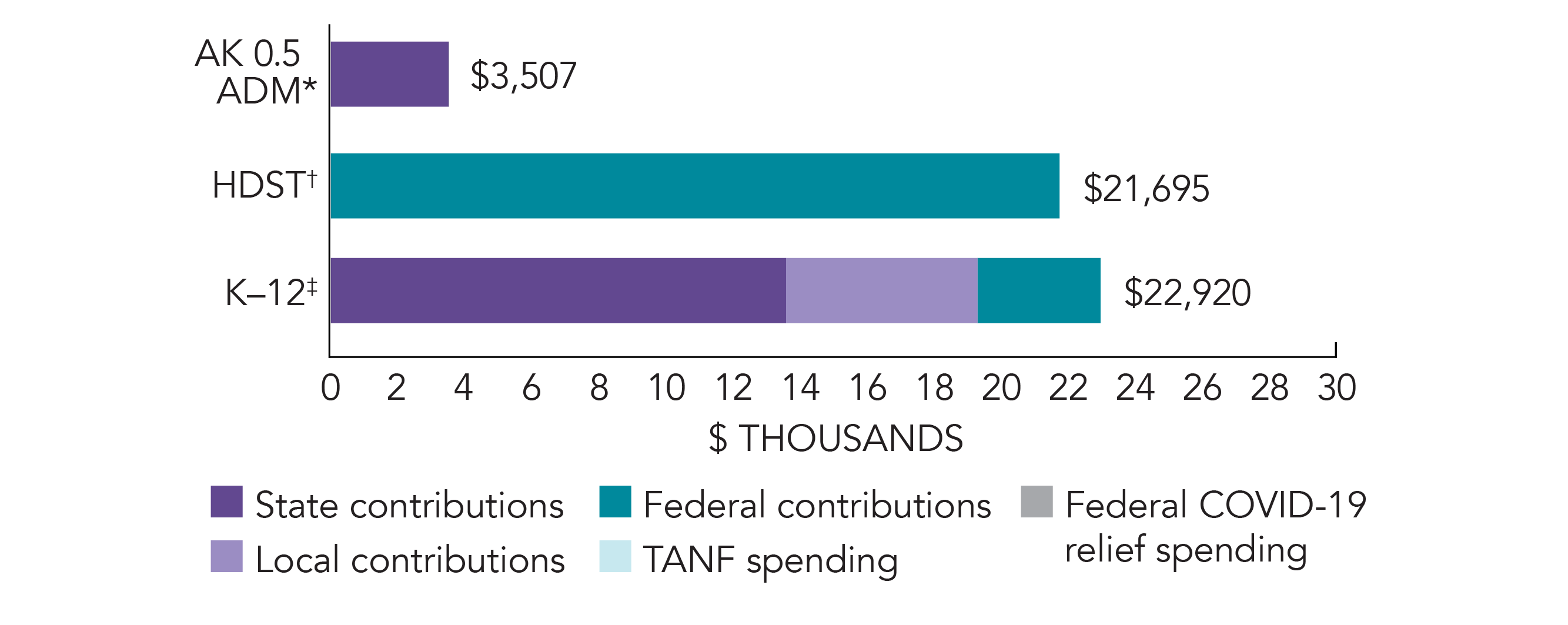
Total state pre-K spending $2,037,583 Local match required? No State Head Start spending $3,507 All reported spending per child enrolled* $3,507 
*Pre-K programs may receive additional funds from federal or local sources that are not included in this figure. †Head Start per-child spending includes funding only for 3- and 4-year-olds. ‡K–12 expenditures include capital spending as well as current operating expenditures.
Alaska 0.5 ADM Approved Early Education Program Program Quality Standards Checklist
| Policy | AK 0.5 ADM Requirement | Benchmark | Meets Benchmark? |
|---|---|---|---|
For more information about the benchmarks, see the Executive Summary and the Roadmap to State pages. | 3benchmarks met | ||
| Early Learning & Development Standards Benchmark | Comprehensive, aligned, supported, culturally sensitive | Comprehensive, aligned, supported, culturally sensitive | |
| Curriculum Supports Benchmark | Approval process | Approval process & supports | |
| Teacher Degree Benchmark | BA (lead teacher); HSD (classroom teacher) | BA | |
| Teacher Specialized Training Benchmark | 6 ECE credits within 2 years of hire (Lead teacher only); None (classroom teacher) | Specializing in pre-K | |
| Assistant Teacher Degree Benchmark | HSD | CDA or equivalent | |
| Staff Professional Development Benchmark | 6 credit hours/5 years (lead teacher only); PD plans (some teachers) | For teachers & assistants: At least 15 hours/year; individual PD plans; coaching | |
| Maximum Class Size Benchmark | 20 (4-year-olds) | 20 or lower | |
| Staff to Child Ratio Benchmark | 2:20 (4-year-olds) | 1:10 or better | |
| Screening & Referral Benchmark | Developmental; Referrals | Vision, hearing & health screenings; & referral | |
| Continuous Quality Improvement System Benchmark | None | Structured classroom observations; data used for program improvement | |